High Speed Rail in Georgia?
 Many blame an inefficient transit system for Atlanta traffic. But as World Cup visitors learned, MARTA handled 4.7 million rail trips with no major incidents over 35 days – even with Five Points Station half closed!
Some have posited that MARTA won’t succeed in terms of ridership without more rail to the suburbs. That may be true, but it doesn’t mean MARTA is doomed without it. Intracity systems also benefit from intercity rail.
The Georgia Department of Transportation recently circulated a questionnaire about passenger rail from Atlanta to Savannah. The survey, which closed Aug. 6, asked what people would pay for a four-and-a-half- to five-hour trip or a three-and-a-half- to four-hour trip, one way, from Atlanta to Savannah, with options ranging from $100 and $200. It also asked about a two-and-a-half- to three-hour trip rate from $200 to $300. By car, Savannah is a four- to five-hour drive.
To pull it off, there is ample infrastructure and promising state resources. In 2024 U.S. Senators Warnock and Ossoff secured $60 million in federal funding to strengthen railroad safety. Of that, more than $25 million was designated to improving eight Patriot railroads in the Southeast, including two in Georgia, and four OmniTRAX-owned short lines across four states, including one in Georgia.
The Georgia Freight Railroad Program was enacted by the legislature in 2020 and is funded by the Georgia Locomotive Fuel Tax. And since 2021, rideshare companies have paid a $.50 excise tax per ride (or $.25 on shared trips) toward the Georgia Transit Trust Fund administered by GDOT.

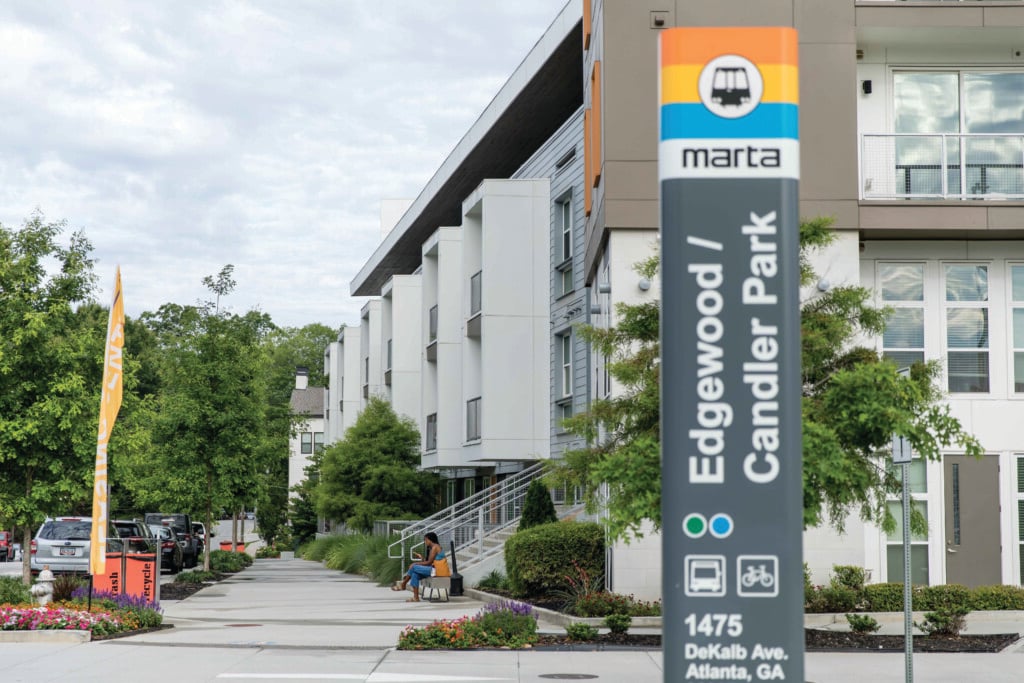
On Track: Intracity systems like MARTA benefit from intercity rail. Photo credit: Contributed
In 2025 the Atlanta-Region Transit Link Authority (ATL) awarded $16.4 million from this fund to numerous projects in the region. (In 2026 Gov. Brian Kemp signed legislation consolidating the ATL with Georgia Regional Transit Authority, which supervises the state’s Xpress bus system, into a new agency called Georgia Transportation Efficiency Authority.)
Based on cases in nearby states, more people would use an Atlanta-to- Savannah passenger rail than some might think. Maybe no transit system will ever break even, but it doesn’t have to break the bank either.
Some feel the private sector should operate passenger rail. Florida’s Brightline passenger rail service from Orlando to Miami is fully privatized, luxurious, avoids traffic and can cost from around $80 to more than $200 for a business-class round-trip ticket from Orlando to Miami, depending on travel dates and times. First-class tickets can run closer to $400 round trip. It connects to state- and locally-funded Tri-Rail, which serves Miami-Dade, Broward and Palm Beach counties. Brightline’s ridership and economic impact of $6.4 billion to Florida’s economy are noteworthy but not enough, many believe, to sustain the business without subsidy. Tri-Rail is also popular, but not making enough, and the state nearly suspended $60 million in funding in 2025.
North Carolina has been more successful. The name NC By Train may sound bland but the decades-old system serves 16 cities with frequent service along Interstates 40 and 85. Roundtrip nonstop fares from Rocky Mount to Charlotte range from around $90 for coach to around $170 for business class. The roughly five-hour trip is similar to Atlanta-Savannah.
Maybe no transit system will ever break even, but it doesn’t have to break the bank either.
State and local authorities provide considerable funding to North Carolina’s rail network (roughly $35 million annually) but robust ridership has helped offset costs and allow for expanded and more frequent service. In fact, 2025 was its fourth consecutive year of record ridership.
While the Trump administration wants to cut spending on Amtrak by 13.5%, ridership hit a record high in Fiscal Year 2025. Amtrak has proposed relocating its small and somewhat inaccessible Atlanta station to a location Downtown.
Meanwhile, GDOT has become adept at public-private partnerships, which play a big role in funding Georgia Express Lanes. There’s a chance to combine strategies here: GDOT could partner with Amtrak, like NC By Train does, and also leverage private funding sources like Florida’s Brightline does, to build out a broader network including rail to Savannah, since there is no current Atlanta-Savannah Amtrak route. Direct connection revenue could be augmented by commuter service for workers to Bryan County’s Hyundai metaplant and other employers. Maybe the employers could help pay for it too.
Georgia’s inability to “get on board” is embarrassing. The investment by other states (including Virginia, which is spending nearly $6 billion to expand passenger rail) puts them in a stronger position to compete for our jobs and residents. It’s a “you snooze, you lose” moment for Georgia, which is flush with transportation money. 
Ben Young is Editor-in-Chief and Publisher of Georgia Trend. |  byoung@georgiatrend.com