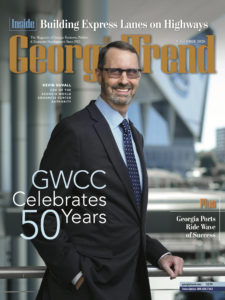
Georgia Express Lanes: Building For Our Future
A public-private partnership project on Georgia 400 marks the start of an exciting phase of transportation infrastructure development.
It might surprise Georgians to know how well-regarded the state’s highway system is – No. 2 overall in the nation in the Reason Foundation’s 29th Annual Highway Report. The study examines each state’s roads and bridges in 13 categories, including traffic fatalities, pavement condition, congestion, deficient bridges and spending. The 2026 report found that only Virginia tops Georgia in the best-performing, most cost-effective highways. However, anyone who regularly drives in, near, through or around Metro Atlanta won’t be surprised to learn where Georgia’s roads need improvement.

Preparing for a Population Boom: Jannine Miller, executive director of the State Road and Tollway Authority. Photo credit: Eric Sun
“The state performs exceptionally well in arterial pavement condition, bridge quality, and spending efficiency, but congestion remains a key challenge,” Baruch Feigenbaum, the highway report’s lead author and senior managing director of transportation policy at Reason Foundation, said in the report.
While there is no universally accepted definition of traffic congestion, when traffic requires commuters to nearly double their commute time to arrive on time, there’s a problem. The average commuter spent 87 hours in Atlanta traffic in 2024, according to the 2025 Urban Mobility Report from the Texas A&M Transportation Institute. Atlanta was ranked 9th for delays among major U.S. cities in 2024.
A ‘Good Policy Outcome’
Express lanes have proven to be a popular tool for moving motorists around Metro Atlanta. July 2026 data reveals more than 1.5 million active transponders in use. The data shows that millions of Georgians are using express lanes each month:
- Interstate 85 – 1,078,614
- Northwest Corridor – 779,356
- I-85 Extension – 480,131
- Interstate 75 South Metro – 454,372
In April, the Georgia Department of Transportation broke ground on the much anticipated Georgia 400 Express Lanes project, which will transform the corridor and the communities it serves and will change how GDOT builds large transportation infrastructure projects in the future.
The Georgia 400 Express Lanes project adds 16 miles of tolled express lanes in each direction between the North Springs MARTA Station in Fulton County and McGinnis Ferry Road in Forsyth County. At a cost of approximately $12.8 billion, it is GDOT’s first public-private partnership project and the nation’s largest. But it won’t be the last. The agency already has managed express lane projects lined up for the top end of Interstate 285, spanning from South Atlanta Road on the west side to Henderson Road on the east side, and another on I-285 East from Henderson Road to just past Interstate 20.

Ambitious Project: Russell McMurry, commissioner of the Georgia Department of Transportation. Photo credit: David Parks
The public-private projects include funding from federal, state and mostly private-sector sources. Last year, after a two-year bidding process, GDOT selected SR400 Peach Partners, a consortium of domestic and international asset and project management firms and engineering and transportation construction companies, to design, build, operate and maintain the lanes for the next 55 years. In exchange for toll revenue, the company paid a $3.8 billion concession fee to build, manage and maintain the road; no additional taxes will be used to maintain Georgia 400 during the length of the contract.
“One of the biggest complaints we get is that we use taxpayer dollars to build express lanes and now you’re charging me a toll to drive on it,” says GDOT Commissioner Russell McMurry. “But this model is a really good policy outcome. We’re not having to raise the gas tax or take on debt for the state for somebody in Southwest Georgia who might never drive on [Georgia] 400. It’s very specific to the people who are using the corridor.”
Maximizing Effect, Minimizing Disruption
Like any entity funded to serve the public, GDOT seeks best practices from other state departments of transportation and lessons learned from previous projects.
McMurry says GDOT’s vision of an interconnected system of express lanes came from looking at other states, like Virginia and Texas, specifically Dallas-Ft. Worth, and while the I-285 and Georgia 400 interchange renovation wasn’t a public-private partnership, it was a massive undertaking that offered plenty of insights, especially around an issue called alternative technical concepts.
During the bid process, proposing teams may suggest alternatives to the contracting agency’s basic configurations, project scope, design or construction criteria, provided the solution meets or exceeds the requirements in the request for proposal. In the case of the Georgia 400 project, the cost rose slightly as SR400 Peach Partners gained efficiency and improved on the project’s original design through the alternative technical concepts.
“The winning team provided double the number of access points to be able to use the lanes than what we had contemplated in our base design,” McMurry says.
That provided a win for residents and commuters – more access to the lanes. For business owners – more customers. And for the road’s developer – more revenue with which to operate and maintain the road.

Transforming the Corridor: In April, leaders from the Georgia Department of Transportation, True North 400 CID and SR400 Peach Partners attended the groundbreaking of the Georgia 400 Express Lanes project. Photo credit: Arvin Temkar/AJC
“These huge corridors, like 400, that are very congested are easy targets for this type of managed lanes project because the local communities really want a solution for the congestion,” says Javier Gutiérrez Villanueva, CEO of SR400 Peach Partners. “Managed lanes bring that, and that brings alignment and local support, which is key to delivering this project.”
During each phase of the process, from inception through bidding and design, and now at construction, SR400 Peach Partners engaged the local community. The company approached True North 400 CID, city and county entities, and neighborhoods early to learn what was important to them and provide as much information as possible.
“We try to be upfront about anything that is going to happen,” Gutiérrez Villanueva says. “Knocking on doors of the different HOAs that are going to be impacted, [talking with] entities, specific neighborhoods that are going to be impacted, trying to be ahead of any impact, so they know what is coming. During construction, there are plenty of meetings between our contractors and local communities [to let them know] if we are going to start working on an interchange and set up temporary traffic lights. We also have a monthly newsletter that anybody can sign up for. You disturb them, and you are impacting their lives. We try to be as least impactful as possible.”
“One of the biggest complaints we get is that we use taxpayer dollars to build express lanes and now you’re charging me a toll to drive on it. But this model is a really good policy outcome. We’re not having to raise the gas tax or take on debt for the state for somebody in Southwest Georgia who might never drive on [Georgia] 400. It’s very specific to the people who are using the corridor.” – Russell McMurry, commissioner, Georgia Department of Transportation
Keeping It Moving
The goal of express lanes is not to accommodate more cars; it is the free flow of the lanes at all times, says Jannine Miller, executive director of State Road and Tollway Authority. To ensure that flow, the lanes will use an operational toll rate, setting soft caps on tolling when express lane conditions are good. If speeds drop below a certain limit, the operator can increase the rate.
“If there are unique conditions on a particular day, the developer can turn up rates to provide a reliable trip value for the money,” Miller says. “There’s a limit to how much they can go up, but we’ve given [the operator] enough room to maneuver.”
In addition to constructing express lanes, starting with Georgia 400, the express lane projects will include what GDOT and other stakeholders call express lane transit, traditionally known as bus rapid transit. Registered transit vehicles, such as Xpress buses, MARTA and state-registered vanpools, would have access to the center express lane, stopping at in-line stations where commuters would have access to above highway connection points to continue to their destination. True North 400 CID received a $2 million transit trust fund grant from the Georgia Transportation Efficiency Authority to move forward with conceptual design and preliminary engineering for planning the multimodal access to the proposed Express Lane Transit stations.
“It would be a missed opportunity if we build these express lanes and don’t add a transit component, especially with the increased level of economic activity we’re going to see around here,” says Kristin Winzeler, executive director of True North 400 CID. “Because one of the things we felt was important was pedestrian connectivity. How do you get people from these transit stations when they’re in the middle of an express lane system?”
Starting with the Holcomb Bridge stop, the team is working with stakeholders and the city of Roswell to plan and build out pedestrian integration, figure out what it would look like, where people want to go, and create seamless connections. Area residents are cautiously optimistic about the overall Georgia 400 project, and the business community is enthusiastic.
“There’s concern about disruption, but I [think everyone can] see the value of the express lanes,” Winzeler says. “People know it’s a special place, and we can’t stop investing in infrastructure.”
And just because SR400 Peach Partners is responsible for building and operating the lanes doesn’t mean GDOT is hands off.

Congestion Solution: Javier Gutiérrez Villanueva, CEO of SR400 Peach Partners. Photo credit: Eric Sun
“The last word in P3 [public-private partnership] is partnership,” says McMurry. “The contractual terms of these arrangements have the State Road and Tollway Authority as the toll operator, meaning Peach Pass works seamlessly. There is still very much a state hand involved in the administration of this corridor for the next 50 years.”
Life at the Top End
The next P3 on deck, the I-285 Top End Express Lane project, will add two barrier-separated lanes in both directions, from South Atlanta Road on the west side to Henderson Road on the east side, and will connect to Georgia 400. The project scope, which includes elevated lanes, is enormous, and the price tag – projected in the tens of billions – will match.
“There are only a few companies on the planet that could even bid on it,” says Ann Hanlon, executive director of Perimeter CID. In October, GDOT selected the international consortium Top End Mobility Group to build and maintain the express lanes in exchange for 50 years of toll revenue.
Despite the companies and residents in the area having endured their share of transportation infrastructure construction over the past decade, Hanlon believes the I-285 Express Lane project will benefit the region.
“The success of our market totally depends on the ability of people to get in and out,” she says. “And we are one of the biggest job centers in the Southeastern United States, with companies that are headquartered here. We supported the I-285 and [Georgia 400 interchange] project. Right now, we’re one of the most accessible markets in the whole state, and we want to keep it that way.”
Waiting in the Wings
Wedged between the interchanges of I-285 and I-85 and I-285 and U.S. Highway 78 is the bustling Tucker-Northlake Community Improvement District. It also includes U.S. Route 29, also known as Lawrenceville Highway, and Lavista Road. More than 200,000 vehicles drive through the Tucker area on I-285 daily, according to GDOT data. The I-285 East Express Lanes project with express lane transit will make a significant impact.
“Particularly in our area – where you have so many people who are not just getting on the expressway to go one or two exits up – they’re getting on the expressway, and they’re passing through the area,” says Matthew Lee, the CID’s executive director. “This is going to allow that traffic to not get caught up behind tractor-trailers and to just continue to get to their destination.”
Currently, GDOT plans one express lane interchange inside the CID at Northlake Parkway, with two more interchanges outside the CID at U.S. Highway 78 and Redan Road. As with other public-private partnership projects, construction firms competing for the contract can offer alternative design concepts allowing for more access points during the design and procurement process. But only if it makes sense.
“They won’t do it if it’s going to make the system more congested,” he says. “They want a system that’s going to flow well.”
Not everyone is happy with the prospect of these enormous transportation projects, and some neighborhoods and property owners, like those in the Lindmoor Woods neighborhood in DeKalb County, just inside the Perimeter and Highway 78, would be hit especially hard. In addition to losing the barrier of mature trees that stands between the highways and affected area, several homes would likely be lost to the expansion. The remaining neighborhood would be negatively transformed by the project, says Lara Martin, a Lindmoor Woods homeowner who met with GDOT to share the community’s concerns. She says GDOT should “press pause” on a plan that may be out of date by the time it’s built.
“Tell me that the express lanes actually reduce congestion,” Martin says. “I think the moment that these express lanes are built, the moment that the expansion opens, we’ve already exceeded the capacity.”
In response, a GDOT spokesperson offered this statement: “GDOT understands the concerns raised by residents of Lindmoor Woods and other communities along the I-285 East Express Lanes corridor, particularly how a project of this scale may affect properties and established visual buffers. We take those concerns seriously and will continue working with affected communities and the future selected P3 Developer as the project advances, to identify opportunities to avoid and minimize impacts, where possible. The project is designed to respond to both current needs and anticipated future demand to support the project’s need and purpose by reviewing complex traffic studies and models. Property impacts shown in the preliminary engineering designs are subject to change. At the same time, the transportation challenge along I-285 is significant. Portions of the corridor carry approximately 190,000 to more than 250,000 vehicles each day, with average speeds dropping as low as 20 mph during the a.m. peak, and as low as 14 mph during the p.m. peak. The I-285 East Express Lanes project is being advanced to address those mobility challenges by adding new capacity.”
‘The South Side Has Something to Say’
GDOT’s ultimate plan is an express lane system that radiates out from I-285 on major arterial interstates like spokes on a wheel. It has already begun a multiyear project that will convert the 12-mile stretch of currently reversible I-75 south express lanes in Henry County between Interstate 675 in Stockbridge and State Route 155 in McDonough into dedicated, two-lane, non-reversible express lanes. The conversion project is not a partnership but is approved for Design-Build, meaning one entity works under a single contract with GDOT to provide design and construction services. The governor allocated $1.8 billion for the project in the budget.
The project, currently in the design and planning phase, is welcome news to Henry County commuters. That particular stretch of I-75 through McDonough was ranked the 10th most congested freight interstate in the country by the American Transportation Research Institute.

Pivotal Point: Carlotta Harrell, Henry County Commission chair and head of the Atlanta Regional Commission’s transportation committee. Photo credit: Contributed
“Henry County is centrally located; we’re that gateway,” says Carlotta Harrell, the county commission chair and head of the Atlanta Regional Commission’s transportation committee. “When it comes to moving freight, the I-75 corridor is that pivotal point, which I think had a lot to do with the governor’s decision. I can say that GDOT has been a great partner; they hear me all the time in meetings because the south side has something to say.”
Payoff for the Future
The ambitious express lanes project will take years to build, with delays and disruptions along the way. But McMurry also says managed express lanes in other states such as Virginia and Texas have proven to provide the trip-time reliability Atlanta commuters deserve, with added benefits.
“When we get all this linked up, mobility options expand significantly, giving more people access, including to more labor markets,” he says. “Integrated transit is truly going to be our mobility for the future.
“We will certainly have signs out to ‘Pardon our Progress,’” adds Miller. “But we are building for a population boom that’s coming. We have the responsibility to not just think about the traffic today, but what’s coming in the next 20 to 25 years. The few years of construction will pay off for decades to come.”