Automotive Industry in Georgia: In The Driver’s Seat
Carmakers hit milestones and keep assembly lines flexible, even as the war with Iran, tariffs and expiring EV tax credits take their toll on the industry.

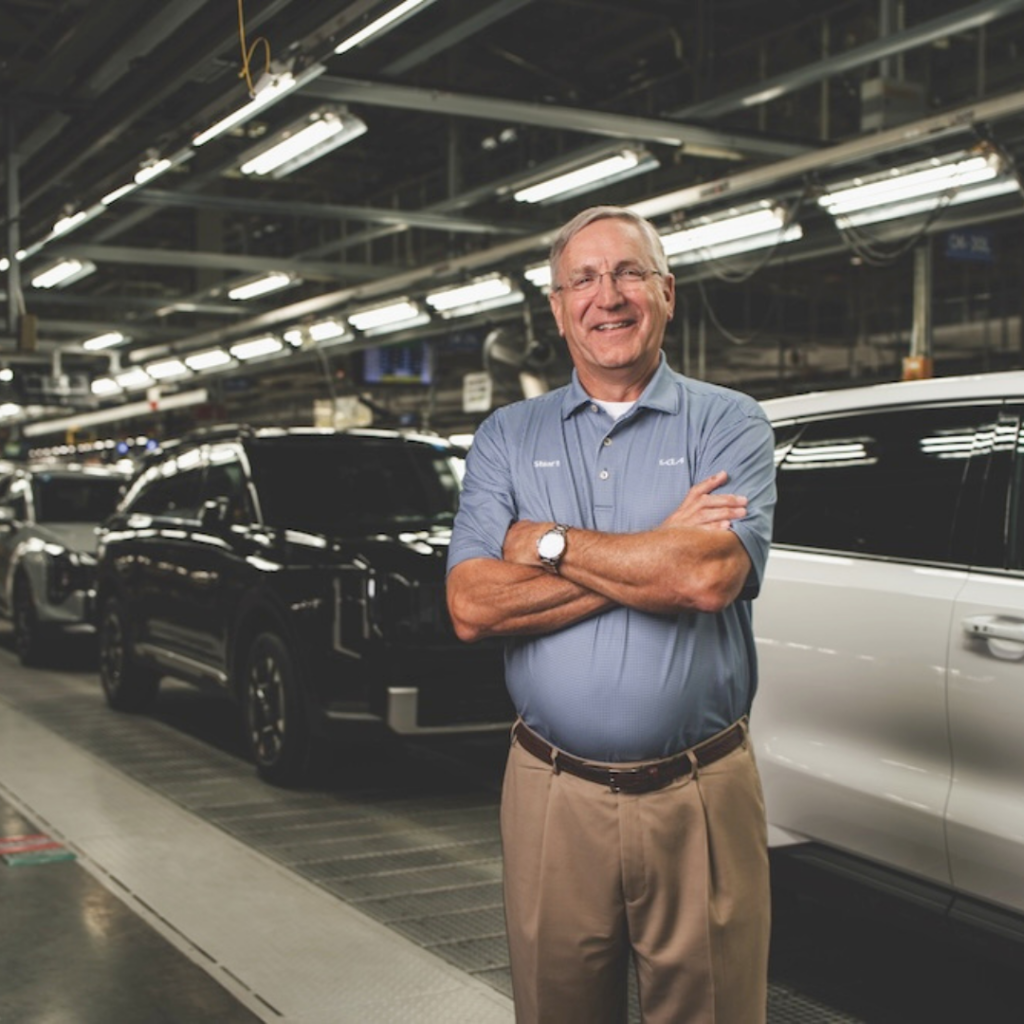
Celebrating Success: Kia Georgia President Stuart Countess. Photo credit: Nathan LeDuc
Some folks might be taking it easy during the dog days of summer, but not the state’s rapidly expanding and forward-looking auto industry. As Rivian ramps up the construction of its facility near Social Circle, Mercedes-Benz, Porsche and Kia are hitting historic milestones. The manufacturers are responding to evolving consumer demands for the full range of powertrain options – internal combustion and electric engines and hybrids.
This scene is playing out after concerns that production and sales floor activity would decelerate this year due to a variety of factors, chief among them the expiration of federal EV tax incentives, the war in Iran disrupting the supply chain and the impact of tariffs. And while all those issues remain a concern, there is some positive news: Hybrid sales are up 7.8% so far this year.
“We see the hybrid as a bridge to convince customers about the advantages of the electric part of mobility.” – Stuart Countess, president & CEO, Kia Georgia
Across the state, the automotive sector, which includes more than 200 automotive and automotive-related facilities, is steering toward growth.
“Georgia’s automotive facilities mean good jobs, and as the industry has evolved, the state has evolved with it to continue our mission to deliver generational benefits to Georgians,” wrote Misti Martin, deputy commissioner of Global Commerce at the Georgia Department of Economic Development, in an email. These benefits are evident in the Atlanta headquarters of luxury brands Mercedes-Benz and Porsche.
Mercedes doubled down on its commitment to Georgia by establishing One Mercedes-Benz Drive (1MB) in Sandy Springs as the company’s North American headquarters and moving 500 positions from Michigan to both 1MB and the new $34 million research and development hub in West Midtown. The moves, which include corporate, technical and financial services employees, are expected to be completed by the end of the month.
The R&D hub, formally Mercedes-Benz Atlanta Technology Center, is in the Northyards Business Park, a historic former Southern Railway roundhouse and freight complex near Georgia Tech. Being situated close to Atlanta’s nationally recognized research universities will create opportunities to advance innovation.
Mercedes is celebrating its 140th anniversary this year. One of the cofounders was making a name for himself as early as 1886. That’s when Karl Benz applied for a patent for his “vehicle powered by a gas engine” – considered the first true motor car.
The German-based automaker’s R&D in the U.S. includes powertrain development, vehicle certification and in-car user experiences, among other things. Recently, the company began integrating ChatGPT into car information and entertainment systems and adding an automated driving pilot that allows for hands-free driving.
“Looking to the future, the extended Mercedes-Benz North America headquarters in Atlanta will play a significant role in continuing to shape our legacy as well as the U.S. automotive industry,” wrote Jason Hoff, CEO of Mercedes-Benz North America, in an email. “We have big plans in this country, this state and this city.”
Those plans include investments of more than $7 billion into U.S. operations by 2030.
The headquarters and R&D moves are part of a broader strategy for the company to establish a unified North American headquarters for Mercedes-Benz, which will ideally help increase speed to market and improve customer experience.
The Porsche Experience
Porsche Cars North America (PCNA) marked several major milestones in 2025 resulting from a strategy that reflects “what our customers value most: choice and a great experience,” wrote PCNA President & CEO Timo Resch in an email. One of those successes in what Resch called “a year of profound change” was a record-breaking sales performance totaling 76,219 vehicles nationwide. A second was the 10th anniversary celebration of the $128 million-plus Porsche Experience Center in Atlanta, which includes 2.9 miles of driving tracks, 13,000 square feet of event space, an upscale restaurant and a driving simulator lab. Between the Atlanta location and a second Porsche Experience Center in Los Angeles, more than a million people have visited the centers in the past decade.
“You don’t just drive a Porsche – you experience it,” wrote Michelle Rainey, the Atlanta-based director of Porsche Experience Centers, in an email. “The close, firsthand connection we build with our customers … is unique to Porsche and absolutely core to how we approach our brand.”
Porsche’s strategy emphasizes the company’s belief that U.S. consumers are not a one-size-fits-all market but, instead, want a broad range of choices. This year Porsche offered its latest option, with the all-electric Cayenne S, broadening its range of Cayenne models.
In Porsche’s view, the popularity of its bestseller, the Macan, underscores the success of the company’s strategy. Macan sales jumped from 25,180 cars in 2024 to 27,139 in 2025, an increase of about 7.2%. A hybrid “Macan-sized” SUV is projected to launch by the end of the decade. Porsche credits the Macan EV, which debuted in 2024, for attracting new customers. But demand since then has cooled, especially in the U.S., after $7,500 federal EV incentives ended last fall.
Kia’s Milestones
Kia Georgia celebrated three milestones with the production of a single vehicle in February. When the 2027 Kia Telluride rolled off the assembly line, it was the five millionth vehicle produced at Kia’s only U.S. manufacturing site; it marked the production of a new model year; and it was the first-ever hybrid electric vehicle assembled in Georgia.
Achieving that third milestone means that the Kia Georgia plant now produces three different powertrain systems: internal combustion, hybrid and EV.
“It gives us a lot of flexibility to move wherever the market is taking us. We see the hybrid as a bridge to convince customers about the advantages of the electric part of mobility,” says Kia Georgia President and CEO Stuart Countess, who adds that the five millionth vehicle highlights the plant’s consistency.
That consistency has led to two different but equally important results. One is “all the partnerships that we’ve had throughout the state,” says Countess. The other is providing Georgians “with good, stable employment.”
To meet high demand for the Telluride, Kia Georgia is increasing the vehicle’s production capacity to 180,000 vehicles per year in West Point – the only site that produces it. That’s more than half of Kia Georgia’s overall capacity of 350,000 vehicles annually. It also assembles the gasoline-powered Sorento and Sportage SUVs and the all-electric EV9 SUV and EV6 CUV.
Hyundai’s EV Growth
The Hyundai Motor Group Metaplant America is continuing to ramp up to full production of 500,000 vehicles annually. In time, production is expected to include a mix of 10 hybrid and EV models at the Bryan County site. It was initially promoted as an EV plant but changed plans over time to include hybrids when EV sales grew more slowly than expected.
The metaplant currently makes three vehicles at its Ellabell facility: the Ioniq 5 and Ioniq 9, both EVs, and its first hybrid, the Kia Sportage Turbo Hybrid, which it began manufacturing in June. In May, roughly eight months after the tax credits’ expiration, Hyundai’s overall sales were up 3% year-over-year, due in large part to hybrid sales, which jumped by 90%. In fact, this was the best month to date for Hyundai hybrid vehicles, with four such models achieving record May sales.
Scaling the metaplant to support long-term electrification goals while also adding hybrid production gives Hyundai the ability to adjust to customer demand in an evolving market.
Hyundai says its electrification strategy has never been built around any single incentive, tax credit or tariff structure, but rather it makes product and manufacturing decisions based on customer demand and long-term market opportunity. The company is optimistic EV sales will continue to grow over the long term and is positioning its manufacturing footprint to support that growth.
Hyundai’s commitment includes two joint ventures with EV battery makers to build hubs in Georgia. One, with LG Energy Solution, is called HL-GA Battery Company, located a few miles from the metaplant. The $4.3 billion plant produces batteries for Hyundai, Kia and Genesis brand vehicles. The other joint venture is with SK On at a $5 billion plant in Bartow County. Plans call for the plant, operating as Hyundai-SK Battery Manufacturing America, to have the capacity to produce 50 million battery cells that will support approximately 300,000 electric vehicles annually. Production is beginning just a few months after SK Battery America Inc. laid off nearly 1,000 workers, about 37% of its workforce, at a manufacturing plant in Commerce, northeast of Atlanta.

Perfect Site: Tony Sanger, vice president of facilities for Rivian in Georgia. Photo credit: Kevin Garrett
Rivian’s Innovation Adventure
The signage on Rivian’s new East Coast headquarters in Atlanta’s Junction Krog District sums up the EV innovation taking place not just in the city but in the state: “Keep Atlanta adventurous forever.” The Irvine, California-based company that develops and builds EVs and accessories had a grand opening of its 500-person East Coast headquarters on the Beltline’s Eastside Trail in October 2025. It was finishing Phase 2 earlier this year. The company will develop artificial intelligence for its autonomous driving efforts in the new offices, according to Rivian Founder and CEO RJ Scaringe. As the office work was finishing, Rivian was beginning vertical construction of a $4.5 billion EV manufacturing plant in Stanton Springs on Metro Atlanta’s eastern outer edge.
Rivian will produce its next-generation midsize, five-seater R2 SUV and R3 crossover at the 2,000-acre site in an initial phase of 300,000 vehicles annually beginning in 2028. When completed, the plant, which will have room to expand, is expected to create 7,500 jobs.
“You could not find a more perfect site in the country for building an automotive factory than the site Georgia created here,” says Tony Sanger, vice president of facilities for Rivian in Georgia. Road and rail work performed by the state, he says, gives Rivian a “direct connection to Atlanta, the West and to the ports of Savannah and Brunswick.” As part of a partnership, announced in March, Rivian will manufacture fully autonomous R2 robotaxis for Uber at the site. The investment of up to $1.25 billion includes plans for Uber to purchase up to 10,000 autonomous R2 vehicles with an option to buy 40,000 more by 2030, totaling up to 50,000 units. Initial deployments are expected in 2028.
Sanger, who lives on a farm in Monroe, says he’s excited to be “building this factory about 15 minutes from my house. I mean, who gets to do that kind of a project in their career and be that close to home?” He’s also proud Rivian selected Georgia for a project of this scale. “We’re becoming the center for EV manufacturing in the U.S. down here in the Southeast. It’s great to see that happening in Georgia.”