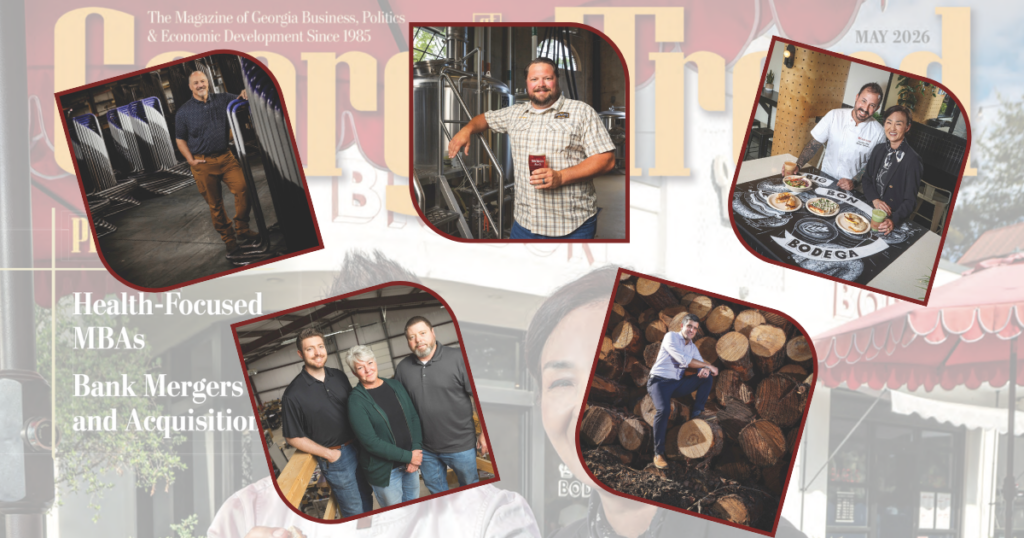
Small Business, Big Impact on Georgia Economics
These 5 Georgia companies demonstrate how it’s done.
Whether trivial or fundamental, here’s something about our state’s small businesses: They tend to pick up the phone. These days, that’s a differentiator.
Their moves aren’t dissected by Wall Street analysts and media pundits, and maybe that’s why they’re so instructive. Georgia’s small businesses are the thin reeds swaying when the economic winds start howling. The ones that survive and prosper are made of the toughest fiber, with the strongest roots, that evolve in real time.
Whether their markets extend around the block or around the globe, Georgia’s locally owned businesses thrive based upon the bonds they forge with their employees and the communities they call home. While 30 jobs in a town of a few thousand counts as big, what can count as even bigger is to witness a local enterprise making a difference.
Five of these businesses have been named Georgia’s 2026 Small Business Rock Stars by the Georgia Department of Economic Development. Each in their way, they embody the local grit that powers Georgia’s innovation economy.
Big Bon Bodega
Savannah
32 Employees
When word got out about the wood-fired pizzas she was selling out of a trailer, Kay Heritage found herself immersed among hungry Savannahians, numbering in the hundreds each night she went out. Encouraged by her success, “Mama Kay” moved the business into a former gas station in Savannah’s trendy Starland District. She called her casual eatery Big Bon Bodega; the menu centered around wood-fired bagels. And pizza, of course. Again, the response was electric.

Electric Response: Kay Heritage, founder of Big Bon Bodega in Savannah, with executive chef and business partner Shahin Afsharian. Photo credit: Frank Fortune
Born in South Korea, she moved with her family to Northern California at age 13, battled through school as she navigated English and joined the U.S. Army, serving four years as a dental assistant at a base in Heidelberg, Germany.
“The Army taught me discipline and accountability,” she says. “It was a tremendous experience for me.”
And yet several years into Big Bon, the crush of running a popular restaurant was extracting such a toll that Heritage, a wife and mother of four with a growing cadre of grandkids, was leaning toward calling it quits. Then she got a text from another ambitious immigrant. Born and raised in Mexico City to Mexican and Persian parents, Shahin Afsharian is a Michelin-starred chef who has worked at restaurants around the world. But he had reached his own breaking point managing a Savannah restaurant group.
“After 20 years of craziness and nonstopping, I needed something else,” he remembers. “My passion is to cook and to feed people.” He wanted to know if Heritage needed a line cook, someone with management skills.
“Without us intentionally looking for each other,” he says, “we connected.” They’ve been business partners ever since.
A big break was being featured by Guy Fieri on the Food Network’s Diners, Drive-Ins and Dives, thus giving worldwide exposure to Big Bon Bodega’s Asian-inspired menu. Favorites included its Korean Mama bagel sandwich with bulgogi beef, kimchi and Korean pimento cream cheese; Wild Truffle Sicilian Pan Pizza; the Bon Mi bowl of braised pulled pork, spicy aioli and pickled and fresh vegetables.
The Korean term that most closely mirrors “bodega,” Heritage explains, is gumong-gagae, loosely translated as mom-and-pop shop or hole in the wall. Big Bon is the nickname of her husband, Kevin, an engineer known for his raging backyard bonfires.
Big Bon Bodega on Bull Street, like its partner in nearby Pooler, is sort of like Cheers.
“The idea of a bodega is that it’s family owned,” Heritage says. “It’s a place to feel ok, where they’re likely to know your order before you place it. It’s a place people can recognize as their own.”
Innotek
Ocilla
20 employees
Chris Estes likes to say he did everything backward. He got married at 19, had his first two children at 21, then went looking for a career. The irony is that the kid who “absolutely hated school” became a man whose life’s work is teaching – and building systems employed worldwide to teach some seriously complex stuff. Electronics, hydraulics, pneumatics and the like. He does so in Ocilla, 10 miles south of Fitzgerald.

Family Business: Chris Estes, owner of Innotek, right, hired his son Aaron and his wife Suzanne when the company started to grow. Photo credit: Matt Odom
School in nearby Tifton, where Estes grew up, was something he finished to please his grandmother. He went straight into factory work as “an uneducated general laborer,” pulling shifts until the birth of his son made him want something better.
A light went on for Estes at Fitzgerald’s Ben Hill-Irwin Technical Institute (now Wiregrass Georgia Technical College), where classes in maintenance and automation finally tied academics to something real. Thus engaged, Estes discovered an inner gift so strong that it allowed him to mentor struggling classmates. Before long, he was teaching the very courses he had taken. The indifferent student became the educator.
Innotek began in a 600-square-foot cypress shed on the family farm, where Estes hunched over plywood circuit boards he’d constructed as training aids. Turns out, there was a market for them – packaged with a written curriculum – among middle and high schools, community and technical colleges and manufacturers. As the nascent business grew and Innotek’s training tools became more refined, Estes hired friends, his son and people who came through the door. Business really took off through a cannily arranged partnership with Japan-based SMC, a worldwide giant in pneumatic automation components. Having expanded twice on the farm, Estes is moving the business into a long-shuttered textile mill in Ocilla, where 160,000 square feet will allow for even more growth.
Estes drives a ’97 Chevy pickup. His wife, Suzanne, keeps the books and answers the phones, usually by the second ring. His son Aaron, 34, holds a master’s degree in chemistry and is the company’s head honcho in waiting. Estes clings tightly to Innotek’s independence and to his sense of personal loyalty.
“I’ve told [potential] investors, ‘We’ll just do it ourselves.’ If someone gives you something, they’ll want something back,” he says.
“When I go to bed at night, I think about the people who work for us, and how they’re putting food on the table and can hopefully put their kids through college,” he adds.
That sense of community might be the clearest indication that, for a man who claims he did everything backward, Chris Estes has gotten some things just right.
“Everyone should have three spaces in their life: their home space, their workspace and then a space to get away from those other two spaces. That’s what we provide, that third space.” – J. Ryce Martin, cofounder, Georgia Beer Company
Fabritex
Hartwell
70 Employees
Lee Adams says he learned how to count to 100 by organizing metal springs. His dad Andy, a Hart County entrepreneur, had bought Lee and his siblings a trampoline, then came to believe that he could build those things even better. Each trampoline required exactly 100 springs.

Seizing Opportunities: Lee Adams, president of Fabritex. Photo credit: Kevin Garrett
Andy brought young Lee on sales trips as far away as Texas, gave him a Rand McNally atlas and appointed him navigator. So began Lee’s education in the trampoline business, a business that did remarkably well and then morphed into something much bigger.
“Just being around my dad is what taught me,” he says. “It takes a lot to be that type of risk-taker, to be able to see, ‘This will make money, this won’t.’ We’ve had projects that didn’t work out, but he was brave enough to try.”
Maybe the biggest roll of the dice was to commit to a new factory, 110,000 square feet in Hartwell, just as the family’s fabrication business was diversifying and Fabritex was being born. That was 1989.
“I was working in maintenance that year,” Adams remembers. “I helped dig the footings, helped build this place.” And the former Clemson cheerleader with a degree in ceramic engineering runs it now.
Going back decades, the family business has shown a knack for recognizing and seizing upon opportunities. The fabrication skills developed to make trampolines opened the door to a line of wire carriers, tubular frames that bundle wire for shipping. Next came a rolling series of contracts with the U.S. Army Corps of Engineers for stainless steel mesh to combat erosion. Fabritrex also manufactures the customized metal guts of hospitality spaces that pop up around sporting events, including the PGA Tour.
“We have the ability to be a one-stop shop,” Adams says. “If you’ve got a problem and metal’s involved, we’ll figure it out.”
“When I go to bed at night, I think about the people who work for us, and how they’re putting food on the table and can hopefully put their kids through college.” – Chris Estes, owner, Innotek
Georgia Beer Company
Valdosta
15 Employees
The idea for the Georgia Beer Company emerged from a night of drinking. Five old friends at a bachelor party were drifting around Lake Lanier, riffing on what they’d do if they hit the lottery. When someone proposed that he’d purchase a brewery, “hire the four of us, and we’d drink beer all day,” J. Ryce Martin’s ears perked up. Rather than wilting in the glare of morning, the basic concept stuck. Martin, who holds a master’s degree in biology from Valdosta State University, kept thinking about it, especially as he began to feel burned out in his job as an analyst at the state crime lab in Moultrie.

For the Love of the Job: J. Ryce Martin, cofounder, Georgia Beer Company. Photo credit: Daemon Baizan
Martin and cofounder Chris Jones secured a homebrewing kit and began to tinker in Martin’s garage in Clyattville, just south of Valdosta. Early lagers, pilsners and IPAs went straight down the drain. “We learned from our mistakes,” Martin says. Things began to turn when they came up with a coffee milk stout, dark and roasty. They named it Destress Express. It would come to earn medals at prestigious national beer competitions.
“When we first started to taste Destress Express,” Martin recalls, “we realized that we were going to be able to open a brewery and brew delicious beer.”
The far-fetched dream began to reach fruition in early 2019, when the Georgia Beer Company moved from Martin’s garage to Valdosta’s brick waterworks. Long abandoned and then refurbished with support from a local economic development authority, the handsome relic was thus recast as Valdosta’s first microbrewery and taproom. It’s become especially popular, Martin says, among pilots and such at nearby Moody Air Force Base.
“Everyone should have three spaces in their life: their home space, their workspace and then a space to get away from those other two spaces,” Martin says. “That’s what we provide, that third space.”
Ever eager to experiment, Martin says he’s amassed close to 200 recipes, a vast reserve from which to fuel 16 permanent taps, anchored by the brewery’s flagships. Oktoberfest is a four-day blowout. Martin brings down a polka band from Pennsylvania, sets up tents and hauls in real German food. They break out the lederhosen. “It’s like Munich,” he says. “It’s when you’ve got to come down.”
The dream didn’t come easy. There were the early failures, the gallons of dreck they had to flush. Permits dragged, alcohol regulations kept shifting. More than once, Martin thought he was beaten. And yet he shrugs at those years of grinding and embraces what he’s created.
“You really have to love what you do,” he says. “And I do. I love, love, love doing this every day.”
“The idea of a bodega is that it’s family owned. It’s a place to feel ok, where they’re likely to know your order before you place it. It’s a place people can recognize as their own.” – Kay Heritage, founder, Big Bon Bodega
Greenfield
Savannah
24 Employees
If you’d asked Gregorio Aznarez 20 years ago to list 100 possible futures, running a timber export company in Savannah would not have made the cut. He grew up in Uruguay in a forestry family, one of eight kids on a large tree farm, and figured he’d probably stay there.
Instead, he followed his girlfriend to Georgia.

Making the Cut: Gregorio Aznarez, founder and director of Greenfield. Photo credit: Frank Fortune
Milagros, now his wife and mother of three, had landed a scholarship to Savannah College of Art and Design. Aznarez, studying supply chain management and international business in Uruguay, finagled a summer internship with Savannah’s Peeples Industries, which had timber relationships with his family. Frank Peeples, the company’s legendary chieftain, took him under his wing.
After getting an MBA from Georgia Tech, Aznarez worked for a Chinese state-owned company, running timber export for North and South America. During President Donald Trump’s first term, as economic tensions with China ratcheted up, his Chinese partners got nervous. “I said, ‘No problem. Let me buy you out.’” Right around the time that COVID-19 hit, Aznarez launched Greenfield LLC in Savannah.
The timing was brutal. “COVID has been the biggest disruptor since World War II,” he says. Global supply chains ground to a halt, container ships stacked up, trucks and crews were scarce. As competitors withered under pressure, “we decided to double down,” he says, taking a second mortgage on his home to buy trucks and loading equipment.
“At the time, [it was the riskiest] decision I ever made,” he says. “Now I can tell you it was the best.”
Clients half a world away didn’t forget who was there in a crisis. Today, Greenfield ships hundreds of thousands of tons of southern pine logs a year from yards it owns in the Southeast to customers in 15 countries. A pine tree felled in Emanuel or Effingham County might end up as sofa frames in Vietnam, doors and windows in India, or wood pellets for heating. And despite the complex bilateral relationship, Aznarez is still doing business in China. He maintains an office of four in Xiamen, in Fujian Province, near Taiwan.
“It’s a beautiful place,” he says. “I love it there.”
He maintains close contact with his far-flung customer network and recently spent a month touring China, Thailand, Cambodia, Malaysia, Singapore, Vietnam and Japan, talking up Georgia timber along the way.
“The key thing is relationships,” Aznarez says. “That’s what we’re trying to [create].” 
A small business, according to Georgia law, has fewer than 300 employees and brings in less than $30 million in annual gross revenue. They employ 1.7 million Georgians, according to the University of Georgia Small Business Development Center.