Big & Bigger: Georgia Ports’ Rising Tide
The future-is-now approach at Georgia’s ports means not only sustaining high-level performance but also deepening their horizons.
Georgia’s ports are making big waves even hundreds of miles from the water’s edge – and that is the latest secret to its success as one of the nation’s leading trade hubs. A new inland port in Hall County will handle 200,000 container shipments per year and support nearly 15,000 local jobs, while eliminating 18 million truck miles from Georgia’s highways.

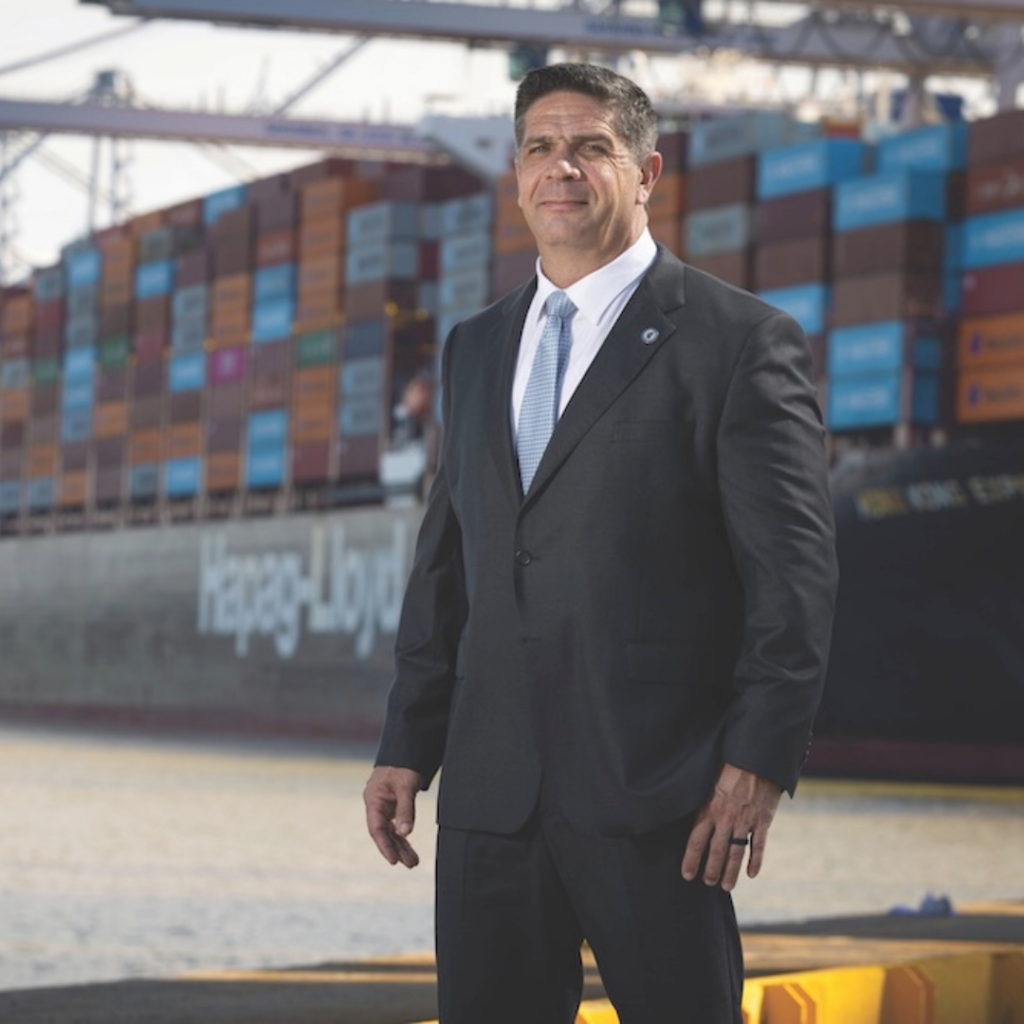
Winning Components: Georgia Ports Authority President Kevin Price. Photo credit: Frank Fortune
“Manufacturers across the region now have a seamless rail connection to more than 40 weekly vessel calls linking to global markets,” says Georgia Ports Authority CEO Griff Lynch.
Increased rail connections – dozens of trains depart Savannah to GPA’s three inland ports per week – mean more opportunity, increased economic development and reduced environmental impact. Overall, the GPA board approved $4.13 billion in infrastructure improvements in the last decade with nearly $5 billion in investment planned for the next 10 years, which includes the current $1.6 billion investment to upgrade the Ocean Terminal from a 200,000- to 1.75-million-container facility.
Making Inroads
The names Lula and Crandall might not evoke global trade hubs such as New York and Los Angeles, but big attention is being directed to the North Georgia towns, better known in logistics circles as the locations for the state’s newest inland ports. The May opening of GPA’s $134 million Gainesville Inland Port (in Lula just outside of Gainesville), combined with the Appalachian Regional Port in Murray County, broadens the reach of Georgia’s ports, boosts logistical efficiencies and enables even greater upside for the state’s economy.

Keeping Pace: Georgia Ports Authority CEO Griff Lynch. Photo credit: Frank Fortune
It only makes sense that the ports would connect with the nation’s best performing small city, a distinction Gainesville earned in 2025 from the Milken Institute. Providing a direct rail link to the Port of Savannah via Norfolk Southern, the Gainesville Inland Port features 18,000 feet of working tracks and will have a capacity of 200,000 containers per year. With more than 330 manufacturers operating in Hall County, the inland port serves quite the robust business pipeline.
“The Gainesville Inland Port is already strengthening one of our biggest competitive advantages – our ability to make things here and efficiently move them to markets around the world,” says Tim Evans, president and CEO of the Greater Hall Chamber of Commerce. “The inland port is more than a transportation investment; it’s becoming an economic development asset that helps us compete for the next generation of manufacturing and logistics investment.”
The momentum is readily apparent in new company arrivals and expansions in Gainesville-Hall County, including CJ Foodville Corporation’s new bakery and food processing facility and Cirkla’s plans to establish a new food packaging manufacturing facility. The combined investment will exceed $52 million and create approximately 425 new jobs.
Balanced trade and reduced environmental impact are additional advantages gained from the rail-connected ports and important to the long-term success of the inland network. According to the GPA, Gainesville Inland Port will offset 600 roundtrip highway miles for every container moved on rail.
“Imports to the Gainesville area provide a fresh supply of containers, facilitating the export of goods such as logs from North Georgia,” says Lynch. “This, in turn, supports the landowners growing trees, truck drivers and others supporting the forest industry.”
The Appalachian Regional Port might not be moving mountains, but operations there are getting quite accustomed to peaks. GPA reports that the inland port, serviced directly by CSX, handled an all-time high of approximately 4,800 containers in July, up 41% compared to July 2025. The ARP ended fiscal year 2026 (through June 30) with a record annual volume of more than 49,000 containers, up nearly 20% over the previous 12 months. The first two months of the current fiscal year have exceeded 25% in volume growth year over year.
As in Hall County, the Appalachian Regional Port has also demonstrated its economic development value, proving to be a strong draw to the Murray County area for appliance makers, flooring companies and solar technology producers.
GE Appliances was the first company to build a distribution facility near the inland port, with its 504,000-square-foot Southern Logistics Center posting a 23% increase in volume since its first full year of operation in 2020, according to Harry Chase, senior director of Central Materials for GE Appliances. The regional port provides greater visibility and control over critical materials coming through Savannah before they reach the company’s factories, including the Roper Corporation facility, one of the largest cooking products manufacturing plants in the country, located an hour west in LaFayette.
“We took a calculated risk on a new logistics model and made a big bet on the Georgia Ports Authority,” says Chase. “That bet proved to be a sound investment, and it has become an important part of how we support our manufacturing operations.”
Gonna Need a Bigger Boat
Waterways remain the vital link, of course. As port traffic grows, so do logistic challenges. It takes substantial long-term planning and investment as a port to optimize waterway throughput for the next generation of larger vessels. For the Georgia Ports Authority, it starts with a harbor modification study.
“The ships of the future are getting larger, and every port must keep pace or watch business move elsewhere,” says Lynch.

Economic Impact: Jeff Humphreys, director of the Selig Institute for Economic Growth at the University of Georgia’s Terry College of Business. Photo credit: Ben Rollins
Savannah’s previous harbor expansion was designed for ships carrying 8,200 containers, but not surprisingly vessel demands shifted considerably during the more than 20-year federal project. When dredging was completed in 2022, the Port of Savannah was already serving ships much larger than what was planned in the project design. Today, GPA serves ships twice that size, vessels that carry more than 16,000 20-foot containers on a regular basis.
If the doubling of ship size coming into the Port of Savannah wasn’t compelling enough for another harbor modifications plan, the last feasibility study in 2022 for the previous Savannah Harbor expansion found $7.70 in economic
benefit to the nation for every dollar spent on construction.
Authorized under the 2024 Water Resources Development Act and in collaboration with the U.S. Army Corps of Engineers, the harbor study will consider deepening the channel and adding passing lanes for two-way ship traffic to allow today’s larger vessels to enter the port with greater ease at any time of day and enable greater traffic flow. The process will include projecting the most common ship size in Savannah’s future and then designing harbor modifications to suit that vessel class.
The U.S. Army Corps of Engineers has authority over both the economic and environmental impacts of the proposed harbor expansion. After completing the study, the Corps will make its recommendation to Congress. A decision to expand the Savannah Harbor would then require additional congressional authorization, followed by federal and additional funding for construction.
The channel improvements, five new container berths and multiple Georgia DOT projects – including increasing the height of the Talmadge Bridge to accommodate the taller clearance of ships carrying up to 22,000 TEUs – will prepare the GPA for the future, according to Lynch.

Wide Berth: The GPA is planning another expansion, to accommodate larger ships. Photo credit: Frank Fortune
Strength in the Numbers
Georgia’s deep-water ports boasted a $181 billion economic impact on the state, according to a fiscal year 2025 study from the University of Georgia’s Terry College of Business. Reflecting a 4% increase over 2024, the financial effect constitutes about 12% of Georgia’s total output.
“It follows that almost one out of every eight of Georgia’s jobs is in some way dependent on the ports,” Jeff Humphreys, director of the Selig Center for Economic Growth at UGA’s Terry College, tells Georgia Trend.
Released last summer, the study showed a year-over-year increase of almost 45,000 jobs totaling nearly 606,000 full- and part-time positions – 12% of Georgia’s total employment – made possible by the ports. Humphreys adds that more than half of those jobs are in manufacturing (25%), transportation/warehousing (21%) and agriculture/forestry (7%). Mining is another industry of which the ports are “especially supportive,” according to the study.
With numbers like those, it may come as little surprise that Savannah has been the fastest-growing port in the Southeast the past five years, and the Port of Brunswick has claimed the top national ranking in automobile and machinery volumes. New Georgia Ports Authority President Kevin Price says if you add to that Georgia’s top business ranking, access to Atlanta and overall growth in the region, “these are all winning components in our model for companies looking to do business in Georgia.”
Charting a Course Through Choppy Seas
The Georgia ports’ 4% year-over-year increase in economic impact is especially impressive given the economic headwinds confronting the state and country. The effects of tariffs extend beyond merely higher prices for consumers to supply chain disruption and more.
As of midyear, the effective tariff rate on U.S. imports was around 8% or about four times the level prior to the Trump Administration’s April 2025 “Liberation Day” levies, according to UGA’s Humphreys. While not enough to trigger a recession, plenty of harm has been done.
“Higher tariffs and trade tensions will cause Georgia’s ports and the industries that use them to grow more slowly than they would absent protectionist trade policies, but growth will not stop,” the Selig Center director says. “My main concern is the high level of U.S. policy uncertainty that accompanied that increase. Until U.S. trade and industrial policies are more predictable, few of the potential benefits of trade associated with the development of domestic industries can be realized.”
“The ships of the future are getting larger, and every port must keep pace or watch business move elsewhere.” – Griff Lynch, CEO, Georgia Ports Authority
The economic effects of the Iran War on the ports and Georgia’s overall economy have been modest, according to Humphreys. Yet the energy shock of higher oil and fuel prices has increased operating costs for shippers and pushed up inflation while increasing the risk of recession.
“Unless the Iran War causes oil prices to rise to $150 per barrel on a sustained basis or we begin to see vehicles lined up into the streets in front of gas stations, I do not believe that the oil shock alone will cause a recession,” he says. “Georgia’s economy and Georgia’s ports industry are amazingly resilient.”
There is no silver bullet for the macrolevel hindrance and uncertainty of inflation, tariff effects and the Iran War, but GPA’s capacity, reliability and time to market help to keep customers in line with the global business imperatives of supply chain reliability and cost savings.
“Even in a period of global trade uncertainty, Georgia Ports maintained steady container volumes in fiscal year 2026 [which ended June 30],” says Price. “We have the capacity and connectivity to respond quickly to disruptions and market fluctuations, enabling customers to adjust supply chain speed and routings, maintain flexibility and strengthen competitiveness.”
Big Present, Bigger Future
It’s hard to overstate the importance of Georgia’s deepwater ports to the state and region. Like a 16,000-container ship cruising past downtown Savannah, the numbers capture a lot of attention, from the ports’ giant infrastructure investments and the myriad multimodal moves to the billions of dollars’ worth of economic impact.
“No other port in the nation moves at the speed of Georgia Ports,” says Price. “The Port of Savannah is one of the best-connected ports in the U.S. to world markets, with 40 ships and 42 double-stack trains to inland markets per week and 15,000 truck transactions a day, making it one of the best ports in the nation to do business.”
Georgia Ports’ impressive output and impact are not possible without strong vision and forethought. While balancing enormous customer demands and stakeholder interests and navigating major economic variables, the Georgia Ports Authority keeps its eyes on the future.
With the new Gainesville Inland Port, the current upgrade to the Ocean Terminal and the Savannah Harbor modifications study, the GPA continues to pave the way toward meeting next-era needs while expanding its comparative advantages. 

Collaborative Leadership: Kevin Price, president of the Georgia Ports Authority, will also become CEO when Griff Lynch steps down in August. Photo credit: Frank Fortune
New GPA President Eyes Next Level of Performance
The Georgia Ports continue to make room for more ships, cargo volume and multimodal connections. Kevin Price, the new president of the Georgia Ports Authority, also sees room for improvement.
“My focus is on constant improvement in our port and inland operations,” says Price, who has more than three decades of experience running complex operations in the maritime and logistics industry. “Completing projects like the $1.6 billion Ocean Terminal expansion and continuing to advocate for improvements to the Savannah Harbor are among our top priorities.”
Price assumed the role of Georgia Ports Authority president on July 1 and will add CEO duties on August 1, 2027, when Griff Lynch retires after 15 years at the helm. Price served as president of Gateway Terminals in Savannah for four years prior to joining the GPA, and as chief operating officer at Virginia International Terminals before that.
“Kevin understands that Georgia Ports has built its success through long-term decisions, investments and operational excellence that are an economic engine for the Peach State and the Southeast region,” says GPA Board Chair Alec Poitevint. “The board is confident Kevin’s collaborative leadership and customer focus will keep Georgia Ports at the forefront of innovation and growth in our industry.”
Having prior working relationships with the Georgia Ports leadership and board, Price admired their long-term view on infrastructure and “focus on making it easy for customers to do business here.” Their self-financed $5 billion investment in the future of the port is unrivaled in the industry, ensuring the long-term competitiveness and growth of customers, he says.
Combining his operations experience with vision, strategy and long-term planning will be essential for Price’s improvement goals. GPA’s new leader underscores the importance of boosting port productivity, which means vessels can enter and exit more easily so they can make up time in their sailing schedules, trains can ensure port departures within 20 hours of cargo unloading and Georgia’s important agribusiness industry can have more ways to compete globally via agile and resilient supply chains.
“Every company wants access to a competitive port system to ensure their supply chains can compete in world markets,” Price says.