The Georgia World Congress Center: A World of Its Own
Since its strategic launch 50 years ago, the Georgia World Congress Center has been an economic powerhouse, attracting conventions, events and visitors from around the globe.
Fifty years ago, Atlanta city leaders created the Georgia World Congress Center because they were anxious, maybe even afraid. That might seem to be a shaky foundation to build upon, but it can be a powerful source of motivation.

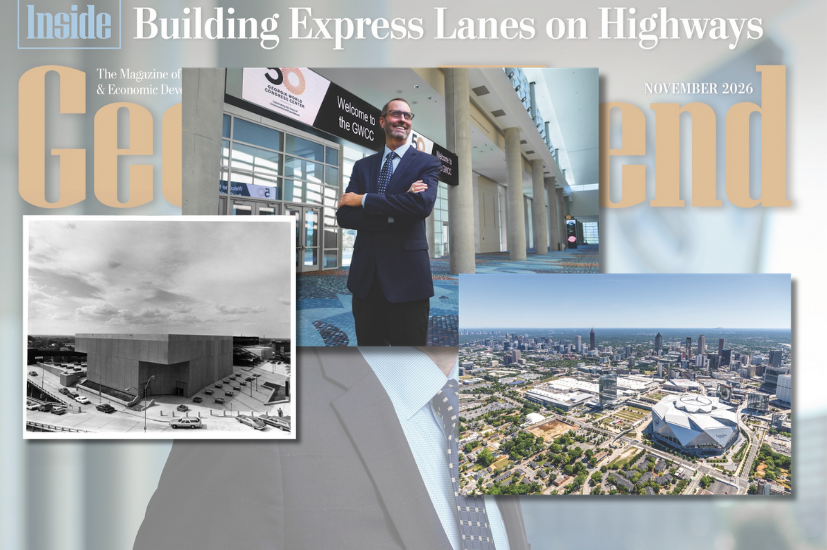
Remarkable Growth: Kevin Duvall, CEO of the Georgia World Congress Center Authority. Photo credit: Daemon Baizan
In the early 1970s, the region’s thriving hospitality scene was outgrowing local venues, leaving longtime expos like the Bobbin Show eyeing other destinations, like New Orleans, Chicago and Orlando. The fear was clear: Lose that business and risk economic calamity.
“Atlanta didn’t want to lose anything we already had, whatever it might have been,” says Kevin Duvall, CEO of the Georgia World Congress Center Authority. Duvall has been part of the GWCC management team since 2002, including 15 years as COO.
“I think building the [World Congress] Center was a defensive move – a play to ensure the future of Atlanta as a major convention center,” he says. “And over time, it’s evolved into a great offensive move, because we planted a seed of something remarkable that continues to grow.”
That seed has grown into one of the country’s largest and busiest convention complexes – a three-building campus spread over 200 acres of Downtown Atlanta, woven into a 900-acre district of stadiums, hotels, arenas and parks.
The GWCC is the kind of place where you can serve dinner for 8,000 sorority members on a Friday night, dismantle the ballroom setup on Saturday and spend the next week building a small city of industrial booths under one roof for the next big expo.
For Duvall, the 50th anniversary is less a ceremonial milestone than a checkpoint: a moment to measure how far the center has come from its origin story – and whether today’s decisions will look as visionary in another quarter century.
From Concept to Reality
A 1970 feasibility study spelled out the obvious: Without a larger convention center, Georgia risked losing millions in visitor spending, jobs and tax revenue. The proposed answer was a $35 million facility in Atlanta that was easier to imagine than to develop. In 1974 the General Assembly authorized state-backed financing, clearing the way for the GWCC in Downtown Atlanta, across the street from the Omni Coliseum (now the site of State Farm Arena).
From the start, that $35 million was never meant to pay for itself at the convention center – it was a down payment on regional economic development, with benefits rippling outward.
“Bringing people to Atlanta meant filling hotels, supporting restaurants and local businesses and creating opportunities across the region,” Duvall says. “We always saw the center as an economic development strategy. That idea has always been at the heart of our mission.”
When the GWCC opened in 1976, it consisted of one 750,000-square-foot building with 350,000 square feet of exhibit space, setting a long-term development strategy in motion. The original hall multiplied, first through additional phases, then into new buildings.
“Building something to last doesn’t mean building something that never changes,” notes Brian Daniel, president and CEO of Carroll-Daniel Construction, and chair of the Georgia World Congress Center Authority Board of Governors. “In many ways, it means the opposite. A great facility must be able to evolve.”

Decades of Transformation: When the GWCC opened in 1976, it consisted of one 750,000-square-foot building, above (photo credit: GWCCA); today the three-building campus spread over 200 acres is woven into a 900-acre district of hotels, parks and other buildings including Mercedes-Benz Stadium and State Farm Arena, below (photo credit: Aerial Innovations Southeast).

Fifty years ago, no one knew what the convention and hospitality industry would look like in 2026.
Today, the campus has three buildings – A, B and C – built in five phases, with about 3.9 million square feet of total space, making it one of the world’s largest LEED-certified buildings. That includes 1.5 million square feet of exhibition space, 12 exhibit halls, nearly 100 meeting rooms, two grand ballrooms, three fixed-seat auditoriums and a hotel with 976 rooms.
He works at the complex every day, but it still hits Duvall – more than occasionally. “The continuous enormity of this place and its impact,” he muses, finishing the thought. “It’s pretty impressive.”
Empty Spaces
Not long ago, Duvall was struck by another aspect of the World Congress Center’s sheer enormity – how empty it can feel when the world shuts down.
“The COVID pandemic was extremely difficult, especially from a human standpoint,” he says, recalling the jobs that were eliminated, and the echoes in the halls. “It was tough, but we had to be resilient.”
He remembered an earlier disaster and resilience in the wake of another challenge – the 2008 tornado that ripped through Downtown Atlanta, damaging the GWCC, Centennial Olympic Park and the old Georgia Dome, causing about $55 million in damage.
“Within 45 days the halls were open again, and we were hosting shows, even as crews were finishing repairs,” Duvall says.
The pandemic was a different kind of test.
“It felt so empty here,” Duvall says. “But I was glad that we could step up again.”
For a time, the center served as a backup and overflow hospital location, with staff pitching in wherever needed.
“Our entire team, including our leadership, did everything they needed to do – grounds work, setting up tables, cleaning restrooms,” he says. “But still, walking into those big empty spaces, and no people – that’s not what I’m wired for. That’s not what anybody’s wired for.”
Bringing the Big
Through the years, the GWCC has hosted some enormous events. Earlier this year, MomoCon, a four-day anime and gaming gathering, drew 67,277 unique visitors over Memorial Day weekend.

Built for Crowds: The GWCC has 1.5 million square feet of exhibition space, which in October 2023 housed the PRINTING United Expo. Photo credit: GWCCA
The GWCC’s largest annual industrial trade show is the International Production & Processing Expo (IPPE), which fills around 600,000 square feet of exhibit space for more than 32,000 poultry and agribusiness professionals. And there was a single day in February 2015 when the campus set a GWCC record by hosting 120,000 people for three simultaneous events.
All of that adds up to about $1.94 billion in economic impact and more than 15,000 jobs in Fiscal Year 2025. It’s that second number that makes Duvall happiest. “Those jobs include hotel employees, servers, drivers, small-business owners, event vendors and security teams, just to name a few whose livelihoods benefit from the visitors we bring,” he says.
And when Duvall talks about visitors, the GWCC campus is only part of the equation. The authority also manages Centennial Olympic Park, Mercedes-Benz Stadium and the Signia by Hilton Atlanta. It also oversees the Savannah Convention Center.
Last year, Duvall’s team wanted to get a better idea of the statewide impact, so they set out to find where all those workers come from and where all those vendors are based.
“We created a heat map that identified 101 of Georgia’s 159 counties that we touch,” he says. “I needed that. For me, visualization is much more impactful than just talking numbers.”
Duvall says there’s another impact he hasn’t quantified but is equally significant.
“A convention attendee may come back with their family,” he says. “A company executive may see Atlanta as a place to invest or expand. A major event can introduce millions of people to Georgia. So the $1.94 billion is an extraordinary number, but in many ways, the real impact is all the individual paychecks, businesses and future opportunities behind it.”
City within a City
The best way to grasp the scale of the GWCC is to watch it change identities.
During a week in August, the campus is draped in crimson and cream as Delta Sigma Theta members grace the halls. The next week, it’s a global gathering of about 30,000 woodworkers.

World Cup Gathering: The city of Atlanta and the Georgia World Congress Center Authority hosted the FIFA Fan Festival in June and July. Photo credit: GWCCA
“We are literally setting up a city of booths inside the World Congress Center,” Duvall says of the International Woodworking Fair, an event that has come to Atlanta for decades. It takes up to 1,000 workers to construct 1,000 booths of varying shapes and sizes.
“It requires many hands,” Duvall says. “It requires people to truck in materials for the booths. It requires support in Savannah and elsewhere to welcome the freight that gets shipped in for our international exhibitors.”
Attendees see the finished city: the polished booths, the gleaming machinery. What they don’t see are the hundreds of workers who’ve already spent a week building, wiring, loading in crates and solving problems.
Over 25 years, Duvall has watched the convention business change. The basics remain the same – people still want to walk a show floor, shake hands, make deals. What’s changed is everything underlying that experience.
“The most notable change is the reliability and the emphasis on technology,” he says, noting the GWCC recently installed Wi-Fi 7, tested for at least 10,000 concurrent users – with a target of handling 40,000 at once. “In an age when every attendee carries multiple devices and exhibitors run real-time demos at their booths, we need to be always on,” he says.

Investment and Development: Atlanta Convention & Visitors Bureau President and CEO William Pate. Photo credit: Daemon Baizan
Competing as a Destination
The GWCC sells more than physical space and bandwidth; location matters, a lot. What puts Atlanta near the forefront is the world’s busiest airport, the hotels, the museums.
But from the perspective of Atlanta Convention & Visitors Bureau President and CEO William Pate, the GWCC itself is the decisive factor. He points to the 2020 development of Exhibit Hall BC, a 100,000-square-foot expansion connecting Buildings B and C to create more than a million feet of contiguous exhibition area.
“It gives Atlanta the capacity to accommodate major conventions that previously couldn’t consider the city,” Pate says. “The new space provides additional flexibility and makes it easier to bring the show’s growing footprint together under one roof.”
That capacity is about more than bigger trade shows.
“GWCC is a critical piece of Atlanta’s economic infrastructure,” says Pate, who says the campus “is also a catalyst for continued investment and development.”
For the past few years, the Georgia World Congress Center Authority has been working to advance a $1.1 billion to $1.3 billion master plan that envisions 2.95 million square feet of new residential, retail, hotel, office and parking space. The next canvas in the plan is the International Plaza, the elevated greenspace between the convention halls and Mercedes-Benz Stadium.
“Our biggest challenge is making sure we don’t become comfortable simply because what we have today is successful,” says Daniel. “The cities and convention destinations we compete with will continue investing as well.”
Looking toward the GWCC’s 75th anniversary, Duvall frames the ongoing development in generational terms – planting trees whose shade others will enjoy some day.
“I think that’s what the visionaries who built the Georgia World Congress Center did back in the 1970s,” he says. “And I think that’s our role as caretakers of these facilities moving forward.”