Prospects for Augusta

Augusta’s economy has major positives: the U.S. Army Cyber Command at Fort Gordon, the Georgia Cyber Innovation and Training Center, a focus on healthcare, strong postsecondary education institutions, retiree-based economic development and low costs of living and doing business. In addition, Augusta is a center for telecommunications services and call centers. Demographic trends are favorable, too. Positive net migration is expanding the labor force, ensuring that talent is available for growth, and increasing demand for housing, healthcare and other industries. Structurally, Augusta’s high dependence on the military, healthcare and cybersecurity provides a cushion against U.S. economic slowdowns.
Economic development prowess brings many projects to the Augusta region. Project Eisenhower – which could open by 2027 – is a proposed 2.15-million-square-foot data center located about five miles from the U.S. Army Cyber Command that could create between 160 and 200 long-term jobs when fully operational. OXERRA, a manufacturer of iron-oxide pigments, completed a regional distribution center at its existing facility this year. Germany-based Ritz Instrument Transformers began operations in June at a new factory manufacturing high-voltage instrument transformers at the nearby Burke County Industrial Park. The new facility will support more than 160 jobs. GF Casting Solutions AG – which is now part of Nemak – is investing over $184 million in a new manufacturing facility that will create 350 jobs when fully operational in 2027. Syensqo is also building a new manufacturing facility, expected to become fully operational in 2027. It will support about 100 high-skill manufacturing jobs. StandardAero’s expanded operations at the Augusta Regional Airport opened in 2025, creating approximately 100 jobs. StandardAero overhauls, repairs and services aircraft engines. The expansion allows StandardAero to work on larger aircraft.
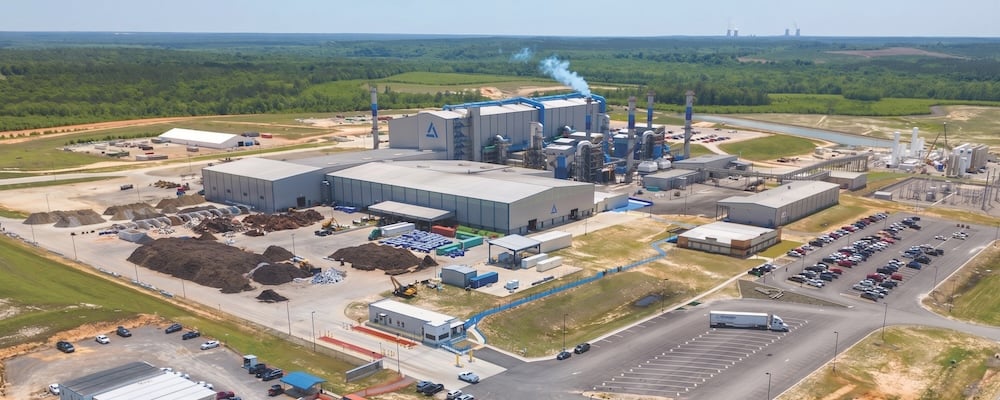
Augusta is also home to Aurubis, the first copper smelting and multi-metal recycling facility in the U.S. Aurubis expanded the facility in 2025, boosting its total investment to $800 million and creating over 200 jobs.

Massive Project: Aurubis operates the first large secondary smelter in the U.S. Photo credit: Contributed
Plant Vogtle in nearby Waynesboro employs about 1,700 people. The opening of Unit 4 in 2024 at the nation’s first new nuclear power plant in 30 years gave the energy industry a bigger role in the region’s economy. The expansion of nuclear power-generating capacity may appeal to energy-intensive businesses, especially those prioritizing clean energy sources.
Augusta is home to many high-quality medical facilities as well as Georgia’s largest medical school, the Medical College of Georgia. Augusta’s aging population will support growth of its healthcare industry. In the Augusta Metropolitan Statistical Area, around 18% of the population is 65 years or older. The 2022 purchase of University Hospital by Piedmont Healthcare is expected to generate about $1 billion in capital investment by 2032.
Fort Gordon and the U.S. Cyber Center of Excellence comprise Augusta’s largest employer with over 31,874 military and civilian employees. Fort Gordon brings economic stability, and the Cyber Center provides upside potential for growth. Fort Gordon’s multiyear $1.6 billion construction program focused on the Cyber Center of Excellence – which trains professionals in cyber defense – is projected to be complete in 2028. Fort Gordon also houses the NSA (National Security Agency) Georgia Cryptologic Center, which employs at least 4,300 people.
Fort Gordon helps Augusta tap into the ongoing expansion of federal defense spending. In addition to the direct creation of military and civilian jobs at the Cyber Center of Excellence, the base also draws military contractors. The Georgia Cyber Innovation and Training Center at Augusta University’s Riverfront Campus supports the large cluster of cybersecurity activity.
In early 2026, Augusta’s home prices were 72% above their pre-COVID-19 peak level, and up 4% on a year-over-year basis. Due to high mortgage rates, decreased affordability, a high vacancy rate and less robust population growth, home prices are likely to hold steady in 2027.
In recent years, net migration of people to Augusta has been a major source of population growth, and, in turn, economic growth. Natural amenities, a low cost of living and positive – albeit slower – job growth will keep people moving to Augusta. The foreign-born population accounts for only 3.8% of the area’s total population, compared to 14.1% rate for the U.S. The stricter enforcement of U.S. immigration laws therefore is a weaker headwind for Augusta’s economy than for the U.S. economy. 
Jeffrey Humphreys is Director of the Selig Center for Economic Growth at the University of Georgia’s Terry College of Business.