Prospects for Savannah
 Despite a backdrop of spiking oil prices and the recent retreat from the globalization of markets, Savannah’s prospects for economic growth are very good for many reasons:
- Significant economic development project announcements will provide a solid foundation for growth.
- Savannah’s tourism industry will grow, partly because it depends heavily on domestic travelers rather than international travelers.
- Infrastructure improvements at the Port of Savannah mean higher container traffic, which will attract more distribution, logistics and manufacturing companies.
- Entrepreneurship thrives in Savannah due in part to in-migration of people and businesses as well as low business costs.
- Demographic trends are favorable. Savannah’s population should grow.
- Increases in defense spending will likely boost spending associated with Hunter Army Airfield.
The Savannah area has had several economic development projects over the last several years. The largest was Hyundai Motor Group Metaplant America in Bryan County in 2025. Many auto parts suppliers followed. Hyundai and its suppliers generate more import and export traffic for Georgia’s ports. The Port of Savannah helped land the Hyundai project and will continue to help attract projects to the area.

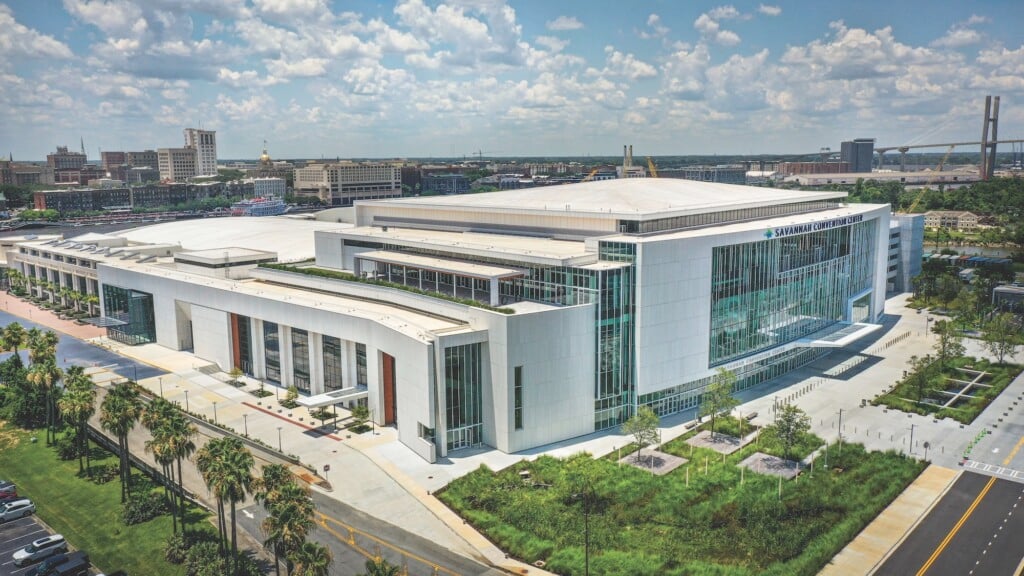
Bigger and Better: The Savannah Convention center’s recent expansion makes it the second-largest convention center in the state. Photo credit: Frank Fortune
Higher education is an economic driver, too. Savannah State University’s economic impact was $164 million in fiscal year 2024, up 9% from FY 2023. In addition, SCAD will continue to increase enrollment and expand its mission. The Deloitte Foundry positions SCAD to provide high-tech research and design services to private businesses and government organizations.
In 2024, the Medical College of Georgia in a partnership with Georgia Southern University’s Armstrong Campus opened a four-year medical school campus in Savannah accepting 40 more students per year. This will help alleviate the area’s physician shortage, boosting the availability of clinical healthcare – a critical need. More physicians will make Savannah even more attractive to retirees.
While retirees will continue to diversify the region, Savannah’s population is increasing in all age groups. Hyundai and other projects will prompt prime-working-age people to relocate to the region. Veterans account for 9.9% of Savannah’s population, compared to 6.1% for the U.S. Those born outside the country account for about 8% of Savannah’s population, far lower than the 14% rate nationally. The dramatic expansion of Immigration and Customs Enforcement (ICE) and surge in deportations and detention of immigrants and asylum seekers therefore should be less problematic for Savannah’s economy than for the U.S. economy.
The Port of Savannah helped land the Hyundai project and will continue to help attract projects to the area.
The completion of the Savannah Harbor Expansion Project in 2022 positioned the Port of Savannah for substantial growth. Meanwhile, the Mason Mega Rail project, also completed in 2022, doubled the Port of Savannah’s rail capacity, allowing the port to tap into new markets. The Port of Savannah continues to add container capacity and storage options. The new capacity will accommodate future growth and help manage unexpected surges in container traffic.
Savannah’s ambience and transportation infrastructure make it an attractive place to live and to do business. The thriving historic district and waterfront developments draw both vacationers and business travelers. The expansion of the Savannah Convention Center establishes the city as a premier destination for national conventions, trade shows and meetings. The expansion – completed in 2025 – doubled the convention center’s size, adding exhibit space, a ballroom, meeting rooms and parking. Enmarket Arena, which opened in 2022, seats about 9,500, allowing Savannah to host top level music, sports and entertainment events.
As of late 2025, single-family home prices in the Savannah MSA were 82% above their pre-pandemic peak levels compared to 71% for Georgia and 60% for the U.S. On a year-over-year basis, single-family home prices in the Savannah MSA increased by 4%. By traditional metrics, homes are overvalued, but Savannah’s housing market is largely unaffected by that because population growth is strong. Many jobs are being created. The area’s focus on tourism and higher education supports high demand for rental units and, in turn, home prices.
The long-term economic outlook for Savannah is good, but any further retreat from globalization will be a headwind because of the area’s high dependence on international trade. Exports equal 20% of the Savannah MSA’s GDP, the 23rd highest rate among U.S. metro areas.
Jeffrey Humphreys is Director of the Selig Center for Economic Growth at the University of Georgia’s Terry College of Business.