Downtown Atlanta: City on the Rise
Revitalization, Investment, Housing

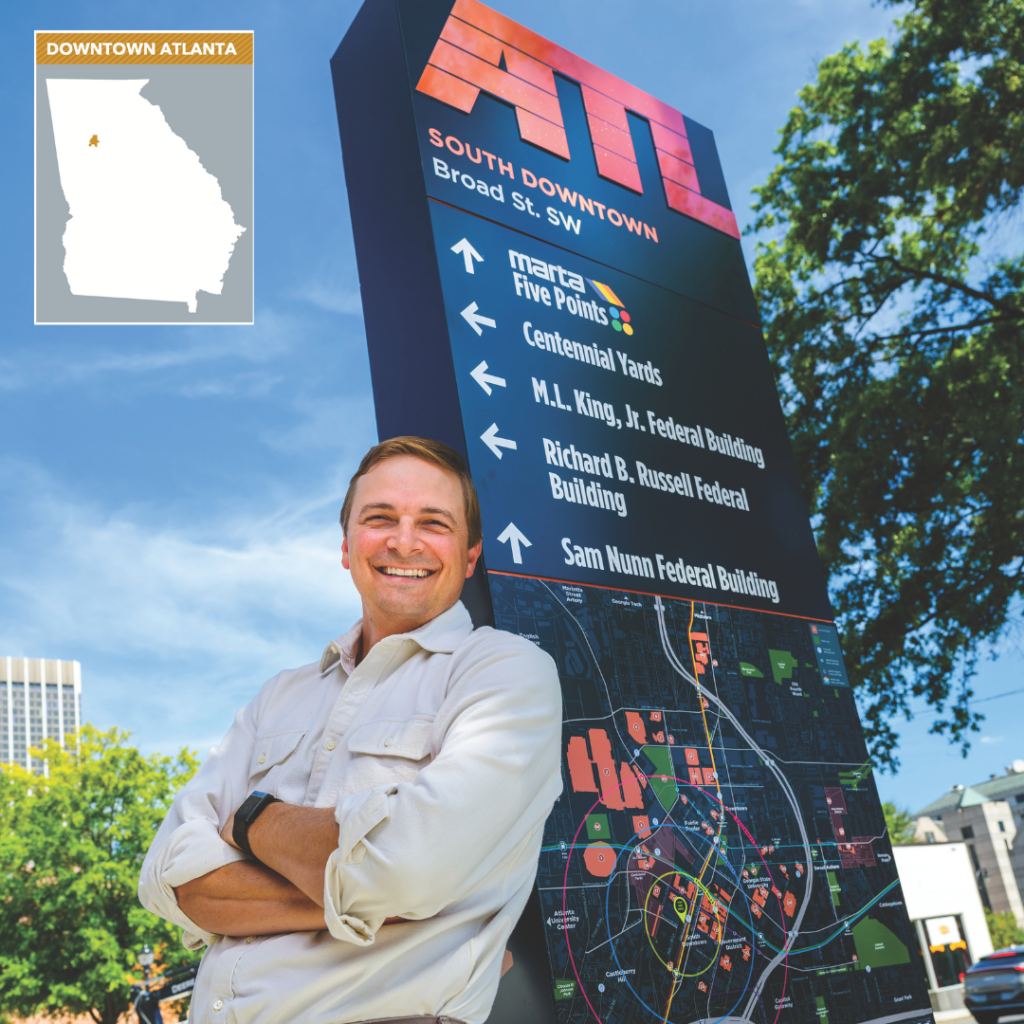
Positive Change: Jon Birdsong, SoDo Atlanta CEO. Photo credit: Daemon Baizan
Roughly a month after the last FIFA World Cup soccer game ended in Atlanta, SoDo Atlanta CEO Jon Birdsong walked along Mitchell Street in South Downtown Atlanta.
It was a Tuesday, not quite noon, when he spotted a group of jurors, name tags visible on their chests, looking for a place to eat lunch. “Welcome jurors,” he shouted across the street. “We’re glad you’re here.”
The jurors had more than a half-dozen restaurants to choose from – all part of a $140 million, 10-block, 56-building revitalization project dubbed “South Downtown,” or SoDo, thanks to Birdsong and Atlanta Tech Village co-founder David Cummings, SoDo Atlanta’s owners.
In addition to the restaurants, the first phase of the development includes Atlanta Tech Village (ATV) Sylvan – housed in the former Sylvan Hotel – along with 100,000 square feet of retail space and 140 housing units. With Phase I wrapping up, Birdsong says SoDo plans to give the market time to absorb the new development before deciding when to move ahead with Phase 2.
Birdsong estimates more than 40,000 people visited South Downtown during the World Cup, filling the areas around Mitchell, Broad and Forsyth streets and gathering for outdoor watch parties in the neighborhood’s new pocket park, Founders Green.
All told, 500,000 people attended FIFA Fan Festival in Centennial Olympic Park, nearly 545,000 fans attended matches at Mercedes-Benz Stadium, and more than 2.5 million riders took MARTA during the tournament – a 200% increase from regular ridership, according to the Atlanta World Cup Host Committee.
William Pate, president and CEO of the Atlanta Convention & Visitors Bureau, says the World Cup “really punctuated” a resurgence that was already underway.
For years, Downtown has functioned largely as “a point-to-point destination,” says Andrew Saltzman, president of business enterprise and chief commercial officer for the Atlanta Hawks and State Farm Arena. It was a place people visited to watch a game, see the Georgia Aquarium or the National Center for Civil and Human Rights, attend a convention or concert – or because they had jury duty. Then they left.
Birdsong believes that reality is changing. When he gives tours of South Downtown to Atlanta residents who haven’t visited in a while, he says they’re often stunned by what they see. “They just have to experience it,” says Birdsong. “It’s about awareness.”
Downtown’s Tipping Point
After decades of individual investments that never quite generated enough momentum to become self-sustaining, Brian McGowan, president of Centennial Yards Co., believes Downtown has reached a tipping point. “One of the major problems with Downtown, which everyone has acknowledged, is that there was a 50-acre hole in the middle of it.”
When completed, Centennial Yards, a $6 billion, 8-million-square-foot mixed-use district, will have filled in that 50-acre hole, formerly known as the gulch. Centennial Yards will include more than 2,000 apartments, 1,800 hotel rooms, about 1 million square feet of office space and 900,000 square feet of retail – including a 5,300-seat Live Nation music venue. The district will also have an outdoor stage, giant video screen, public art and shaded spaces, according to McGowan.
McGowan notes that an economic-impact analysis conducted by Oxford Economics estimates that the development will add $1 billion annually to the regional economy and create 7,000 jobs, once it is fully built out. “It’s the largest sports-adjacent entertainment district under construction anywhere in the world,” says McGowan.

Committed Approach: Shaneel Lalani, founder and CEO of Lalani Ventures, which owns Underground Atlanta. Photo credit: Daemon Baizan
As of August 2026, about 25% of Centennial Yards had been completed, including Hotel Phoenix, the 304-unit luxury high-rise The Mitchell, and Cosm Atlanta – an immersive entertainment experience.
Filling in the gulch has also created pedestrian connections that allow people to move easily between Castleberry Hill, South Downtown and the Fairlie-Poplar district. “Suddenly all these places are linked and connected,” McGowan says.
In addition to Centennial Yards and South Downtown, the former CNN Center – renamed The CTR – is getting a refresh. The 1.2-million-square-foot mixed-use destination opened its CTR Food Works atrium food hall in June, followed by the upscale Mastro’s Ocean Club this month. The Looking Glass, a 38,000-square-foot Alice in Wonderland-inspired immersive restaurant and entertainment venue, is scheduled to open in the second quarter of 2027. It will offer a venue-wide adult-themed scavenger hunt, European nine-pin bowling, carnival and table games, a hall of illusions and more.
Chris Eachus, founding partner with CP Group, the commercial real estate firm behind The CTR, says Centennial Yards and the city of Atlanta’s broader commitment to Downtown made the former CNN Center an attractive investment. Eachus expects the total investment to hover around $425 million, and CP Group has spent nearly half of that on the project so far.
When Lalani Ventures purchased Underground Atlanta in 2020, the four-block property around Five Points was only 5% leased, says Shaneel Lalani, founder and CEO of Lalani Ventures. Since then, Lalani has taken an incremental and experimental approach to developing the space. Nightlife, music venues (including Masquerade and MJQ), art installations and event space rental have proven successful.

Watch Party: Thousands of soccer fans gathered at Underground Atlanta over the summer to watch the FIFA World Cup. Photo credit: Contributed
Currently 65% leased, Underground is aiming for 90%. Lalani says getting there will require more restaurants and “daytime-crowd amenities.” A six-station food hall is slated to open in early 2027. “This is not a fix-or-flop project,” he says. “We’re committed.”
Georgia State University plans to use an $80 million grant from the Robert W. Woodruff Foundation to improve its physical campus, says President M. Brian Blake. Construction has begun on a 6-acre interconnected green space that includes Hurt Park, and the university is putting the finishing touches on the GSU Blue Line, a 3.7-mile, blue-painted, well-lit walking path with branded crosswalks that guides students and employees through the campus.
“It will really flourish as a place that people want to be – a destination,” Blake says.
Another major piece of Downtown’s redevelopment is moving closer to reality: The Stitch will create new park space over the Downtown Connector at Interstates 75 and 85, helping reconnect Downtown and Midtown. Phase 1 calls for approximately 5 acres of green space between Peachtree and Courtland streets, along with improvements to streets that will make them safer and more accessible for pedestrians, cyclists, transit riders and drivers. Project leaders estimate The Stitch could spur 18 million square feet of new development and generate $9 billion in economic impact. The first street improvements are expected to begin in 2028.
“Moving The Stitch from vision to reality is a defining next step for Atlanta and a lasting investment in the city’s future,” says Stitch Inc. CEO Jack Cebe.

Entertainment District: Centennial Yards includes Hotel Phoenix, above, and Cosm Atlanta, an immersive entertainment experience, below. Photo credits: Contributed
 Further east, Grady Health System recently updated signage and key markers to enhance wayfinding and define its campus boundaries, says Shannon Sale, chief administrative officer of Grady Health System. “Grady is an important part of the landscape of Downtown Atlanta,” she says. “As Downtown continues to evolve, we look to partner with our neighbors and the Downtown district to help create a seamless, welcoming experience for all who live, work and visit the area.”
The Tuesday Afternoon Problem
For all the investment, Downtown still faces an economic problem. Eachus calls it “spiky demand.” “When it’s on, it’s 12 out of 10. And when it’s off, it’s 1 out of 10,” he says, adding that the goal is to ensure “the baseline is raised, so that when it’s slower it’s not as slow.”

Attractive Investment: The former CNN Center is now a mixed-use destination called The CTR. Photo credit: Ben Rollins
For restaurants and retailers, the inconsistency presents a practical challenge. Businesses must hire employees, pay rent and cover expenses. In August, South Downtown’s Broad Street BBQ co-owner Jason Furst told Rough Draft Atlanta that during the World Cup, the restaurant could generate $2,000 one day and $20,000 the next.
In August, while giving a tour of the neighborhood, Birdsong chatted with chef Delilah Winder, namesake of Delilah’s Everyday Soul. Winder, who is from Philadelphia, “fell in love” with South Downtown’s historic architecture, walkability and vibe, she says. “We’ve just got to figure out how to get more people in here on nights and weekends.”
In addition to sporting events and concerts, Atlanta’s convention business brings visitors Downtown. In fiscal year 2025, the Georgia World Congress Center Authority reported that its Downtown campus hosted 152 events, drawing nearly 3.5 million visitors. But without a convention, game or major event, Downtown can look very different.
McGowan calls it “the Tuesday afternoon problem.”
At Centennial Yards and The CTR, the answer is mixed-use density: residents, hotel guests, office workers, shoppers and visitors generating demand at different times of the day.

Filling a Hole: Brian McGowan, president of Centennial Yards Co. Photo credit: Daemon Baizan
Saltzman says State Farm Arena and Mercedes-Benz Stadium are functioning increasingly as “anchor tenants to the new mall experience.” The venues draw the crowds, but the restaurants, housing, hotels and entertainment around them give the area an additional boost. “What Centennial Yards does is it gives people an opportunity to come early, stay, enjoy great restaurants, great food, great activities,” Saltzman says.
“You want shiny new? You want historic? You want artsy? Now you’ll be able to go,” says McGowan.
More People, More Often
Nearly everyone involved in Downtown’s redevelopment circles the element that Downtown needs most – residents. Pate of the Atlanta Convention & Visitors Bureau calls it “the missing piece.”
Historically, Downtown has depended on office workers for its economic viability. A 2023 Atlanta Downtown feasibility study prepared by Central Atlanta Progress estimated that prior to COVID-19, Downtown Atlanta’s weekday population was roughly 275,000 people. In its 2025 State of Downtown report, CAP estimated that Downtown’s daytime population had dropped to about 166,500 – nearly a 40% decline.

Campus Improvements: Georgia State University President M. Brian Blake. Photo credit: Contributed
Downtown still has major daytime anchors. It’s the region’s center of government, with thousands of federal, state and local government workers concentrated around the State Capitol, City Hall and the Richard B. Russell Federal Building. Grady Health System’s Downtown campus accounts for another 7,800 or so employees, and Blake says more than 50,000 people associated with Georgia State move through Downtown, approximately 36,000 of them students. Of those, Blake says about 10,000 live Downtown, but he would like to see that number rise.
“For long-term viability, Downtown needs to be a stronger mix of live, work, play,” says Metro Atlanta Chamber President and CEO Katie Kirkpatrick. “We really need to be pushing toward increasing residential so that you have more of a 24/7 activation in Downtown.”
Both the South Downtown and Centennial Yards developments include residential buildings. At 34 Peachtree, a former office tower owned by Lalani Ventures, 20 floors will be converted into 300 apartments. Phase 1 covers 10 floors and 150 rental units, expected to open next year.
CP Group is exploring converting portions of The CTR into several hundred residential units and hotel rooms, but Eachus acknowledges that “the math is having a hard time penciling.” He believes residential conversion projects Downtown may require public-private partnerships. “It’s great real estate,” Eachus says. “It just needs capital and partnership and patience.”

Broad Commitment: Chris Eachus, founding partner with CP Group. Photo credit: Kevin Garrett
Kyle Waide, former president and CEO of the Atlanta Community Food Bank, takes over leadership of Downtown Atlanta Inc., an umbrella organization of the former Central Atlanta Progress and Downtown Atlanta Improvement District, beginning on December 1. The move comes after A.J. Robinson, one of Downtown’s most persistent champions during more than two decades leading the aforementioned groups, announced he was stepping down. Robinson is expected to take over as board chair of the Atlanta Downtown Improvement District next month. He has been in talks with local, state and federal officials to find “infrastructure dollars” to assist with converting vacant office space into residential. “One of our main missions is to make Downtown more livable and easier for folks,” Robinson says. “We’ve got to work on that.”
More residents would create customers for area restaurants and retailers and generate demand for neighborhood staples such as pharmacies, gyms, dry cleaners, banks, childcare and grocery stores. Azalea Market, which opened in 2025, is Downtown Atlanta’s only full-service grocery store.
Prioritizing Safety

Persistent Champion: A.J. Robinson is expected to become chair of the Atlanta Downtown Improvement when Kyle Waide takes over leadership of Downtown Atlanta Inc. on December 1. Photo credit: Ben Rollins
Adding residents and amenities alone won’t change Downtown if people don’t feel comfortable being there. Downtown Atlanta has long grappled with a reputation for being less safe than other parts of the city. According to Central Atlanta Progress’s Q1 2025 Downtown Market report, Downtown Atlanta reported a 33% year-over-year decline in crime in early 2025, including a 45% drop in violent crime. With about 13 million visitors during the quarter, Downtown recorded 312 crimes.
“We’re battling perceptions. With events like [the World Cup] you create new perceptions,” says Robinson.
Having more 24/7 residents could help address that concern. “Density and people create safety,” says Saltzman.
Dealing with Downtown Atlanta’s challenges will require what Kirkpatrick calls the “group project mentality.”
“All of us that care about Downtown have got to continue to convene, connect and collaborate.”
Homelessness remains part of Downtown’s perception challenge. But Cathryn Vassell, CEO of Partners for HOME, a nonprofit the city hired to help address homelessness, says efforts began long before the World Cup.

Housing the Homeless: Cathryn Vassell, CEO of Partners for HOME. Photo credit: Daemon Baizan
“None of this is new,” Vassell says. “We were already laser-focused on unsheltered homelessness and creating a coordinated system that could eliminate street sleeping.”
Since its inception in 2015, Partners for HOME has helped house roughly 17,000 households and reports a 95% retention rate in permanent housing, says Vassell.
Among the new housing made available is The Melody, a 40-unit supportive housing community near the Garnett MARTA station built from repurposed shipping containers. Residents have access to case management and other on-site support.

Long-Term Viability: Metro Atlanta Chamber President and CEO Katie Kirkpatrick. Photo credit: Contributed
Vassell believes homelessness requires a first responder-type mentality: The system needs to be prepared to respond quickly when someone loses housing.
“We need to resource our system as a system,” she says. “We’re going to continuously have people fall into homelessness. Our goal, our North Star, is to secure an ongoing dedicated revenue stream so that we can continue to fund and resource the system to catch people as they fall in and to quickly exit them out of the system.”
In 2025, Partners for HOME and its public, private and nonprofit partners launched Atlanta Rising, a $235 million campaign to end unsheltered homelessness citywide. Its first phase, Downtown Rising, helped move more than 460 people into permanent housing ahead of the World Cup.
According to Vassell, the World Cup imposed a deadline that helped streamline coordination among Atlanta continuum of care agencies. Over the course of the last year, Vassell says, the average time from identifying someone experiencing homelessness to housing that person fell from 108 days to 48 days.
“That’s a muscle we’ve [built] during FIFA and one that we’re going to continue to focus on,” she says.
Preparation Pays Off

New Role: Kyle Waide, former president and CEO of the Atlanta Community Food Bank, takes the helm at Downtown Atlanta Inc. next month. Photo credit: Contributed
Tim Zulawski, president of AMB Sports and Entertainment, believes the preparations made for the World Cup may prove to be one of the tournament’s most important legacies. Public agencies, businesses, sports organizations and civic groups suddenly had a common objective and a countdown, he says. The result was not only development, but coordination.
“We can do this together, and we can do this on the biggest of stages,” Zulawski says. “Let’s keep this going. Because we all win when Georgia shows off.”
The tournament also served as a massive sales pitch for the Atlanta Convention & Visitors Bureau, which Pate says hosted 95 convention customers and prospects during the World Cup. He estimates nearly $950 million in development across Atlanta occurred in preparation for the World Cup. Pate also projects the ACVB will book more than $2 billion in convention business over the next five to seven years as a result of the World Cup.
What’s Next
In the next few years, Mercedes-Benz Stadium will play host to the biggest games in football and college basketball: Super Bowl LXII in 2028 and the Men’s Final Four in 2031. Zulawski believes Atlanta is in “an excellent position” to be selected as a host city for future events. “We are very regularly in the conversations to host the biggest and best [events] from around the world,” says Zulawski.

Full-Service Grocery Store: Azalea Fresh Market opened in 2025. Photo credit: Contributed
One of the most important things to come out of Atlanta’s stint as a World Cup host city, says Robinson, was a sense of civic pride. “These events create a kind of ‘We can do it’ attitude,” he says. “If we can just capitalize on that, we don’t have to wait for a big event.”
As he steps into his new role, Waide echoes the man he’s replacing, saying the next challenge is creating more consistent activity Downtown. “We have to have a higher level of intensity of activity Downtown,” he says. “We’ve got to help people better understand all the improvements that have already been made. And we’ve got to continue to do more and attract more exciting new developments.”
GSU’s Blake believes the true measure of success will be someone living in Dunwoody waking up one day and deciding, without a game, convention or concert to draw them there, “I’m going to go Downtown and get a hot dog at Hurt Park.”
That kind of ordinary Tuesday may matter more than any World Cup crowd.

Soccer Fever: Around 500,000 people attended the FIFA Fan Festival in Centennial Olympic Park in June and July to watch games and see live entertainment. Photo credit: GWCCA
Local Flavor
Downtown’s Playground

Learning Through Play: Edwin Link, the executive director of the Children’s Museum of Atlanta touts the new exhibit coming next year. Photo credit: Daemon Baizan
When the Children’s Museum of Atlanta opened its permanent home on Centennial Olympic Park Drive in 2003, the landscape around it looked much different.
The Georgia Aquarium had yet to open. The World of Coca-Cola was still at Underground Atlanta and the National Center for Civil and Human Rights and the College Football Hall of Fame were more than a decade away. More than 20 years later, the Children’s Museum remains in the heart of Downtown’s tourism district and has welcomed more than 3.8 million visitors, according to its website.
Today, the museum draws roughly 180,000 visitors annually, says Executive Director Edwin Link. About two-thirds come from Metro Atlanta and the surrounding region, with the remainder coming from elsewhere in the U.S. and from abroad.
“Being Downtown has been critical for us,” Link says. “Downtown is the front door for out-of-town guests. It has gravity.”
But Downtown also brings challenges for a family attraction. Link says a recent museum market study found that perceptions about Downtown’s safety affect attendance, even as families expressed high levels of trust in the museum. He also cites transportation as a hurdle in the car-centric metro area. The museum is adapting.
A $2.5 million Lilly Endowment grant is funding a new interactive exhibit designed to help children explore five character traits: compassion, neighborliness, perseverance, curiosity and critical thinking. Slated to open in fall 2027, the exhibit will replace the museum’s longtime Ball Machine – which closed in August 2026 – with a robot-themed experience where children practice those traits through play. The grant will also fund caregiver workshops, community outreach and online resources.
“Play is such an underutilized option for our children,” Link says. “It’s a key component of any child’s development.”
Affordability is also a concern. Attendance has neared pre-pandemic levels but has not fully recovered, Link says, as families face greater economic pressures. Through the national Museums for All program, families receiving SNAP benefits can purchase deeply discounted admission. The museum joined the program in 2024, and 27,330 people visited in the first year, according to museum data. Only 1% of those visitors would otherwise have visited if they had to pay full-price admission, Link says.
Link ties the museum’s future to Downtown’s and is counting on two projects to help. Centennial Yards is designed to connect Centennial Olympic Park with neighborhoods south of Mercedes-Benz Stadium, while The Stitch will cap the Downtown Connector with a park. Together, he believes, they can help turn Downtown from a collection of destinations into a neighborhood where visitors, residents and families have reasons to linger.
“We want Downtown to be a neighborhood because Atlanta is a city of neighborhoods,” Link says. “We want other neighborhoods to feel like this is their neighborhood as well.”