Catching up with… Kwame Johnson
President and CEO, Big Brothers Big Sisters of Metro Atlanta
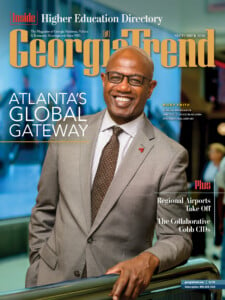
In addition to his work with Big Brothers Big Sisters, Kwame Johnson is the author of The Hope Inside: Harnessing the Power of Mentorship in Life and Career. He was named one of Georgia Trend’s 40 Under 40 in 2020.

Photo credit: Daemon Baizan
How does your passion for mentorship shape your work?
My passion comes from an unfortunate situation – when I was 17, [and] I had to go to prison. Mentorship actually gave me a second chance at life. In prison, I met young men whose stories still stay with me. I found my passion in that tough moment and made a promise to those young men that I would not forget them. This led me to college and then into the youth development space.
For my entire adult life, I’ve worked on the behalf of young people. I consider myself not a CEO, but a defender of potential, and that is what mentoring is. Everybody – you, me, any adult who’s doing something with their life – had someone defend their potential. And that is where my passion came from. I wouldn’t trade [my past] for the world because it’s where I found my passion, and that’s what’s fueled me over these 25 years.
 What has your leadership taught you about building and impact?
Our growth has really been about innovation, and it’s a big part of my leadership approach. What I’ve infused into [Big Brothers Big Sisters] is to innovate and to listen to the community. Those are two key things I learned going through this process of becoming a leader, and that is why we’ve been able to grow with new programs.
Four years ago, we launched this new innovation called Level Up, which actually has a paid mentor working with kids in school buildings every day. The results have been amazing around suspensions, attendance, academics. We’re now in six middle schools with this model in Atlanta, Clayton and DeKalb.
What do you think Georgia leaders need to understand about the challenges facing the next generation?
In my opinion, the biggest challenge we face as a city, as a state and as a country is poverty. It is the most wicked issue we face in this country.
Think about crime and violence, drugs, homelessness. All these issues are … byproducts of poverty. So if you solve poverty, you solve all those other issues, and the fastest way out of poverty is a high school diploma.
And what I would also say is that poverty is not a Black and brown issue. It’s an everybody issue. So my pitch to leaders in this city, in this state, is to challenge them to think about how they are contributing to solve poverty. When we solve that problem, we solve a whole lot of other problems. But too often we think the problem is crime and violence. The root cause of that is poverty. You solve poverty, you solve crime.
What excites you about the future of mentoring?
I think that [in] Atlanta, and in Georgia, we have an opportunity to make mentoring a part of the fabric of what we do. If you study the etymology of the word “mentoring,” the word does not exist in every language. It’s [largely] a U.S. term. If you visit different parts of the world and talk about mentoring, they equate it to family. They don’t need the word because it’s just something they do. They mentor, they defend potential, they help their neighbor.
And my hope is that in Georgia, we can make mentoring the same thing that Southern hospitality is, where it’s something that we do, and we won’t need the word anymore. Because we all should be mentoring young people in some shape or form, which can start to move us towards solving poverty in [the state] by helping young people get to the next level.
Is there anything else you’d like to tell readers?
My shameless plug is that I always have kids waiting for mentors. I’ve got about 400 to 500 kids on a waiting list here in Atlanta.
I ask readers to sign up to be a Big because we need you to come and become a defender of potential and support a young person.