Dalton | Whitfield: Growing It and Loving It
Industry, Jobs, Livability
Sometimes an economic downturn can be the start of a transformation. That’s what happened in Dalton as it weathered the Great Recession and a global pandemic. Dalton and Whitfield County have nurtured a resilient and robust business community. While flooring remains paramount, with the area supplying over 70% of the world’s carpet, efforts to diversify the industry are paying off with a number of new manufacturers locating here over the last 10 years.

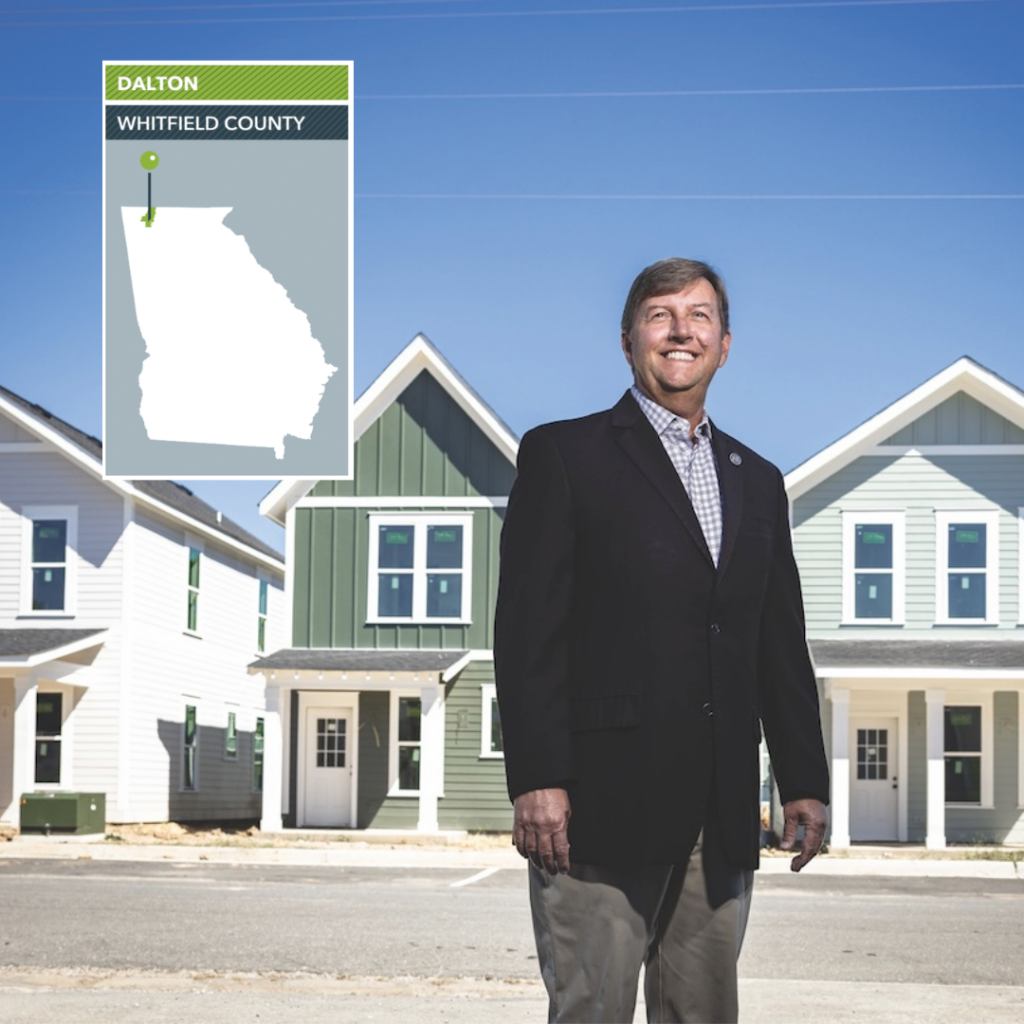
Flourishing Businesses: Carl Campbell, executive director, Dalton-Whitfield Joint Development Authority. Photo credit: Kevin Garrett
 “We’re actually seeing the results of the investment we’ve been working on for a long time,” says Carl Campbell, Dalton-Whitfield Joint Development Authority’s executive director. “We’re seeing businesses flourish and do their thing.” Since the shift began 15 years ago, the county has welcomed thousands of new jobs. Campbell points to Qcells, manufacturer of solar panels, the fourth-largest employer behind Shaw, Mohawk and Engineered Floors. Qcells opened in 2019, attracted by Dalton’s workforce and manufacturing history. Starting with 750 employees and 1.7 gigawatts of annual solar-module capacity, the company has expanded three times – investing a total of $2.8 billion. Today it employs about 1,800 people and can produce 5.1 gigawatts of solar modules annually. Together with Qcells’ newer Cartersville operation – the first and only solar factory in the U.S. that produces every major component of a solar panel under one roof and the only factory like it outside China – the two Northwest Georgia plants are expected to employ about 3,800 people and produce 8.4 gigawatts of solar modules annually. That’s enough energy to power roughly 1.3 million American homes for a year.
Since opening in 2016, Sustainable Corrugated has grown into a multistate business and this year joined longtime affiliate Jackson Paper Manufacturing under the new Sustainable Corrugated & Containerboard name. The companies had long operated under common ownership and shared leadership and are now acting as a unified entity. Its plant remains in Dalton.
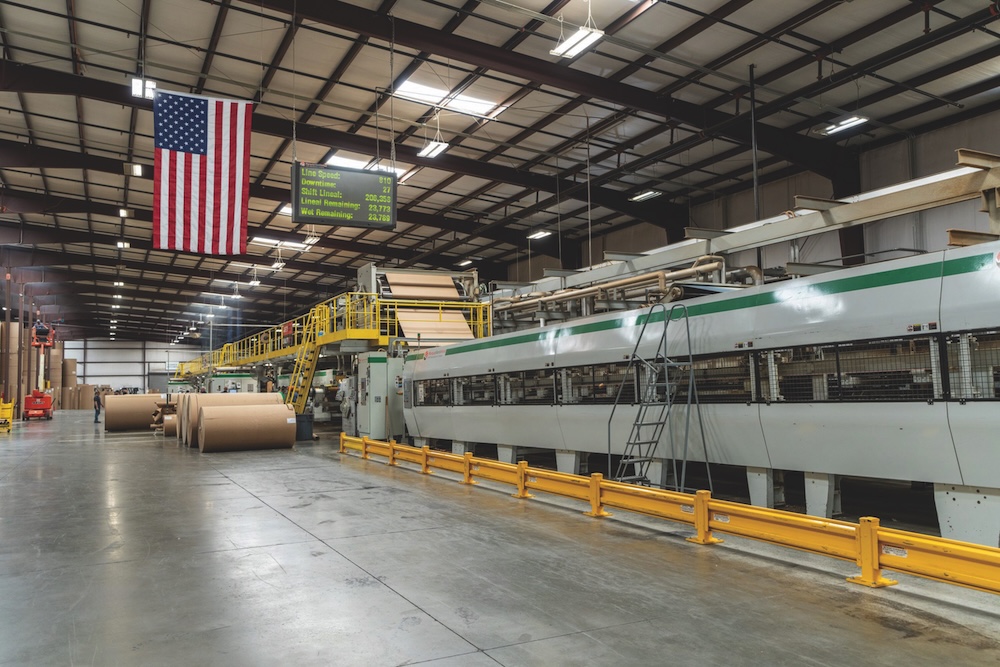
Unified Identity: Sustainable Corrugated has joined longtime affiliate Jackson Paper Manufacturing under the new name, Sustainable Corrugated & Containerboard. Photo credit: Contributed
German automotive supplier GEDIA opened in Dalton in 2020, making structural parts and assemblies for Mercedes-Benz, Volvo, BMW and more. The plant was built initially around Mercedes’ EQE and EQS vehicles. After President Trump was elected in 2024, he enacted new policies, including the expiration of federal electric vehicle tax credits for any vehicles purchased after September 30, 2025. That meant sales started to go down.
“Everybody was putting a lot of money into the holy EVs, and the EVs didn’t take off,” says Michael Lehmann, CEO of GEDIA North America. Rather than shut down, GEDIA adapted. He says the company had expected to have 200 employees by now but instead it has 90. But, he says, “We are working on a lot of new programs, and we hope that by 2028, 2029, we’re going to ramp up here again and have this facility filled and even have plans to expand here.”
Lehmann says the company chose Georgia for its business environment and Dalton for its central location among major automakers. GEDIA, says Lehmann, “fits right into” Dalton’s diversification story.
“When a company gets that first punch in the nose, and they get up and dust themselves off and say, ‘What do you do next?’ then you know you’ve done something right,” Campbell says.
The joint development authority’s strategy is no longer about landing a blockbuster employer, he says. It’s building a diverse economy.
“If I bring one company to hire a thousand people, and they go under, I just lost a thousand jobs,” he says. “If I bring 20 companies that hire 50 each, and one of them goes under, I’ve still got 950.”

Job Generator: Qcells, a manufacturer of solar panels, is the region’s fourth-largest employer. Photo credit: Contributed
That strategy continues. Marvin, formerly Marvin Windows & Doors, is adding a distribution center in Dalton, bringing about 60 jobs, according to the JDA.
Data centers continue to be part of Dalton-Whitfield’s mix – with two companies and several facilities within Dalton and one under construction outside the city that will bring about 75 jobs.
Trucking and logistics company TCW first arrived in Dalton in 2018, providing container transit to and from the Appalachian Regional Port, Northwest Georgia’s inland port in Murray County. TCW has outgrown its leased space and is now building its first permanent facility in Dalton, a nearly 11,000-square-foot terminal and a nearly 5,000-square-foot maintenance and wash building. TCW says the new facility is expected to open in April 2027 and will have 50 employees, including drivers, technicians and office staff.
Not long before TCW’s arrival, the floor covering industry recovered and expanded, and remains the dominant industry. In 2013, Shaw Industries invested $100 million to both streamline its distribution network and expand its fiber extrusion facility, adding around 175 jobs; Mohawk, following its 2015 acquisition of the IVC Group, invested $100 million into capital and infrastructure, creating approximately 200 jobs; and Engineered Floors opened a 550,000-square-foot carpet tile manufacturing plant in 2017.
It’s All About Growth
Diversifying the economy has addressed one problem. Now, community leaders are trying to solve the next one – turning economic growth into population growth. Over the past 12 years, population growth in Whitfield County has effectively flatlined. That’s spurred new priorities: housing, quality of life and attracting new residents.

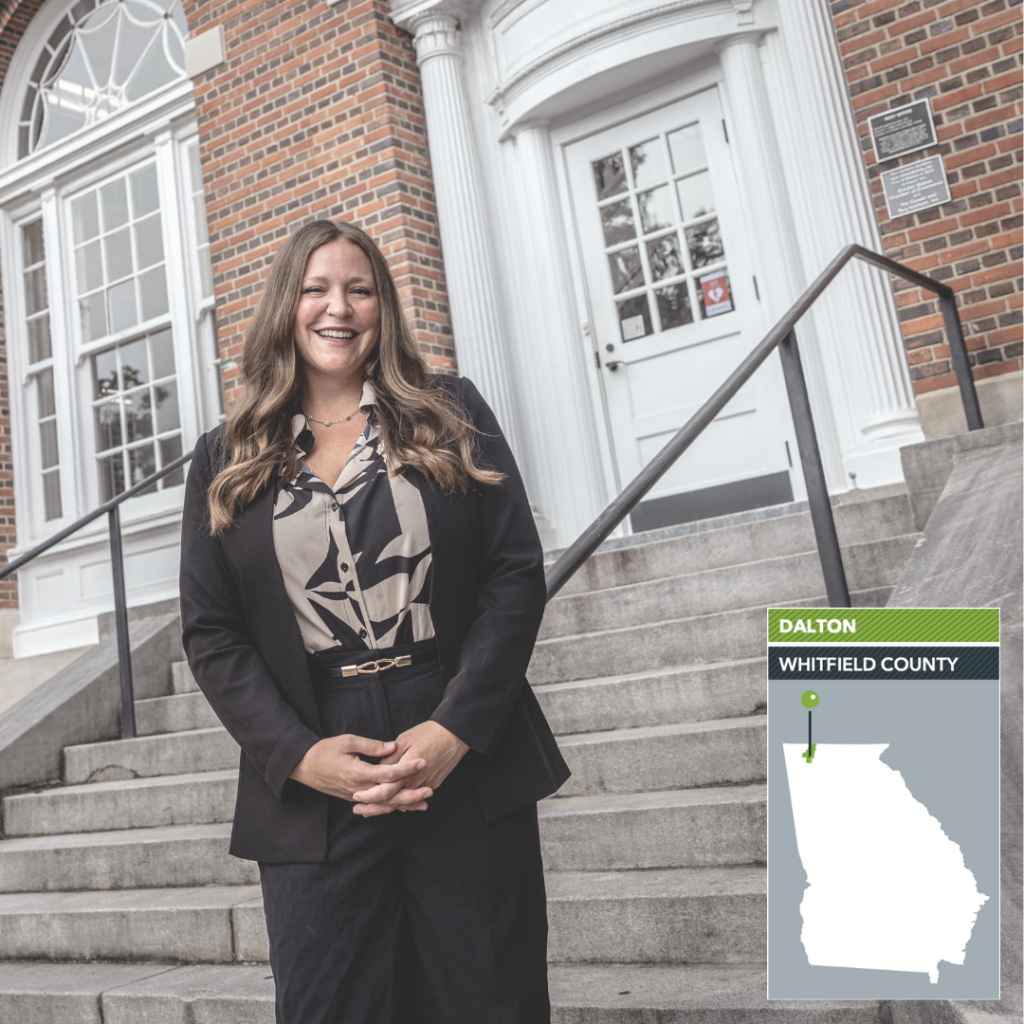
Quality of Life: Anna Adamson, dual executive director of Believe Greater Dalton and Flooring Capital Development Corporation. Photo credit: Kevin Garrett
“We need to wrap our arms around the need for population growth,” says Anna Adamson, dual executive director of Believe Greater Dalton, the development arm of the Greater Dalton Chamber of Commerce, and the Flooring Capital Development Corporation, a nonprofit that focuses on housing. “For a smaller community, growth can be scary, but it can be good growth. It can be thoughtful.”
During the same 12-year period, the county added more than 4,000 jobs but fewer than 400 housing units – roughly one home for every 10 jobs. Thousands commute into Whitfield daily but live elsewhere, which means Whitfield gets no property tax revenue but all the traffic costs.
Community leaders, including nontraditional partners such as the JDA and Hamilton Medical Center, are working together to creatively address the bottleneck in the housing market.
Sandy McKenzie, president and CEO of Hamilton Medical Center, says over the last few years the hospital has added 30 apartments for their medical residents and leased Hamilton-owned land to a developer for 218 luxury apartments. She says they “don’t want to be in the housing business,” but they do want to be part of the solution. “In order to be a thriving community,” says McKenzie, “we’ve got to have population growth.”
Years of studies, grant-writing and development are now paying off. “We’re finally seeing houses and the apartments come out of the ground,” says Adamson. This past year, those projects include 40 affordable houses through a $1.5 million grant to the JDA from Rural Workforce Housing Initiative funds, and 90 low-income apartments. An in-design project will add nine houses around a lower-infrastructure-cost courtyard design. Each addition, says Adamson, expands the county’s property tax base. “We just have to keep chipping away at it,” she says.
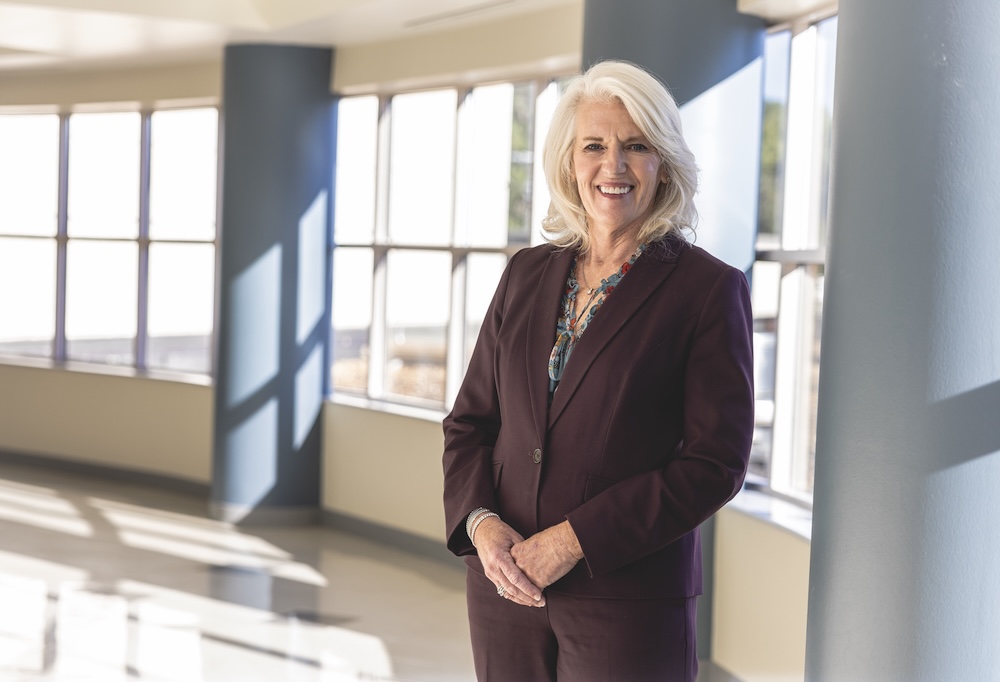
Part of the Solution: Hamilton Medical Center President and CEO Sandy McKenzie. Photo credit: Kevin Garrett
Greater Dalton Chamber of Commerce acting president Stephani Womack says the city has brought nearly 900 apartments online in the last 18 months. “It’s wild, but we have new housing in all parts of our community.” She calls that progress “life-changing stuff.”
Nearly four in 10 Whitfield County residents are Hispanic, putting immigration policy among the issues facing the community. “The majority of Hispanics encountered by the Sheriff’s Office are either U.S. citizens or those who have legal status to remain in the United States,” Captain Wes Lynch of the Whitfield County Sheriff’s Office said in an email.
By law, Georgia is not a sanctuary state and, according to Lynch, has routinely reported arrested undocumented immigrants to Immigration and Customs Enforcement. Lynch says his office has seen an increase in those transfers to ICE in the current administration.
Calling Dalton “Home”
When Bruce Frazier, communications director for the city of Dalton, first arrived in 2008, he went to Chattanooga on Friday and Saturday nights. “There’s still great things to do up in Chattanooga,” says Frazier, but now, there are great things to do in Dalton. He and his wife eat at one of the many new restaurants or attend the Off the Rails summer concert series at Burr Park. “We don’t leave downtown anymore,” says Frazier.
That’s exactly what city leaders want. Believe Greater Dalton’s Adamson says attracting new residents requires strategically “leaning into what we have to offer” as a smaller community located between Chattanooga and Atlanta. “We’re in a position now where we are capturing population that really wants that balance of quality of life.”
The efforts to improve livability are visible throughout Dalton-Whitfield: in a newly renovated rec center, paved trails, ongoing downtown revitalization with additional public artworks and renovated storefronts through an expanded façade grant program. Construction on a new community center is also in the works.

Life-Changing Progress: Stephani Womack, acting president of the Greater Dalton Chamber of Commerce. Photo credit: Kevin Garrett
Infrastructure projects are also boosting livability, including a record paving of 30 miles of county roads three years in a row, according to County Commission Chair Jevin Jensen.
And city of Dalton’s Frazier says they’re now a quarter of the way through a 30-project stormwater plan announced in 2023. He says the city, which was founded in 1847, had been developing for decades without a plan. While Frazier says stormwater management may not be exciting, the improvements have been like “flipping a switch” in some neighborhoods. One resident whose yard often flooded with knee-deep water during heavy rain now reports that “nothing happens when it rains.”
Adamson says the public investment has spurred private investment in housing, businesses and the redevelopment of older properties. As a result, city leaders are now revising a 2025 master plan to focus on what Adamson calls the “urban core” and adapting their master plan given the private development happening on its own. “It’s been really neat to see the private side already picking up some of those recommendations that the master plan included,” says Adamson.
Quality-of-life investments are also paying dividends in tourism. Margaret Thigpen, executive director of the Dalton Convention and Visitors Bureau and the Dalton Convention Center, says hotel-motel tax revenues are running 13% ahead of last year, fueled primarily by sports tournaments and convention business. Thigpen says Dalton is increasingly attracting groups from nearby Atlanta and Chattanooga that are seeking a smaller, more compact destination with easy access via Interstate 75.
Sports remain Dalton’s tourism niche. Tournaments and events such as the summer concerts, this past summer’s 250th celebration and the Christmas tree lighting generate an estimated $10 million in economic impact, according to Thigpen. And while the city’s Soccer Town identity has grown largely from the success of local high school teams, Thigpen says baseball and softball currently drive tournament tourism.

New Housing: Walton Fields is a mixed-income and affordable housing apartment community that will begin leasing in the spring. Photo credit: Contributed
The same amenities that attract visitors are also part of a broader effort to make Dalton a place where people want to stay. Chamber COO Womack says livability is increasingly about not just attracting but also retaining residents.
“Our employers are also asking deeper questions about the community surrounding [their] investment,” she says. As a result, she says she’s become intentional about in-person meetings so “we’re better able to connect dots across our community” – identifying holes in education, retail, workforce and housing.
“Instead of us working in different silos across the community,” says Womack, “it’s pushing us closer together so that we can continue to help the entire community rather than just one piece of it.”
Investing in People
Workforce development is increasingly starting before students even enter college. Through Future Fest, the Chamber introduces every 11th and 12th grader in the county to local career opportunities. In February, more than 60 employers and local colleges participated, showing students both jobs available directly out of high school and careers they can return to after college.
Womack says employers are eager to participate rather than wait for workers to arrive. “They want to be a part of the solution.”
Nowhere is cross-community collaboration more apparent than at Dalton State College, where enrollment has grown nearly 30% over the past four years.
President John Fuchko says while artificial intelligence is causing a major economic shift, Dalton-Whitfield must still attract talent.

Outdoor Fun: The Off the Rails concert series is held in Dalton’s Burr Park on Fridays in the summer. Photo credit: Contributed
“We’re going to be in competition with the rest of the country to attract people,” he says. “People drive everything else.”
That means giving people reasons not only to come to Northwest Georgia, but to stay.
“We’ve got to have those fundamentals in play so that our talent, our people will stay here, they’ll work here, they’ll thrive here, they’ll live here, they’ll raise families here,” says Fuchko.
One way Dalton State is working to keep that talent local is through a new partnership linking Dalton State, Georgia Northwestern Technical College and Murray County Schools with Hamilton Medical Center and AdventHealth. Qualified graduates of healthcare pathways at the schools are guaranteed a job interview with the two healthcare providers, creating a clearer path from classroom to career.
Dalton State is also expanding the pipeline itself. With support from the University System of Georgia, private partners and a Georgia Board of Health Care Workforce grant of $500,000, the college has added roughly 114 slots to its nursing programs. Hamilton provides an employee to help with clinical instruction, and AdventHealth is preparing to do the same, according to Fuchko, who expects nursing capacity to grow another 40% to 50% over the next couple of years.

Attracting Talent: John Fuchko, president of Dalton State College. Photo credit: Kevin Garrett
For him, partnerships like these are part of Dalton State’s role in building the community it will need decades from now. “One way or another,” he says, “we’re competing for people.”
Georgia Northwestern Technical College President Heidi Popham says their biggest challenge is continuing to build a strong, sustainable talent pipeline as experienced workers retire and employers adopt new technologies. “We must prepare more students and adult learners for high-demand careers, while also helping current employees continually update their skills,” she said in an email. The technical college has expanded its construction management program to the Whitfield Murray Campus, as enrollment had nearly doubled in 2020 going from 28 to 54 students and then increased to 70 students in the next five years. Industry demand is also driving growth in programs for healthcare, automation, diesel technology, engineering, precision manufacturing and welding.
Popham says the school is now constructing a commercial driver’s license training facility on the Whitfield Murray Campus and will begin accepting students in January 2028. The facility should provide a pipeline of drivers for local companies like TCW as operations at the Appalachian Regional Port continue to grow. Through the first five months of fiscal year 2026, the inland port processed more than 20,000 containers, up 20% from the same period a year earlier.
Hamilton Medical Center’s investment in workforce and community building is another piece of the Dalton-Whitfield growth puzzle. Earlier this year, the medical center received a Level 1 Emergency Cardiac Care Center designation by the Georgia Department of Public Health, providing the highest level of emergency cardiac care. It’s one of only two Level 1 facilities in Northwest Georgia, firmly establishing Hamilton’s regional importance.

Talent Pipeline: Georgia Northwestern Technical College has a program in automation engineering technology. Photo credit: Contributed
Vitruvian Health, Hamilton Medical Center’s health system, is also expanding its regional reach from its Dalton base. A new facility under construction in neighboring Murray County will provide urgent care and specialty services, including cardiology and endocrinology, when it opens in summer 2027. McKenzie says the medical center also plans to restore inpatient pediatric care in 2027; it had been discontinued during COVID-19.
Like Dalton State, Hamilton Medical Center is investing in its own talent pipeline. Internal and family medicine residency programs launched in 2020 have so far produced 11 physicians who stayed to practice locally, with a 12th signed to join next year, according to McKenzie. Last year, the medical center also welcomed back its first medical resident who left the community for fellowship training and returned to practice.
For McKenzie, those investments reflect the same collaborative approach evident elsewhere in Dalton and Whitfield.
“We’re all very well connected in how we work together,” she says. Hamilton Medical Center is “big enough to do a lot of things that our community needs, but we’re small enough that we all know each other.”
Challenges remain. McKenzie says Hamilton is already seeing an increase in uninsured patients, including people who earn too much to qualify for Medicaid but cannot afford health insurance, raising concerns that they will delay care until they are sicker and require more resources.

Future Forward
If this year’s story is less about splashy announcements than long-term investments beginning to show results, Adamson says that’s intentional. Dalton, she says, “is honoring the legacy that built our community while intentionally investing in its future.”
The JDA’s Campbell sees evidence of that future all around him – in industrial projects, new housing, recreation facilities and community improvements.
“I think the future of Dalton is bright,” he says. “We are growing, and we are improving. We’ve got things to fix and things we can do better, but things are good, and we feel good about the future.”
Local Flavor
One Stitch At a Time
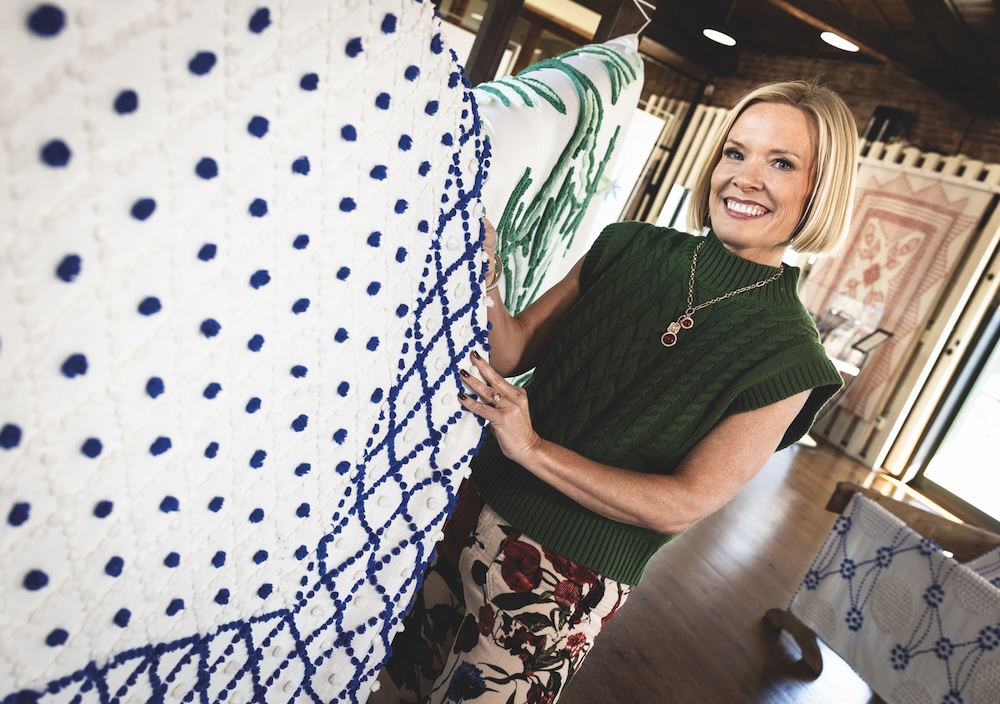
Fabric of the Community: Rachel Smalley, author of Tufted: The Stitch and Story of Catherine Evans Whitener. Photo credit: Kevin Garrett
Long before Dalton became known as the “Carpet Capital of the World,” it was simply another Northwest Georgia community where resourcefulness was a way of life. Dalton resident Rachel Smalley’s new children’s picture book, Tufted: The Stitch and Story of Catherine Evans Whitener, is not just a biography of an overlooked local pioneer. It’s a history of Dalton’s defining industry – and why that history still matters.
“Catherine’s life gives young readers evidence that important ideas can begin outside powerful institutions,” Smalley said in an email, “without wealth or connections, with ordinary materials, and in the hands of a young person willing to wonder, work and persist.”
In the mid-1890s, 15-year-old Catherine worked for three months to recreate a candlewick bedspread she had admired. She experimented until she rediscovered a tufting technique and eventually sold a bedspread for $2.50. She then taught others, whom she called her “thimble and needle ladies,” creating a cottage chenille bedspread industry that led to Dalton’s textile economy. Entrepreneurs adapted tufting principles for mechanized production, eventually giving rise to the carpet industry that made Dalton a global manufacturing center.
“Catherine did not simply find a way forward for herself,” said Smalley. “She built a door to opportunity and held it open for other women. She turned women’s work into women’s wages.”
Smalley says Catherine reverse-engineered the stitch, developed a method for transferring patterns to fabric and shared her patterns, including the popular peacock design. Women would hang their spreads for sale along the Dalton stretch of Highway 41, leading to the nickname “Peacock Alley.”
Smalley, a former teacher, nurtured her children’s book idea for 20 years before diving into the writing, editing and publishing worlds, ultimately deciding to fundraise and self-publish. She says Tufted has become a “community project.”
Believe Greater Dalton has supported Tufted’s release and promotion. Dalton Public Schools is giving the book to every student in grades 3 through 6. Smalley says proceeds will go to the Appalachian Historic Preservation Fund, a foundation to preserve the region’s history and stories.
Believe Greater Dalton Executive Director Anna Adamson says that while Dalton’s “Carpet Capital” story has evolved over the years, Tufted reveals something deeper.
“It’s the innovation and ingenuity of a people, and that doesn’t change,” says Adamson. “That is in the fabric of a community and those who call it home.”
It’s a fabric Smalley is helping to preserve.
“Go ahead,” says Smalley. “Pull the thread. ‘The Carpet Capital of the World’ unravels all the way back to a girl.”