Where Bio Meets Tech
Georgia’s engineering schools are pioneering exciting solutions and turning out a robust biomedical engineering workforce.

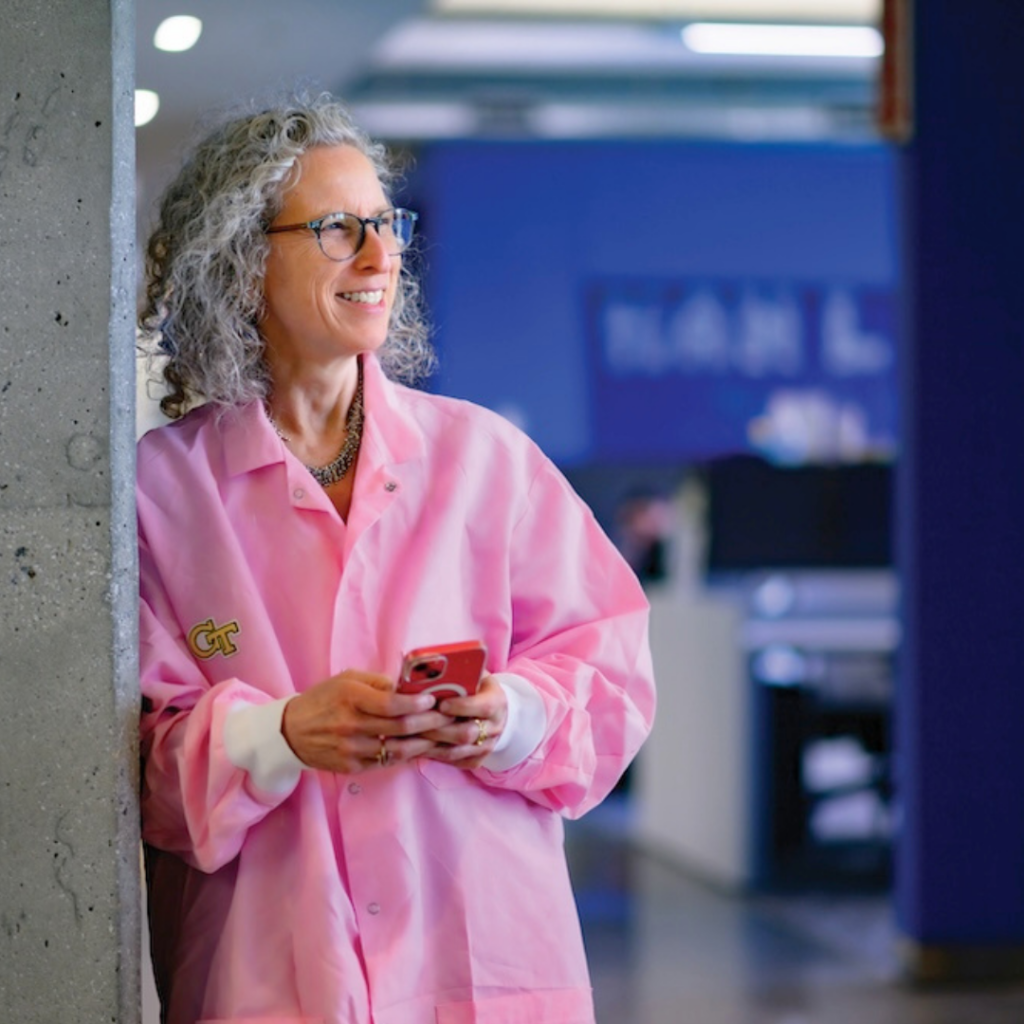
Understanding Medical Needs: Alyssa Panitch, professor and chair, Wallace H. Coulter Department of Biomedical Engineering, Georgia Tech and Emory University. Photo credit: Daemon Baizan
In March, Gov. Brian Kemp announced that Belgian-owned biopharmaceutical giant UCB was investing $2 billion to build its first U.S. pharmaceutical biologics manufacturing facility in Gwinnett County. The company plans to create more than 300 jobs over the next several years at Rowen, a 2,000-acre planned R&D community designed as a hub for companies in the health services, biotech, agriculture and advanced manufacturing areas.
Companies that will fill Rowen and other life sciences districts – such as Science Square, located adjacent to Georgia Tech’s Midtown Atlanta campus – are counting on a steady stream of well-educated, highly skilled workers to fill the jobs they plan to bring or create. They’ll find plenty. Georgia colleges and universities are home to some of the most respected and innovative biomedical engineering (BME) programs in the nation.
Many of today’s medical breakthroughs rely on biomedical engineering, the intersection of biology and technology. The field typically employs translational research, also known as bench-to-bedside, which moves basic scientific discoveries from the lab into clinical applications to improve patient health. Each institution’s BME program reflects its priorities and characteristics and seeks to address challenges across industries and sectors.
“Because of the incredible importance of robotics in medicine, we want to make sure that there are physicians who can innovate in that space and work with other engineers to improve robotics for healthcare.” – Alyssa Panitch, professor and chair, Wallace H. Coulter Department of Biomedical Engineering, Georgia Tech and Emory University
A Powerhouse Partnership
The Wallace H. Coulter Department of Biomedical Engineering at Georgia Tech and Emory University is a remarkable 25-year-and-counting partnership combining the strengths of two premier institutions: Georgia Tech’s singular leadership in engineering and technology, and Emory University’s recognized excellence in medicine and life sciences.
“We bring top engineering together with the [Emory] medical environment, and that partnership allows us to speak with clinicians, patients, their families, nurses, other caregivers, to really understand the unmet medical needs, and then improve on those needs,” says Department Chair Alyssa Panitch.
In addition to developing AI-driven healthcare solutions, researchers are working in a host of areas, including medical imaging, cell therapies and biomaterials.
“We do a lot [of research] with drug delivery and therapeutics. Two of our people, Gabe Kwong and James Dahlman, are leading in that area, [designing] drug delivery systems to hone in on the area of need and deliver the most drug there and spare the rest of the body so it doesn’t get some of the side effects we hear about on the drug commercials,” Panitch says.
Georgia Tech’s engineering expertise also aligns with the advancement of medical robotics, and, thanks to the partnership with Emory, a new Master of Science/MD dual degree program will begin in fall 2026. Students will earn a master’s in robotics with a focus on medical technology from Georgia Tech, then begin their research and go to medical school.
“Because of the incredible importance of robotics in medicine, we want to make sure that there are physicians who can innovate in that space and work with other engineers to improve robotics for healthcare,” says Panitch.
Stimulating A Different Response
Biomedical engineering students have the opportunity to engage in research projects that apply engineering perspectives to medical problems. Ming-fai Fong, an assistant professor and neuroscience researcher at Georgia Tech, and her students are seeking a solution to amblyopia, a problem commonly known as lazy eye. Currently, people wear a patch or use eye drops to blur vision in the good eye and force use of the weaker eye. When these treatments happen in early childhood, they’re often successful. But without early eye exams and treatment, the problem persists and can lead to vision loss.
The problem lies in the brain, which learns to turn off signals from the affected eye. But research shows that people who have later lost vision in the unaffected eye due to disease or injury often regain use of the “lazy” eye. Because sight is essentially the brain’s response to visual stimulation, Fong wondered whether the condition could be treated by harnessing the brain’s natural neuroplasticity, the ability to reorganize its structure, functions and connections in response to new information, experience or injury.
“We know the brain has this capacity,” says Fong. “Maybe it becomes more difficult as kids age, but we’re inspired by the idea that adults retain the capacity for neuroplasticity also. We just have to figure out different ways to tap into it.”
One hypothesis Fong considered, based on research, was simulating the loss of the unaffected eye by anesthetizing it to force reliance on the “lazy” eye.
“If we simulate loss of the eye for a long enough period of time, the brain thinks it has to now rely on the only eye that’s left,” says Fong. “The fact that it was efficacious in the lab setting, and we have these clinical cases in which people actually lost their [unaffected] eye and then had improvements, gives us a lot of confidence to push through.”
Fong says many of her students are interested in taking their research beyond academia into industry, R&D and medical training upon graduation, and most hope to remain in Georgia.

Improving Cardiac Care: Lakshmi Prasad Dasi is a professor of biomedical engineering in the Wallace H. Coulter Department of Biomedical Engineering and a researcher in cardiovascular engineering. Photo credit: Contributed
An Ecosystem Exploding With Solutions
The combination of resources from the Emory and Georgia Tech partnership serves as an accelerant for innovation in biomedical engineering, says Lakshmi Prasad Dasi, a professor of biomedical engineering in the Coulter Department and a researcher in cardiovascular engineering.
“When you have doctors and engineers working within the same umbrella, you have organically created an environment that can explode with solutions,” he says. “From Day 1, when someone decides to solve a problem, it’s not their own bubble. They’re identifying the problem and developing the solution together. And there are a lot of resources available.”
Dasi moves seamlessly between the worlds of education and medical device innovation, with a particular focus on congenital heart disease. He has launched two startups. The first, Dasi Simulations, is a patient-specific modeling software that helps cardiac surgeons make surgical decisions by predicting the likelihood that certain complications may occur during operations. More than 160 hospitals use the product, which has received FDA clearance. His second startup, YoungHeartValve, was co-founded in 2020 to develop heart valves made of longer-lasting polymeric biomaterial, a combination of synthetic and natural materials designed to integrate with the body’s systems, rather than relying on expensive valves made from animal tissue, which rarely last beyond a decade.
Dasi’s lab is funded by grants from the National Institutes of Health, the American Heart Association and the Department of Defense and staffed by 13 graduate students and postdoctoral researchers.
“Students work towards their graduate degrees while developing the technology, and then they become experts by the time they’re ready to graduate or go to the next phase of their career,” says Dasi. “They have already done something very impactful, but they themselves are the biggest resource that’s going out because they are now the experts, future leaders who can go out into the industry and make an impact.”
Capstone: Fulfilling Unmet Needs
In August 2025, Thanmayee Kavuri and Saif Khan partnered with two other fourth-year biomedical engineering students to form RECUVERY, a Capstone Design project aimed at addressing an unmet clinical need. Capstone teams identify challenges with industry leaders and clinicians, offer solutions, receive feedback, iterate and engineer concepts. The RECUVERY team worked with a radiology team from Emory on the problem of what’s delicately called “retained surgical items,” such as a sponge left inside a patient’s body after surgery. This is a potentially life-threatening issue, especially in places where access to quality medical services is unreliable.

Challenge Accepted: Georgia Tech grads Saif Khan and Thanmayee Kavuri partnered with other students to design a system for tracking sponges to ensure they are removed from a patient’s body after surgery. Photo credit: Daemon Baizan
“It’s about a 1 in 10,000 chance of it occurring in the United States because [surgeons] have such great technology,” says Kuvari, who, along with Khan, graduated from Georgia Tech in 2026. “But we learned that this occurs at a 1 in 300 rate in low and middle-income countries because many [hospitals] don’t have access to intraoperative X-ray.”
The RECUVERY team designed a two-part tracking solution. First, a surgical sponge is sewn with biocompatible ultraviolet-reflecting threads, visible under a low-cost flashlight. Second, a surgical nurse attaches a magnetic clip to the used sponge after removal from the patient’s body, then clips it to the visual organizer, a rack that tracks sponges as they are removed.
The team had to do a time-consuming patent search.
“We ran into a lot of problems related to which parts of our ideas were patentable, which parts of our ideas had ‘freedom to operate,’ the term used for whether or not you’re infringing on someone else’s patent,” Khan says. “These are the things that we’re taught to consider because if you’re infringing on someone else’s idea, you don’t have an idea.”
The RECUVERY team prototyped UV threads in Georgia Tech’s BME Design Shop, then Kavuri and her mother hand-sewed the threads into the sponges. Next came the real test: soaking the sample sponges with blood. After calling area butcher shops, the students drove to Stone Mountain to purchase pig’s blood for their test.
“It’s much more accurate than dye because it matches what’s in the human body in terms of opacity, viscosity and there are still cells in there,” Khan says. “If we were to shine a UV light on it, and all the blood shone with the threads, then our device is useless.”
In January, the RECUVERY team traveled to Ecuador to gather field intelligence, observing multiple surgeries each day in a range of settings. They came away more convinced of the efficacy of their product and decided to continue developing their Capstone through their final semester of BME studies.
“Patients need access to safe surgery,” Khan says. “I think that’s what our project is really focused on, making that surgery and that experience more dignified and [safer] for patients.”
“When you have doctors and engineers working within the same umbrella, you have organically created an environment that can explode with solutions. From day one, when someone decides to solve a problem, it’s not their own bubble. They’re identifying the problem and developing the solution together.” – Lakshmi Prasad Dasi, professor of biomedical engineering and associate chair for undergraduate studies, Georgia Tech
Taking a Different BME Tack
The opportunity to explore practical solutions to real-life challenges through a biotech lens isn’t just for graduate students. In 2023, Augusta University received approval to introduce a bachelor’s degree in biomedical systems engineering, the first such program in Georgia.
“To my knowledge, there’s nothing like it in the United States,” says Jeffrey Morris, the program’s director. By focusing on systems, he says, the program is quite different from biomedical engineering, which is the study and design of medical devices.
The biomedical systems engineering program at Augusta University instead addresses the critical issue of securing medical devices, healthcare data and systems, which Morris says is more relevant than ever. So is the need for skilled workers who understand the breadth of healthcare security issues.
“You hear about medical organizations being breached,” he says. “We’ve done all kinds of projects; we were able to hijack hearing aid audio channels. Yet there’s no [federal] cybersecurity requirement for any of these device types. Most medical organizations don’t have the knowledge or the budget to hire cybersecurity-specific people, and there’s a shortage of individuals with any type of experience in this space.”
Rather than educating a student with medical training to become a cyber specialist, Augusta University leans into another core strength: graduating systems engineers with a focus on cybersecurity in healthcare.
“We start off teaching them systems engineering and secure system design, then they get a background in math, physics and electrical systems,” says Morris. “Then they go over to the allied health department, where they learn about health informatics and health law. Finally, in their senior year, they learn healthcare-focused cybersecurity, along with general cybersecurity and a series of electives.”
Students train with faculty from the Medical College of Georgia, Wellstar MCG Health Medical Center and other local healthcare organizations. The Georgia Cyber Innovation and Training Center provides cybersecurity services to rural hospitals that cannot afford their own security teams. Augusta University BSME students will have opportunities to intern with the cyber center. Morris is hunting for other healthcare-related industries where his students can train.
“We want to provide every student with some type of internship or experiential learning before they graduate,” says Morris.
“Maybe it becomes more difficult as kids age, but we’re inspired by the idea that adults retain the capacity for neuroplasticity also. We just have to figure out different ways to tap into it.” – Ming-fai Fong, assistant professor and neuroscience researcher, Georgia Tech
Interdisciplinary Program
Mercer University in Macon has long had a successful biomedical engineering department that educates students, many from rural Georgia. It offers opportunities for applied research and prepares students to become part of a highly skilled workforce. The program’s scale – four dedicated BME faculty within the larger school of engineering – is smaller than Georgia Tech’s, but its size is viewed as a positive differentiator.
“Mercer’s biomedical engineering program was, for a long time, the only other program besides Tech’s,” says Joanna Thomas, associate professor and chair of the biomedical engineering department in the College of Engineering. “We offer a unique place and faculty-to-student ratio for students. Our students are known entities to us from Day 1.”

Unique Place: Joanna Thomas, associate professor and chair of the biomedical engineering department at Mercer University’s College of Engineering. Photo credit: Matt Odom
Thomas describes Mercer’s program as interdisciplinary because students earn a BME specialization rather than a BME degree.
“Their degree is strictly engineering,” she says, “So they come out with a lot of core experience in mechanical and industrial [engineering]. Those are very applicable when they are looking into jobs that require a combination of skill sets, like the biomanufacturing jobs. Our students thrive in the medical device industry. They come out with such a strong skill set in both mechanical, electrical and BME. And a lot of our students are graduating with international experiences and design-on-the-fly type experiences.”
Thomas attended a conference where industry leaders discussed what they were looking for in engineers.
“They said, ‘All engineers learn calculus; they all learn thermodynamics. I want the engineer who has the interpersonal skills for the technical work and the ability to interface with the other parts of the company,’” she recalls. “Because we have small class sizes, faculty members can emphasize those [skills] in our courses. That makes for different graduates with different skill sets than those coming from other universities.”
A BME Bulldog Scales Up
The majority of the University of Georgia’s biomedical engineering students, particularly the graduate students, pursue industry roles in biotech or medical technology companies. Others take a different approach, says Eduardo Silva, professor and chair of the School of Chemical, Materials and Biomedical Engineering.

Different Approach: Eduardo Silva, professor and chair of the University of Georgia’s School of Chemical, Materials and Biomedical Engineering, holds a prototype of a nonhormonal contraceptive ring that his lab is developing. Photo credit: Daemon Baizan
“I have a former grad student, for example, who is in law school because she’s very interested in patent law and wants to take advantage of these two hats, her Ph.D. hat looking into technologies and another, more law-oriented way,” he says.
Seeking insight into workforce trends to align the curriculum is a priority for the BME department. The faculty regularly convene an industry advisory board during the academic year to make adjustments.
“Our students thrive in the medical device industry. They come out with such a strong skill set in both mechanical, electrical and BME. And a lot of our students are graduating with international experiences and design-on-the-fly type experiences.” – Joanna Thomas, associate professor and chair of the biomedical engineering department, Mercer University College of Engineering
“We cannot be an island,” Silva says. “We cannot say ‘Oh, [industry and the broader external ecosystem] will follow us.’ It needs to be balanced. We need to be open, not close ourselves into our silos, which is a common issue in academia. At the same time, universities play a critical role in leading innovation and exploring ideas that may not yet be on industry’s immediate horizon.”
For example, leaders of the BME program learned that industry leaders were concerned that students were not receiving adequate training in the ethical use of artificial intelligence as a tool. The information was incorporated into the curriculum, but for students who want or need more AI training, two undergraduate certificates in AI (Language, Minds and Machines, and Pharmaceutical Sciences) will also be offered in fall 2026 through the university’s Institute for Artificial Intelligence.
Another connection opening in fall 2026: UGA’s new School of Medicine.
“We see ourselves as a bridge connecting engineering innovation with clinical needs, and our students see exactly the same path,” Silva says. “It creates opportunities for collaborative research and translational projects, especially for our capstone students. I think as the medical school develops, this connection will become even stronger and more integrated. We are in a growth phase. We are being very intentional about where we are investing and building our program. I’m looking forward to what the future brings to us.”