Rethinking Lung Cancer
From precision therapies to advances in early detection, new approaches are reshaping how the disease is diagnosed, treated and understood.

Specialized Regimen: Natalie Pawelski takes a pill designed to specifically attack cancer cells that have the genetic mutation connected to her cancer. The treatment allows her to continue her favorite activities, like hiking. Photo credit: Daemon Baizan
When Natalie Pawelski hikes the trails of the Chattahoochee National Recreation Area or sings in her church choir, no one would guess she is living with stage IV lung cancer.
“Most people think that means you’re going to die next Tuesday,” she says. “[They] think that means you look or act sick – and I don’t.”
For Pawelski, a mom, business owner and former CNN correspondent, the lung cancer diagnosis came in August 2024 after an early morning trip to the emergency room for chest and shoulder pain she feared might be a heart attack.
Scans showed the cancer had already spread beyond her lungs, including to her bones. As a lifelong nonsmoker and avid hiker who had recently trekked in the Rockies, she seemed like the least likely person to be receiving such news.
“I yelled at the doctor and said, ‘No. I’ve never smoked. I have a child. I can’t leave,’” she recalls. “I knew what metastatic meant. I thought my life was over.”
But it wasn’t.
Further testing showed that Pawelski’s cancer was ALK-positive, a subtype of lung cancer linked to a particular genetic mutation. Identifying that mutation changed everything. Instead of traditional chemotherapy, she now takes a targeted therapy – a pill designed to specifically attack cancer cells with that mutation.
A New Era of Treatment
That Pawelski has never smoked underscores a question that researchers are still working to better understand: How does lung cancer develop in people without a history of smoking? In Georgia and across the Southeast’s “tobacco belt,” the disease is still most often linked to tobacco use. Yet an increasing number of nonsmokers are being diagnosed.

Transformative Approach: Dr. Suresh Ramalingam, executive director of Winship Cancer Institute of Emory University. Photo credit: Winship Cancer Institute of Emory University
Pawelski’s story also shows how much treatment has changed. Lung cancer is no longer a single disease with one path, but a group of different conditions – many of which can be treated far more effectively than in the past. From targeted therapies and immunotherapy to advances in early detection and minimally invasive surgery, a new generation of treatments is changing what a lung cancer diagnosis can mean. “Lung cancer is the No. 1 cause of cancer death. It kills more people than breast, prostate and colon cancer combined,” says Dr. Allan Pickens, a thoracic surgeon and cochair of the Oncology Lung Cancer Steering Committee for Piedmont Healthcare.
But that reality is beginning to shift, says Dr. Kristin Higgins, a radiation oncologist and chief clinical officer for City of Hope Cancer Center Atlanta. “Lung cancer today is not the lung cancer your grandmother had. Treatment is better, much more personalized, and patients are living much longer,” she says.
“Primary care providers should be thinking about lung cancer screening the same way they think about breast cancer or colorectal cancer screening.” – Dr. April McDonald, pulmonologist and critical care specialist, Northeast Georgia Physicians Group
For a growing number of people, newer treatment strategies offered at centers across the state are not only extending life but doing so with fewer side effects than the chemotherapy-heavy approaches that once defined care.
Targeted Therapy: Precision Treatment

Tremendous Difference: Dr. Allan Pickens, a thoracic surgeon and cochair of the Oncology Lung Cancer Steering Committee for Piedmont Healthcare. Photo credit: Daemon Baizan
Drugs like the targeted therapy controlling Pawelski’s cancer represent one of the most important advances in lung cancer treatment – medicines designed to act on specific genetic changes that drive tumor growth.
This shift has fundamentally changed how doctors think about lung cancer. Rather than treating it as a single disease, they now recognize that tumors can be driven by different genetic changes – each of which may respond to a different treatment.
Using biomarker testing – which analyzes a tumor’s genetic makeup – physicians can identify these mutations and match patients with therapies tailored to those changes. This testing is now standard for many patients, particularly those with advanced disease, and often helps guide treatment decisions from the outset.
“Biomarker testing is one of the keys to making sure our patients live as long as possible after diagnosis,” says Higgins. These molecular insights allow clinicians to identify mutations that can drive cancer to grow and can serve as targets for treatment. Drugs called tyrosine kinase inhibitors (TKIs) – the drug type Pawelski is taking – work by blocking specific abnormal proteins created by these mutations. These proteins help cancer grow, so blocking them often shrinks tumors significantly and helps to control the disease longer. In some people, targeted therapies have helped people live for years while maintaining quality of life.
Some of these therapies can also penetrate the central nervous system, an important consideration given that lung cancer can spread to the brain. This has further improved outcomes by allowing physicians to better control disease in multiple parts of the body simultaneously.
By targeting the specific drivers of a tumor, these therapies can improve outcomes while helping people avoid unnecessary side effects and get to the most effective treatment more quickly.
Immunotherapy: Search and Destroy
Immunotherapy takes a different approach, working not by targeting the cancer directly but by helping the body’s own immune system recognize and attack it.
“Immunotherapy has made even very advanced forms of lung cancer treatable and has transformed the way we approach the disease,” says Dr. Suresh Ramalingam, executive director of Winship Cancer Institute of Emory University.

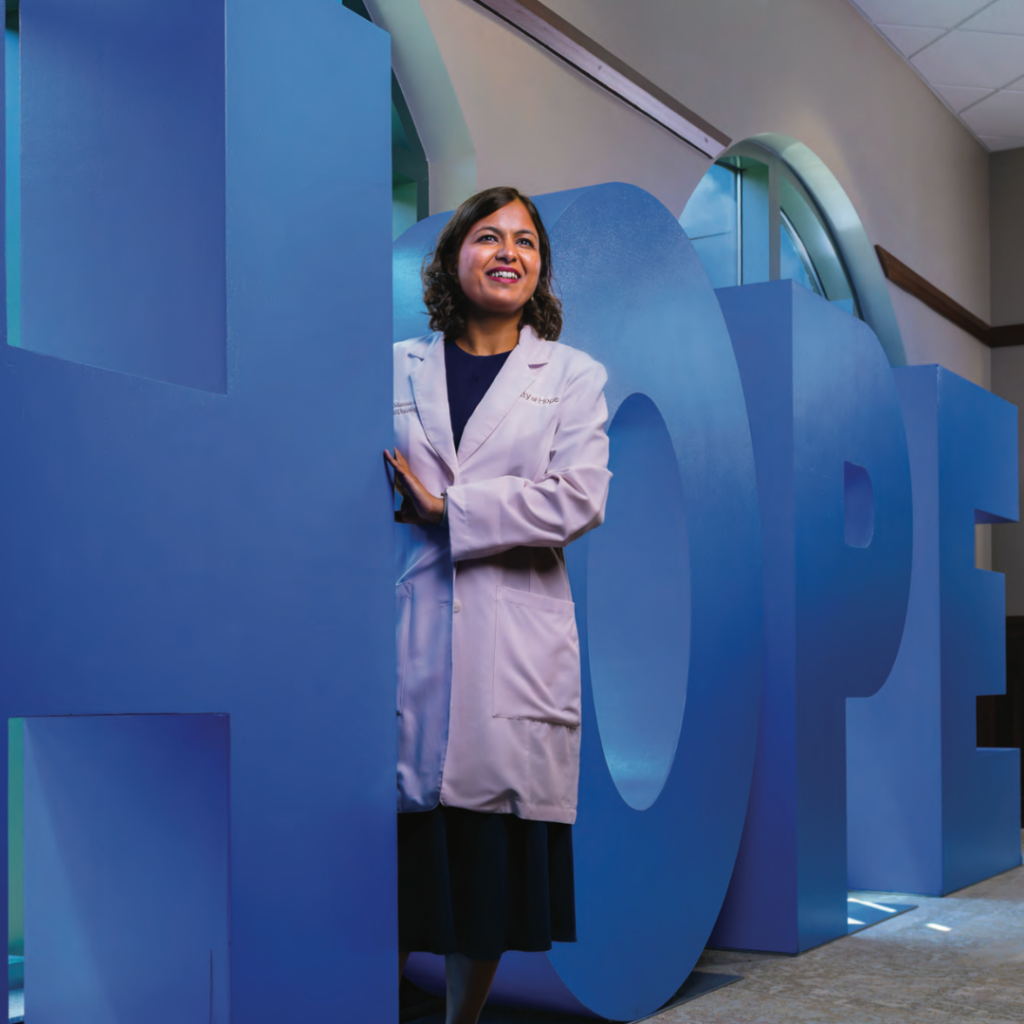
Longer Survival Rates: Dr. Kristin Higgins, a radiation oncologist and chief clinical officer for City of Hope Cancer Center Atlanta. Photo credit: Brandon Clifton
Cancer cells can evade detection by suppressing the immune response, so that the body does not recognize them as harmful. Immunotherapy drugs – particularly checkpoint inhibitors – help remove these “brakes” on the immune system, allowing the body’s own immune system cells to identify and destroy cancer more effectively.
Unlike chemotherapy, which targets rapidly dividing cells, immunotherapy works by strengthening the body’s own defenses. In some people, this can lead to long-lasting responses that continue even after treatment has stopped – an outcome that was rarely seen with older therapies.
“Immunotherapy has been transformative for lung cancer and has improved survival to levels we’ve never seen before,” says Higgins.
These therapies are now widely used in people whose tumors do not have genetic mutations that other drugs can target. And in some cases, immunotherapy is combined with chemotherapy or other treatments to improve outcomes.
The impact has been significant, with data showing steady improvements in survival over the past decade. While outcomes still vary widely depending on the stage at diagnosis and the biology of the tumor, the trajectory of the disease is changing in ways that were once considered unlikely.
“Five-year survival has improved dramatically – I think close to double – because of more effective systemic therapies like immunotherapy and targeted treatments,” Higgins says.
Chemotherapy: Long-term Care
For many people with lung cancer, targeted therapies and immunotherapy have helped turn what was once an aggressive, rapidly fatal disease into one that can be managed for a much longer time – often with fewer side effects than traditional chemotherapy.
At the same time, chemotherapy – long the backbone of lung cancer care – has not disappeared. Instead, it has evolved.
“When we talk about better therapies, we’re really thinking about two things: increasing effectiveness and reducing side effects,” explains Ramalingam, who specializes in lung cancer and other thoracic cancers. “Targeted therapies and immunotherapies have dramatically improved outcomes for many patients, but chemotherapy remains one of the cornerstones of lung cancer treatment.”
“There are many situations where we still use chemotherapy – sometimes in combination with targeted therapy or immunotherapy, sometimes on its own,” Ramalingam adds. “The good news is that modern chemotherapy can often be given without causing a significant decline in quality of life.”
In many cases, treatment now involves a carefully sequenced combination of therapies, tailored not only to a person’s specific tumor but also to how the disease evolves over time.
“For patients with more advanced forms of lung cancer, we often treat the disease as a chronic condition,” he says. “There are effective therapies that can keep the cancer under control for years.”
Treatment is increasingly tailored to the individual, often combining different approaches based on the stage of disease and a patient’s overall health. While surgery remains a key option for many patients with early-stage disease, other approaches may be used depending on individual circumstances.
“Lung cancer is the No. 1 cause of cancer death. It kills more people than breast, prostate and colon cancer combined.” – Dr. Allan Pickens, thoracic surgeon and codirector, Oncology Lung Cancer Steering Committee, Piedmont Healthcare
“In early stage, localized lung cancer, a high dose of ablative radiation therapy can be used as an alternative to surgical resection in patients who may not be surgical candidates due to other health conditions or in patients who decline surgery due to the risks or side effects of the operation,” says Dr. Isabella Zhang, radiation oncologist and co-medical director of the Gamma Knife Program at Northside Hospital. “This can often be delivered in just three to five treatments and may be more easily tolerated than surgery.”
In more advanced but nonmetastatic lung cancer that cannot be removed with surgery, radiation is usually used in combination with chemotherapy and followed by immunotherapy with the goal of long-term control and even cure of the lung cancer, Zhang says.
“In the setting of limited metastatic disease, there is growing evidence that adding radiation to systemic therapy can delay disease progression and prolong a patient’s life.”
Surgery: Better Tools, Better Timing
While new therapies have transformed outcomes, equally important is the progress in how lung cancer is diagnosed and treated surgically – advances that often determine whether a person has a chance at cure. Increasingly, these gains are being driven by minimally invasive and robotic procedures that allow physicians to both detect and treat lung cancer with greater precision and less trauma.

Better Biopsies: The Ion robotic bronchoscopy platform is designed to reach small nodules in lung biopsies. Photo credit: John Fellows/Piedmont Healthcare
“Earlier detection of lung cancer provides greater opportunity for cure with surgery,” says Pickens. “We’re able to detect these lung cancers at a smaller size before the tumor cells have an opportunity to break away and go to other locations.”
When tumors are caught before they spread, surgeons can often remove them completely – offering the possibility of long-term survival or cure.
This underscores the importance of identifying lung cancer early, when localized treatment can be most effective. In these cases, surgery remains one of the most powerful tools available.
In particular, the advancements in minimally invasive technology have made a tremendous difference in the care of patients with lung cancer, says Pickens.
“We’re able to address these cancers using small incisions … and have less trauma to the patient. They have a less painful recovery process, and they recover quicker and get back to their usual activities or work.
“They also are able to recover faster so that they can proceed with any additional therapies, such as the chemotherapy and immunotherapy if needed,” he adds.
Robots: Keys to Early Diagnosis
At the same time, advances in pulmonary medicine are transforming how lung cancer is diagnosed. Pulmonary medicine diagnoses and treats respiratory conditions including lung cancer, but also asthma, COPD and pneumonia, for example.
“Pulmonology as a specialty has always had an integral role in lung cancer, but particularly as robotics has come into play, it has been transformative to our field,” says Dr. April McDonald, a pulmonologist and critical care specialist with Northeast Georgia Physicians Group.
One example is robotic bronchoscopy, which uses a thin, flexible tube guided through the airways to reach small lung nodules that are hard to access, with much greater precision than before.
Improved access to these small nodules allows doctors to find lung cancer earlier, when there are often more treatment options and outcomes are better.
“The Ion robotic bronchoscopy platform has really transformed how we biopsy lung nodules,” McDonald says. “It allows us to reach very small nodules in the far reaches of the lung that were much harder to access before.”
Previously, many people had to have CT-guided biopsies through the chest wall – a procedure that came with meaningful risks, including about a 25% risk of lung collapse, McDonald says. With robotic bronchoscopy, physicians can often perform multiple steps in a single procedure.
“Within one procedure patients can have their nodule biopsied … and we can also biopsy lymph nodes at the same time to stage the cancer,” McDonald explains. “It really speeds up the diagnosis.”
That speed is not simply a matter of convenience – it can directly affect outcomes. “Even small delays – as little as eight weeks – can change the stage of the cancer,” she says.
“Lung cancer today is not the lung cancer your grandmother had. Treatment is better, much more personalized, and patients are living much longer.” – Dr. Kristin Higgins, radiation oncologist and chief clinical officer, City of Hope Cancer Center Atlanta
Clinical Trials and the Next Frontier
Even as today’s therapies continue to help people with lung cancer live better and longer, researchers are building on what has already been learned. They are refining existing therapies while exploring entirely new approaches that could further improve outcomes across different types of lung cancer.
“One major focus of current research is improving the effectiveness of immunotherapy, so it works for more patients,” says Ramalingam. Another is overcoming resistance to targeted therapies, which can stop working well over time as the cancer adapts and finds new ways to grow. “We’re also studying new approaches for patients with early-stage lung cancer to maximize their chances of cure using combinations of immunotherapy, chemotherapy and radiation,” he says.
Much of this work is happening in clinical trials, which give people the opportunity to receive treatments that aren’t yet generally available.
“Clinical trials bring the most promising research advances that are not yet FDA approved to our patients. In many cases, patients are able to access the treatments of tomorrow today through clinical trials,” says Ramalingam. “We discuss both standard treatment options and clinical trial opportunities so patients can make informed decisions about what’s right for them.”
Early Detection and Screening
Despite these advances, one of the most powerful tools for improving lung cancer outcomes is not new at all: screening.
Low-dose CT screening for lung cancer has been available for years and has been shown to detect cancers at earlier, more treatable stages.
“Just like getting mammograms for breast cancer or colonoscopy for colon cancer, CT scans can be used to screen for lung cancer and detect it early when it can be cured,” says Ramalingam.
Yet by some estimates, only about 10% of people who qualify for screening are actually getting a low-dose CT scan, Higgins says.
Doctors say this gap is due to a combination of factors, including lack of awareness among both the public and providers, stigma surrounding smoking and uncertainty about who is eligible.
“When I talk with patients about their smoking history, I tell them it’s a no-judgment zone. Smoking is a very difficult habit to quit, but what matters is being proactive about screening so that if a nodule is cancer, we find it early,” says McDonald.
“It begins with education,” she adds. “Primary care providers should be thinking about lung cancer screening the same way they think about breast cancer or colorectal cancer screening. I also try to empower patients to ask for screening.”
People should also be aware of potential symptoms of lung cancer – such as a cough that doesn’t go away – and see their doctor if something doesn’t seem right.
“If something isn’t resolving in the timeframe you would expect for a viral infection, go to your primary care doctor and advocate for yourself,” says Higgins. “Many patients are treated with antibiotics and steroids for long periods when they actually have lung cancer, and you really need a CT scan to get to the bottom of that.”
“If you develop symptoms such as a cough, coughing up blood or chest pain that is unexplained or new, you should get evaluated and have the appropriate imaging performed to rule out lung cancer,” Pickens says.
For many people, earlier detection through screening could mean avoiding advanced disease altogether. For Pawelski – and many others – advances in treatment have made it possible to manage their cancer as a chronic condition.
“Lung cancer is a cancer that most people fear, but the reality today is very different from what it was 25 years ago,” says Ramalingam. “There are many exciting treatment options available, and patients have more hope than ever before.”