Voting in the 21st Century
There are few rights more sacred than the right to vote. Though the “right to vote” was not formally enshrined in our Constitution at the time of the country’s founding, our democratic system was the envy of the world from the earliest days of our country. While kings and emperors still ruled overseas by divine right, it was the common people of America who got to decide our future from the beginning.
 In those early days, that voting population was almost exclusively white, landowning men, with a few exceptions. Voting rights were not formally extended to Black men until the passage of the 15th amendment in 1870 or to women until the passage of the 19th amendment in 1920.
As we all know, though, states with a vested interest in diminishing the power of non-white, non-male voters spent much of the last century pursuing every possible loophole to keep many voters away from the polls, especially voters of color. Even Georgia, which was the first state to do away with property requirements in 1789, suddenly decided that a poll tax was necessary in 1877 and kept it in place until 1945.
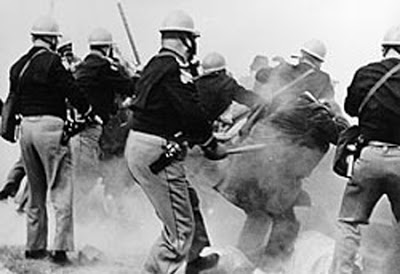
Alabama Highway Patrol troopers attack civil rights demonstrators outside Selma, Alabama, on Bloody Sunday, March 7, 1965. Photo credit: Federal Bureau of Investigation
At the same time, Jim Crow laws were passed across the South, denying Black people access to the same places and resources as white people, including education, transportation and the ballot box. Even after the passage of the Civil Rights Act of 1964, a landmark achievement in fostering racial equality in this country, we have never truly made voting free, accessible and fair in this country – least of all in Georgia.
I offer that short history lesson to provide some context for where we are today and why I am so passionate about voting rights. Having worked closely with the late U.S. Rep. John Lewis, who fought and bled for voting rights, I saw firsthand how he was still forced to fight for those rights all the way until his passing in 2020.
Now it is time for us to prioritize maximizing turnout and participation, and the good news is that we don’t have to reinvent the wheel.
Let’s start with some basic facts. In 2024, 75% of white voters in Georgia turned out to vote, while only 59% of Black voters did the same. The difference among young voters is even more dramatic, with 63% of white voters under 50 turning out for that election while only 39% of young Black voters did so. Overall, about 68% of eligible voters in Georgia made it to the polls that year, despite the fact that we were bombarded with hundreds of millions of dollars in ads telling us to do just that.
And that’s in the presidential election year. For off-year elections, turnout drops precipitously to anywhere from 52% for Congressional and state elections in 2022 to 32% for the Atlanta municipal elections just a few months ago, with similarly low rates for most other local elections.
So, what’s the problem? Is it that people don’t care or that they don’t think their vote matters? Given that politics dominates almost every water cooler conversation these days, it should be obvious that if anything, people care more now than ever.
Could the problem be that Georgia still has restrictions designed decades or even centuries ago that make it harder to vote and that some have used the false pretext of President Trump’s repeated lies about the 2020 election to make voting even more difficult?
There is no question that Georgia’s elections are secure. But concerns about that have been the predominant stated motivation in all our new election laws in the last five years. Now it is time for us to prioritize maximizing turnout and participation, and the good news is that we don’t have to reinvent the wheel.
Other states with higher turnout provide simple, proven solutions like making Election Day a paid holiday (Maryland), sending nonpartisan voter guides to every voter in the state (Colorado and Washington), and providing prepaid return postage for mail ballots (Iowa, Minnesota, Oregon, Virginia and Wisconsin). Each barrier individually may seem small, but when you add them up, they become a towering hurdle.
There’s also the matter of Georgia’s runoff system, which was explicitly designed and implemented to weaken the power of Black voters. It’s hard enough for many people to take time away from work or family responsibilities to vote once, much less multiple times – a problem that could be quickly solved with ranked-choice voting.
Our elections are among the most secure in the country, which provides the perfect foundation to build a freer, fairer democracy where we all get a say in our future.
Tharon Johnson is founder and CEO of Paramount Consulting Group.