Augusta: Richmond County | Flourishing Region
Development, Housing, Momentum

Strong Growth: Cal Wray, president of the Augusta Economic Development Authority, at Aurubis. Photo credit: Hillary Kay
A manufacturing boom fueled by massive international investments, explosive growth in the cybersecurity sector spurred by the U.S. Army Cyber Command, and a robust local healthcare and research network anchored by the Medical College of Georgia are among the key drivers propelling the Garden City and the Central Savannah River Area (CSRA) to new heights.
GF Casting Solutions AG, a Swiss maker of lightweight components for autos, energy and aerospace, invested $184 million and created 350 new jobs at its new manufacturing facility in Augusta, which began operations in August, according to Cal Wray, president of the Augusta Economic Development Authority. Meanwhile, Hamburg, Germany-based Aurubis has far exceeded its original planned investment.
“Aurubis Phase 2 will be online by the end of the year,” Wray says. “When the project was announced [in 2021], it was a $340 million project. Now it’s grown to over $900 million. It’s the gift that just keeps giving.”
Aurubis operates the first large secondary smelter in the U.S. The facility recycles metal from e-waste like circuit boards and cables. The process extracts critical metals such as copper, nickel, tin and zinc for energy infrastructure, data centers, AI applications and the defense industry. The first smelt was conducted on Sept. 24, 2025.

Massive Project: Aurubis operates the first large secondary smelter in the U.S. Photo credit: Contributed
The Aurubis plant is located in the Augusta Corporate Park, a 1,794-acre industrial park that only has “roughly 300 acres left” of available land, Wray says. But, on May 19, voters passed a Special Purpose Local Option Sales Tax that included funding for a sewer extension that will unlock another 1,150-acre site for industrial development.
“The minimum investment on that site is $1 billion and a minimum 1,000 new, full-time jobs,” he says. “We’ve had at least half a dozen [prospects] look at it that meet the minimum requirements – some that are three or four times that size.”
Downtown Progress
From megasites to Main Street, good things are happening.
“We have had just a phenomenal year,” says Margaret Woodard, executive director of the Downtown Development Authority of Augusta. “We’re really focusing on market-rate housing for downtown. In the last year we have completed 500 new market-rate housing units downtown.”

Phenomenal Year: Margaret Woodard, executive director of the Downtown Development Authority of Augusta, at The Conroy hotel. Photo credit: Hillary Kay
Those units represent about $154 million in private investment, Woodard says, noting there are an additional 1,000 units in the planning stages. According to Woodard, at the end of 2024, there were 400 housing units downtown and within 10 months, they had a 95% occupancy rate.
“That just demonstrates that there’s such a demand for downtown housing,” she says.
Two new hotels and a $42 million streetscape project on Broad Street will also add to the growing vibrancy of downtown, Woodard says. The 50-year-old former Ramada Plaza located in the heart of the city is undergoing a major transformation. The historic I.M. Pei-designed property is being renovated and rebranded as a Marriott boutique hotel, The Conroy.
“[The Conroy] is a $50 million project,” she says. “Construction is due to be completed at the end of the year so it will be open in time for the Masters Tournament in 2027. It’s going to be stunning when it’s completed.”
Meanwhile, a new extended-stay Residence Inn by Marriott is planned for the corner of 13th and Walker streets that will add much-needed long-stay accommodations to the downtown area. And the streetscape project will give downtown a facelift.
“The streetscape project on Broad, from 15th to 5th streets, is underway,” Woodard says. “New sidewalks, bike lanes, trees and brick amenities. It’s basically a beautification project, but it will also create more connectivity, more walkability, downtown.”
Thanks to the passage of the May 19 SPLOST, the riverwalk will also be getting a much-needed makeover, according to current Mayor Garnett Johnson. Mayor-elect Steven Kendrick won the nonpartisan runoff in June and will take office in January.
“We’ll invest $12 million in improvements to the Edward M. McIntyre Sr. Riverwalk, which was named for Augusta’s first Black mayor,” he says. “There will be infrastructure upgrades, and it will be ADA accessible.”
Johnson says the project is likely to begin in the fall.

Home Rink: Rendering of the Augusta Arena, which will be home to the new minor-league professional hockey team. Photo credit: Contributed
Another project boosting downtown is the new Augusta Arena. The 10,500-seat facility is on track to be open in time for the 2027-2028 hockey season and will serve as the home rink for the city’s new minor-league professional hockey team, the Augusta Lynx, Johnson says. Heisman Trophy winner and former NFL quarterback Tim Tebow announced in 2025 that he would be one of the owners of the team.
As momentum builds downtown, so does the number of new businesses, according to the DDA’s Woodward. Since the COVID-19 pandemic, Woodard says “anywhere from 45 to 55 new businesses” opened on the Broad Street corridor, including 18 since January.
“Everybody wants to be a part of what’s going on downtown,” she says.
And that’s certainly true for local entrepreneur Allan Soto. Soto is the founder and managing partner of Vinea Capital, a private equity firm focused on investing in ideas and businesses that create community impact.
“We started out with [Pineapple Ink Tavern] in 2020 and ended up closing Pineapple late last year for a reimagining,” Soto says. “Soon we’ll be launching a live music space offering craft cocktails called Off The Record.”
Soto says the new entertainment venue is “a very intimate space” that can hold upwards of 100 people. The goal is to bring a high-fidelity entertainment and speakeasy experience to downtown Augusta, according to Soto.
“We very much want it to be a venue [where] the community as a whole can find something they like and come see an artist they like perform,” he says.
Off The Record will be housed in one of several buildings downtown owned by Vinea Capital. The company is headquartered in the five-story, 127-year-old Leonard Building.

Entertainment Venue: Allan Soto, founder and managing partner of Vinea Capital, left, is launching a new live music space with cocktail specialist Adrian Stone, center, and singer and musician Will McCranie, right. Photo credit: Contributed
“We have seven properties in downtown Augusta,” Soto says. “Some are residential, others are commercial business spaces that we lease out. When we first started investing in properties downtown there were a lot of empty storefronts down here.”
ABLE Kids is one such organization that just opened a new location in downtown Augusta. Founded by Soto, the center offers therapy for children diagnosed with autism spectrum disorder at 23 locations across Georgia and the Carolinas.
“[Vinea Capital is] invested in creating actual services and places other people can bring their businesses to, and creating employment for downtown Augusta,” he says.
However, Soto says he is most excited about the Vinea Foundation, which gives $100,000 in grants annually supported solely by Vinea Capital. Launched in 2022, Soto says the foundation has already donated more than $1 million to charities in the Central Savannah River Area (CSRA), an 18-county region anchored by Augusta.
Next up for Soto and Vinea Capital: building a hangar at Augusta Regional Airport to house a new general aviation company.
Airport Improvements
Expected to open before the end of the year, Soto’s aviation operation will be among several upgrades and additions underway at the airport.
“We’re the third-busiest commercial service airport in Georgia,” says airport Executive Director Herbert Judon. With about 680,000 passengers a year, Augusta ranks after Atlanta and Savannah.”
There are three “legacy hangars” at the airport, Judon says, along with a hangar for Wellstar MCG Health’s medevac helicopter. Last year, Standard Aero expanded a hangar used for aircraft maintenance, repair and overhaul.
“[Standard Aero] expanded business here and added additional jobs. NetJets, another charter company here, is building a new 30,000- to 40,000-square-foot-hangar that will be completed probably this fall. We’re growing; we’ve seen a good growth trajectory.”
Judon says the airport would like to match that achievement with additional flights. Currently, the airport offers flights to Charlotte, N.C., Atlanta, Washington, D.C. and Dallas.
“We want to continue to add options for our folks in this region,” he says.
The airport is also expanding its security screening lanes from two to four, as well as expanding its parking lots and rental car facilities, Judon says.
“We have a very aggressive capital improvement program estimated at over $200 million over the next five years,” he says. “We’re growing day to day, and we need this additional capacity. Growing the terminal and the security checkpoints helps us manage the crowds we get during the Masters Tournament. It’s only two weeks of the year, but it’s a very important two weeks.”
A very important two weeks that help keep the airport self-sustaining and contributing $270 million annually in local economic impact, Judon says.
Golf City
Just after this year’s Masters Tournament, the Augusta Municipal Golf Course, commonly known as The Patch, reopened after a massive 16-month renovation of its 18-hole course. It also debuted The Loop at The Patch, a new 9-hole short course designed by Tiger Woods.

Learning Opportunities: Kendricks D. Hooker, president of Augusta Technical College, at Augusta Municipal Golf Course, commonly known as The Patch. Photo credit: Hillary Kay
The projects were a collaboration between Masters Tournament Charities, Augusta Technical College and The First Tee of Augusta, a youth development organization. The partnership was partly what attracted Kendricks D. Hooker to take the helm at the technical college. He officially assumed the role on Jan. 2.
“First Tee, ATC, Augusta National, we’re all collaborating to be a part of this opportunity to expose a range of individuals to the world of golf,” he says. “It essentially created this opportunity that provides a linkage to youth exposure through First Tee, the education piece through ATC, and the community now has access to an amazing, amazing golf course.”
The Patch will also serve as a pipeline of talent through the technical college’s golf course management program. Hooker says one of his first priorities as president is raising money for a 15,000- to 20,000-square-foot agronomy center on The Patch. When complete, the agronomy center will be home to ATC’s golf course management program, which prepares students for careers in golf operations, turfgrass management and pro shop operations.
“We’re hoping to raise anywhere from $7 million to $10 million for this space,” he says.

Course Work: First Tee of Augusta is a youth development organization. Photo credit: Contributed
In the meantime, Hooker says he has been meeting with ATC faculty and staff to learn about the college’s culture, what’s working well and where new opportunities may exist.
“I’m doing a lot of listening,” he says. “[As of mid-May], I’m approaching having met with 50% of the people who work here one-on-one. That qualitative data is then going to help me position us to take us to the next level.”
Education and Workforce
Augusta Technical College will soon be home to the Jim Hudson Automotive Institute, which will offer comprehensive training for automotive technicians. The U.S. Department of Commerce approved Augusta Technical College’s $6.8 million grant application for its construction in April. The site is expected to include a program where auto tech and business students can get firsthand experience working with customers.
“These projects are going to have local and regional impact, if not global impact,” says Hooker.
Augusta is also home to Augusta University, the state’s designated public health sciences and medical research university. AU hit a big milestone in fall of 2025, when it began offering a Ph.D. in intelligence, defense and cybersecurity.
“We have 42 students in the program, so it’s taken off in a big way,” says President Russell T. Keen. “That number demonstrates the high demand for that work in the field.”
AU has been designated a Center of Academic Excellence in both cyber defense education and cyber operations – making it one of only two universities in Georgia to hold both designations.

Cyber Training: The Georgia Cyber Innovation and Training Center host events like STEMfest, above, and programs for higher-level cyber education, below. Photo credits: Contributed

Across the country, 417 academic institutions hold a Cyber Defense Education designation and only 22 earned the Cyber Operations honor, Keen says.
The Georgia Cyber Innovation and Training Center, a public-private partnership designed to combat a global cybersecurity workforce shortage, resides on Augusta University’s campus.
“We are one of the businesses housed at the center,” says Tom Clark, president and CEO of the Alliance for Fort Gordon, a resident partner at the center. “The center is designed to have an ecosystem for government, academia, business and institutes of higher education under one roof. Cyber professionals from the MSA [Metropolitan Statistical Area] meet here quarterly, and we discuss best practices and programs that promote K-12 cyber education and higher-level cyber education.”

Positive Partnership: Tom Clark, president and CEO of the Alliance for Fort Gordon. Photo credit: Hillary Kay
To that end, in 2016 the alliance started a free summer CyberPatriot camp for kids ages 10 to 17 at the center. In the last nine years, more than 1,200 students have attended the camp, Clark says, noting the goal is to host more than 300 campers at the two weeklong camps, one in June and one in July.
“The nation is critically short of cyber professionals,” he says, “so by educating them and growing an interest in cybersecurity at a young age, hopefully we can encourage them to join the cybersecurity workforce and whittle down the shortage. Cybersecurity is national security.”
Fort Gordon supports around 32,000 military and civilian jobs and generates an annual economic impact of approximately $7.49 billion across the greater Augusta region. It is the Army’s central hub for cyberspace operations, cyber capability development, training and education.
The installation is home to the U.S. Army Cyber Command, the Cyber Center of Excellence and a multiservice community of Army, Navy, Air Force, Marines and multinational forces.
“As national security increasingly depends on dominance in cyberspace, Augusta’s role will only continue to grow,” he says. “The region is proving that military communities can also become innovation communities – places where defense, education, technology and economic development work together to create long-term prosperity.”
While the alliance is focused on its role in helping Augusta become an innovation community where long-term prosperity is created, the state’s flagship public medical school, the Medical College of Georgia at Augusta University, remains deeply committed to its mission of improving health outcomes and treatments.
That’s crucial across the state and locally, where Wellstar Columbia County Medical Center, a six-story, 100-bed hospital located in Grovetown, is scheduled to open this month. The medical center expands healthcare services already offered in Augusta to nearby rural counties. It also gives students at the Medical College of Georgia the opportunity to train using the latest technologies in healthcare.
“Georgia ranks 39th nationally in physicians per capita, and so 141 of the 159 counties are designated as medically underserved areas,” Keen says. “We’re one of the largest medical schools in the country, and we’re working on filling the voids.”
Chambers Make an Impact
Though they don’t always generate the kind of headlines associated with multimillion-dollar industries that create hundreds of new jobs, the small businesses represented by the Augusta Metro Chamber of Commerce and the Greater Augusta Black Chamber of Commerce remain the backbone of the local economy.

Member Engagement: Angie Cox, Augusta Metro Chamber of Commerce president and CEO. Photo credit: Hillary Kay
According to Georgia Labor Commissioner Bárbara Rivera Holmes, Georgia is home to more than 1.4 million small businesses, representing 99.7% of all businesses in the state. These small businesses employ 1.8 million people and support more than 40% of jobs statewide.
“The thing that I’m most proud of and that I think had the biggest impact on our membership last year was our inaugural spirit week,” says Angie Cox, Augusta Metro Chamber president and CEO. “It was an opportunity for us to highlight and really engage with our chamber members.”
According to Cox, chamber representatives visited 82 members during the four-day event, which also included afternoon workshops covering topics like advocacy and influence and building relationships and networking.
“The larger investors get the visibility and recognition, but close to 85% of our businesses have fewer than 50 employees,” she says. “Spirit week is a way to say thank you for being a member and supporting the community.”
In the nine years since its inception, the Greater Augusta Black Chamber of Commerce has gone from “zero members to almost 200 today,” says president and cofounder Ronic West. One of its signature programs is grants to minority business owners.
“This year we awarded $63,360 in grants to business owners in this area,” she says. “They’re using these funds for technology enhancements, professional services, maybe they hire a CPA, take a professional development course on artificial intelligence or use the funds as leverage to get a loan. Over the last six years we have provided $640,360 in grants throughout the [Central Savannah River Area].”

Grants for Business Owners: Ronic West, president and cofounder of the Greater Augusta Black Chamber of Commerce, center, with other staff executives. Photo credit: Contributed
With the support of U.S. Sen. Jon Ossoff, the foundation of the Greater Augusta Black Chamber of Commerce received a $500,000 federal appropriation to launch and expand its Rural Small Business Impact Initiative. The program seeks to address economic disparities in rural East Georgia by providing technical assistance and training to small businesses and entrepreneurs. The legislation authorizing the grant was signed into law in February.
While the vibrant pink, white and purple azaleas lining the Augusta National Golf Club course won’t bloom again until next spring, it’s thanks to community investments like these that everything’s coming up roses in Augusta.
Local Flavor
A Boost for Businesses

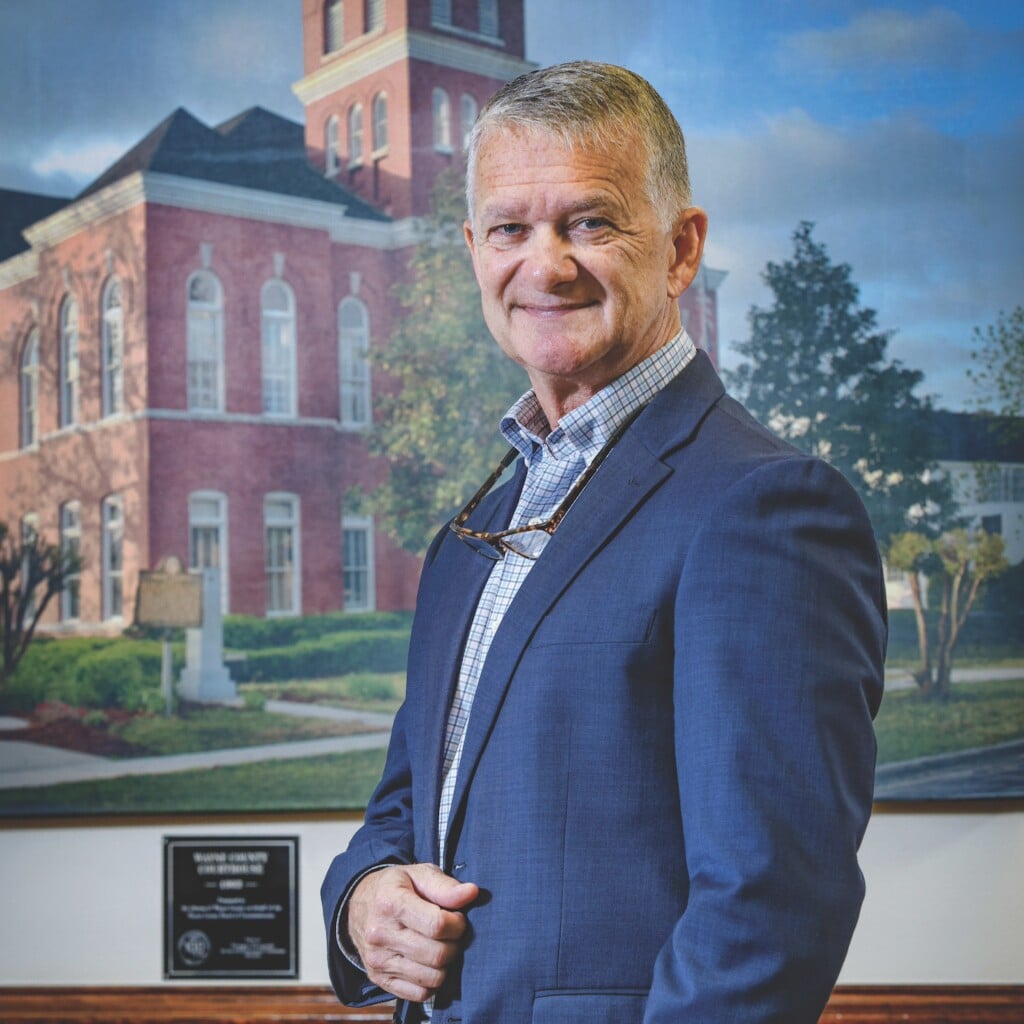
Helping Entrepreneurs Succeed: Shaun Andrews, executive director of Accelerate Augusta. Photo credit: Hillary Kay
Shaun Andrews is an entrepreneur who wants to help other entrepreneurs succeed. Now the executive director of Accelerate Augusta, he landed his first job out of graduate school with Norfolk Southern. Sometimes, he would hop on a train in Columbia, S.C., and ride with the crew to Augusta, never really taking the time to explore the city, he recalls.
“How could I know 20 years later I would be sitting in my office looking at that same train go by?” he says.
Andrews took the helm a year ago at Accelerate Augusta, the official small business incubator and microenterprise center that is a partnership between Augusta Technical College and the Downtown Development Authority.
A deal with the city led to a 20-year rent-free lease at the renovated I.M. Pei building in the heart of downtown that formerly housed the Greater Augusta Chamber of Commerce. The incubator serves not only Augusta, but surrounding communities in Aiken, Burke, Columbia and Richmond counties, to name a few.“My goal is to use our organization … as an economic multiplier in the [region],” he says.
Accelerate Augusta collaborates with civic leaders, chambers of commerce and minority business alliances – and reaches students considering entrepreneurship. It also works with business founders in underserved areas, veterans, nonprofits, rural entrepreneurs and established small business owners looking to grow.
In addition to providing space and resources, Andrews says part of his job is to help the budding entrepreneurs cultivate the confidence they need to be successful.
“[While] they need to know the process of starting a business, there’s also a fear factor that I’ve noticed,” he says.
Andrews understands this, as the founder of a company called MindHAC, an app that uses AI technology to provide therapy for kids with autism.
Accelerate Augusta has served nearly 500 individuals, including 300 entrepreneurs, since 2025, says Margaret Woodard, executive director of the Downtown Development Authority.
“We can incubate six businesses [at a time] in there, and it stays full,” she says. “Since its launch, the incubator has hosted 20 programs with an attendance rate of over 95% and [has] supported 30-plus existing small businesses.”
Those programs include a 7-week immersive bootcamp and ways to connect with and learn from experts, experienced leaders and successful entrepreneurs along with informal pitch sessions and more structured competitions to test the viability of each business idea.
It’s a diverse audience. “We have folks coming in here with ideas on a napkin, and some making multiple six-figures a year,” Andrews says. “We are able to meet the entrepreneur where they are.”