Road Trip Ready in Georgia: Weekend Escapes from Mountain Chic to Coastal Mystique
Is there any better way to reset the soul than to blow off work Friday and hit the road for the weekend? No airports to conquer, no heavy packing, no exhaustive planning required. It’s doable on the spur of the moment, and unlike a longer, more far-flung trip, you’re likely to return refreshed, not wearier than when you departed.
Georgia brims with possibilities to make this happen. The largest state by land area east of the Mississippi River, its most dazzling attractions lie nonetheless within range of anyone’s wheels. Pull out around sunrise, and – depending on side hops – you’re probably there by lunch. Throughout your journey, you’re sure to be enchanted by our state’s singular gifts of natural beauty, beguiling history and easygoing charm.
“The trend is travelers wanting authenticity and to immerse themselves in local experiences,” says Jay Markwalter, deputy commissioner of tourism for the Georgia Department of Economic Development. “And that’s something you’ll find in every corner of Georgia.”
LOOKOUT MOUNTAIN
Drama in every direction
Lookout Mountain is what you get when nearly 300 million years of geology shows off. Its colorful, meandering sandstone cap and deeply carved valleys have helped to author Georgia’s Cloudland Canyon State Park, Rock City’s fantastical boulder gardens and seven-state views, as well as the underground Ruby Falls, where a new Geology Tour explores successive eras of tectonic machinations.

Rocky Links: The Keep, a new golf course at Cloudland at McLemore, opened in October. Photo credit: Contributed
Lookout Mountain’s rising star is Cloudland at McLemore, a boutique resort hotel that clings to a sheer cliff above the sprawling valley that is McLemore Cove. McLemore Resort now offers two 18-hole golf courses. To get there, follow the winding mountain road up from LaFayette, turning left toward the cliffs a few miles south of Cloudland Canyon. Arrive and admire obsessive attention to detail – from the efficient valet service to the presentation at Auld Alliance, the toniest of five resort restaurants, to the luxurious body treatments offered at Selah Spa and the angle of the hotel’s infinity pool, which seems to pour into the valley.
“People are really surprised that such a luxury property exists up here,” says Ben-David Fenwick, McLemore’s marketing manager.

The Height of Luxury: Cloudland at McLemore clings to the mountainside (below) while its infinity pool (above) seems to flow into the valley. Photo credit: Contributed

What’s New: The golf term that best describes The Keep, McLemore’s new 18-holer, is “wow.” Open only since October, the wide and rocky clifftop links already have graced the covers of several prominent golf journals. “The whole property evokes emotion,” says lead designer Bill Bergin, the Atlanta golf architect who was assisted at The Keep by the legendary Rees Jones. “It’s in its own category,” Bergin says. “There’s just no other golf course like it.”

Beauty Inside and Out: The great room at Cloudland at McLemore, above, and Cloudland Canyon State Park, below. Photo credit: 161 Photography

Hidden Gem: Managed by the Georgia Department of Natural Resources, Ellison’s Cave is a 12-mile-long cavern complex embedded in Pigeon Mountain, across the cove from McLemore Resort. The cave’s 586-foot Fantastic Pit – for expert spelunkers only – has appeared in the pages of National Geographic, cited there as the deepest such shaft within the continental U.S.
BLUE RIDGE
Mountain chic
Blue Ridge was founded in the 1880s as a key rail stop along the Toccoa Valley. For more than a century, it remained a modest railroad town with a scattering of mom-and-pop shops and meat-and-threes, less a destination in its own right than a supply stop for nearby cabin owners and short-term renters. My, how things have changed.
“Mountain chic” is a good description of today’s Blue Ridge, says Christie Gribble, president of the Fannin County Chamber of Commerce.

Upscale Oasis: Christie Gribble, president of the Fannin County Chamber of Commerce, at Kerith House, above (Photo credit: Kevin Garrett); a view of Mercier Orchards, below (Photo credit: Colette Boehm).
 A strategic loosening of alcohol restrictions helped fuel the town’s reinvention into an upscale mountain oasis of locally sourced eateries, eclectic brew pubs (including one in a former gas station) and high-end boutiques.
Far from having grown too big for its britches, Blue Ridge continues to play the old hits as well as the new. They include Mercier Orchards – founded in the 1940s – with its delicious apple concoctions; the Blue Ridge Scenic Railway, whose locomotive thunders out of an 1800s depot up to McCaysville and back; and the delightfully retro Swan Drive-In Theatre, where a car hop will gladly bring a burger and fries. And maybe nothing captures the time-worn shine of today’s Blue Ridge quite like lobster corn dogs, served at the swanky Grace Prime Steakhouse.

Appalachian Arts: The front room at the Folk Art Collaborative. Photo credit: Contributed
What’s New: Open since June, Kerith House winery encompasses more than 120 acres of vineyards, woodlands and streams with prime mountain views. The winery offers tastings, workshops, occasional live music and seasonal events. Available lodging consists of an Airstream that overlooks a pond and holds four people.
Hidden Gem: While it may seem a well-kept secret, the Folk Collaborative has been a part of Fannin County for more than a half-century. Folk wisdom, folk cooking, folk remedies and folk legends live on at this Appalachian arts hub.
JEKYLL ISLAND
Where the wealthiest trod
Once the exclusive winter escape of Vanderbilts, Rockefellers, Morgans, Goodyears and other titans of industry, Jekyll Island was secured by the state of Georgia in 1947 as an invitation to people of all means to enjoy an island vacation. Through attentive stewardship, the state has upheld its end of the deal. Even having evolved in an increasingly upscale direction, Jekyll Island remains that place where anyone can walk the manicured lawns and expansive beaches where America’s wealthiest trod. People return not for excitement, but mostly to leave it behind.

Tabby Tales: Mark Williams, executive director of the Jekyll Island Authority, at Horton House, a historic ruin constructed of oyster shells, lime and sand known as tabby. Photo credit: Eliot Van Otteren
“What visitors tell us time and time again is that Jekyll gives them the chance to slow down,” says Mark Williams, executive director of the governing Jekyll Island Authority. The island, Williams says, “is small enough to explore in a few days, and yet each day can feel different.”

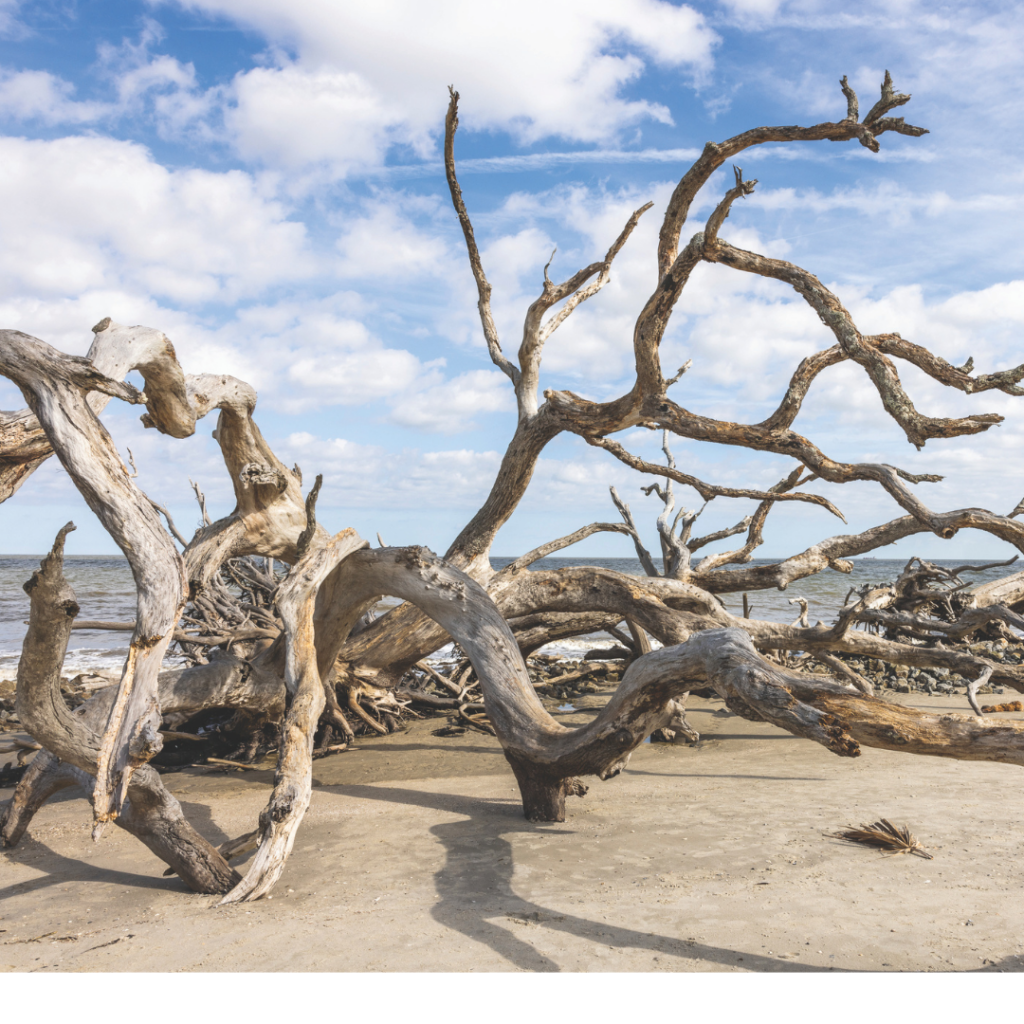
Shore Things: Jekyll Island’s famous Driftwood Beach. Photo credit: Contributed
At Jekyll, it’s the solitary stretches of beachfront. It’s the thrill of getting lost among ponds, marshes and wildlife in a dense, maritime forest. It’s bald eagles, wood storks, roseate spoonbills, gators, osprey, moss-bearded oaks, ibises and Driftwood Beach. It’s biking among the graceful mansions and bungalows of the National Historic Landmark District and maybe a beer on the porch at Founder’s Social, recently opened as part of the new District Shops.

Island Time: Drinks on the front porch of the recently opened Founder’s Social. Photo credit: Contributed
What’s New: And it’s golf. The sand-strewn Great Dunes, which debuted its multi-million-dollar restoration in November, rubs up against the blowy, scruffy, beachfront stretch where Jekyll millionaires honed their own games. Architects Jeff Stein and Brian Ross crafted 18 artful holes – with huge, confounding greens – through careful study and reimagination of the original layout by Golden Age architect Walter Travis. Jekyll’s Pine Lakes (renovated in 2024) and Indian Mound courses are not to be disregarded.
Hidden Gem: First, make a stop at Horton House, the haunting ruin composed of a building mix of oyster shells, lime and sand – famous along the coast as “tabby” construction. From there, take the shady, mile-and-a-half trail to peaceful Horton Pond for more exotic wildlife viewing.
DARIEN
“On fire,” once again

Shrimp Capital: Darien is the site of the annual Blessing of the Fleet. Photo credit: Contributed
Founded in 1736 by Scottish Highlanders and site of the pre-revolutionary Fort King George – faithfully reconstructed in the 1980s – Georgia’s second-oldest city has known its ups and downs. During the Civil War, coastal Darien was burned to the ground by Union soldiers. It clawed its way back as a timber hub, only to wither from overproduction. In its latest incarnation, this postage-stamp town near the mouth of the Altamaha has emerged as Georgia’s shrimping capital, feted each spring through its Blessing of the Fleet, a salty, small-town Mardi Gras replete with festooned trawlers, music and seafood. Thumbs up to the dockside Skipper’s Fish Camp and its Good Time Charlie’s Crab Stew.
Authentic and unhurried, Darien draws travelers seeking serenity cloaked in history. As evidence of its growing allure, coastal developer Art Lucas sank millions into Oaks on the River, a boutique hotel adorned by local artwork with a heated, riverfront pool and graceful dining room.
“I took a risk that Darien was going to get hot like the rest of the coast,” says Lucas. “And now Darien’s on fire. People are moving in like crazy.”

History and Home Brew: The pre-Revolutionary War Fort George, above, and the pre-Civil War Adam Strain Building, below, now home to Tabby House Brewing. Photo credit: Contributed

What’s New: Darien’s Adam Strain Building, one of two structures to have survived the Civil War burning, was on the Georgia Trust’s list of “Places in Peril” and weeks from demolition when Atlantans Milan and Marion Savic swooped in to save it. After four years of costly and meticulous rehabilitation, they opened Tabby House Brewing in late 2024. Home-brewed beers include The Double Darien, Lighthouse Lager and a German-inspired Hefeweizen known as The Hessie. An upstairs event space doubles as a local museum featuring all manner of old stuff recovered in the restoration.

Seeking Serenity: Darien’s scenic shore. Photo credit: Contributed
Hidden Gem: Harris Neck National Wildlife Refuge, a half-hour north of Darien, is an under-the-radar paradise of ponds, marsh and mossy woods laid out across a former airfield. Easy loops and overlooks give close-up views of storks, herons, alligators and other native wildlife.
ST. MARYS
Tales of pirates, smugglers and assorted outlaws
Perched on a deep, sheltered river close to Spanish-held Florida, St. Marys at the turn of the 18th century sat at the edge of empires and good behavior – and seemed to revel in it all. Access to a network of hidden marshes drew scallywags, pirates and privateers, all eager to haul cross-border contraband and otherwise mock civil order. A leading local legend – there are many – holds that smugglers, one night, roped a hapless donkey or horse to a church bell to distract unsuspecting townsfolk from their nefarious deeds at the docks. Today, that checkered past has softened into a gracious, coastal enclave of quiet, Southern charm where the loudest commotion is the ferry horn announcing another departure for Cumberland Island.

Colorful Past: Visitors take the six-block Murders, Mayhem and Martinis tour through the heart of St. Marys. Photo credit: Contributed
But history lives on. Murders, Mayhem and Martinis, a six-block tour through the heart of St. Marys, tells of thievery, brawling and a harrowing assassination before concluding at Captain Seagles Seafood Restaurant and Saloon, the town’s oldest speakeasy. The Fugitives, Fighters and Fudge tour includes a stop at the Archibald Clark House on Osborne Street, where Aaron Burr – fleeing the implications of his bloody duel with Alexander Hamilton – is said to have sought refuge after allegedly slipping across from St. Simons. Both excursions are offered by Molly’s Old South Tours, which also runs a guided trip to Cumberland Island.
What’s New: Recently repurposed for travelers, Borne 605 over the years has served as a hardware store, tax preparer’s office and counseling center, quietly surviving through St. Marys’ ebbs and flows of fortune. Converted in 2022 as a vacation rental village, its stylish lofts and bungalows nod to Georgia’s coastal beauty and the town’s rich cultural heritage.
Hidden Gem: A secluded forest of riverside trails and wetlands, nearby Crooked River State Park is ideal for hiking, birding and sunset watching. But to Angela Wigger, tourism director for the city of St. Marys, the hidden gem is St. Marys itself. “Our lodging’s affordable, our restaurants and shops are all locally owned and our vibe’s relaxing. We’re going to get you recharged,” she says. “You won’t need a vacation from your vacation.”