Affordable Housing in Georgia: Seeking a Solid Foundation
How four Georgia communities innovate to create affordable housing.

Thriving Community: Kimberly Hinton-Poole, president and CEO of NeighborWorks Columbus. Photo credit: Nathan Leduc
Shelter. It’s a basic human need. And for quality of life, that shelter needs to be of a certain standard and, for most people, a certain price. Affordable housing is defined as costing no more than 30% of total household income. Many families pay more than that threshold, which means they’re in constant financial strain. Fortunately, communities around the state are working to help alleviate housing burdens for their residents.
Elliott’s Walk, Columbus
When NeighborWorks Columbus President and CEO Kimberly Hinton-Poole began at the organization as a housing counselor eight years ago, she directly interacted with people “who did not know where they were going to put their head at night,” she says. “They’re looking at their children, trying to figure this thing out.” The organization works to help them do just that through its focus in three main areas: housing counseling and education, lending, and development. In one example of its work to create safe and affordable neighborhoods, it recently completed a large community called Elliott’s Walk, a 33-acre development of single- and multifamily homes of various sizes (up to four bedrooms). The community began with the dream of the late Hal Averett, a local luxury homebuilder who wanted people to have access to quality homes they could actually afford. Averett’s church got involved in the planning, and one of its member families donated land for the project. Surrounded by a creek, the neighborhood includes a nature preserve, walking trails and green space, plus access to public transportation, public utilities and community spaces.
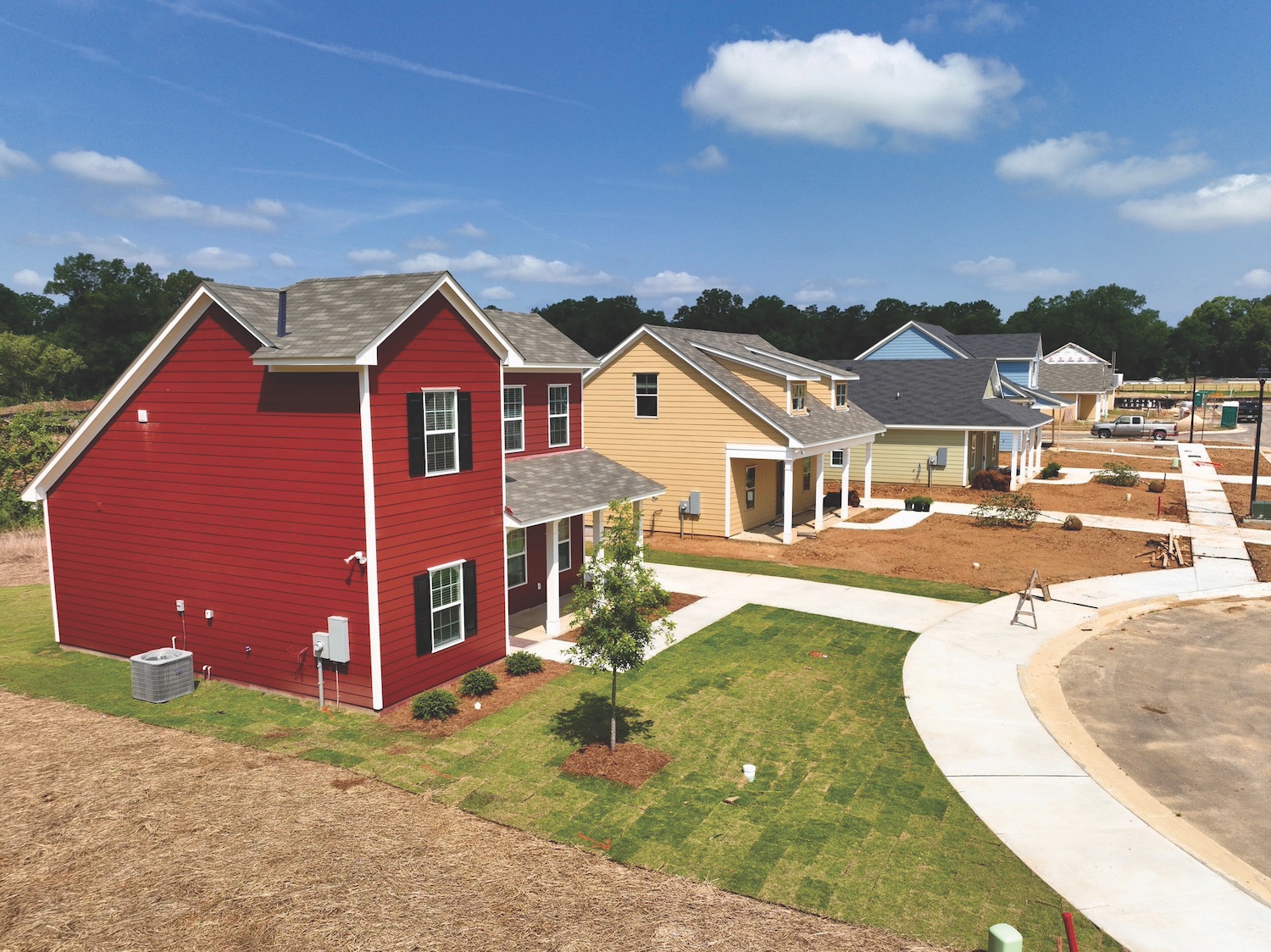
Quality Homes: Elliott’s Walk is a 33-acre development of single-and multifamily homes, above and below.

To cover funds for needs such as infrastructure, numerous additional entities of all types – government, philanthropic, private – came into the project. “It takes multiple innovative income streams to develop affordable housing,” says Hinton- Poole.“There’s no one pot, outside of just unrestricted funds, that you can utilize for every phase of it.”
Homeowners who bought when the first phase opened in 2022 have already seen their home values go up, building equity. “[Elliott’s Walk] is doing exactly what it was designed to do,” says Hinton-Poole. “It is increasing the market value in that community, is making it a thriving community and is bringing in more business and attracting more individuals to that area.”
And it’s not just providing economic stability. “Stable housing is at the core of so many outcomes; it predicts educational outcomes. It creates, of course, as everyone speaks to, generational wealth. There are better health outcomes. There are so many studies out there that link back to just having a stable place to call home,” says Hinton-Poole.
“It takes multiple innovative income streams to develop affordable housing. There’s no one pot, outside of just unrestricted funds, that you can utilize for every phase of it.” – Kimberly Hinton-Poole, president and CEO, NeighborWorks Columbus
Beyond Elliott’s Walk, NeighborWorks Columbus continually makes strides in providing affordable housing throughout Columbus. “We were granted our fourth round of New Market Tax Credits at the beginning of [2025],” says Hinton-Poole. “So we started a scattered site project, and it’s helping us to go into areas that we started in years ago and finish them out. … It’s truly scattered throughout the city to input pockets of affordable housing in different areas.” Additional affordable housing projects are also in the works.
Hamilton Street, Dalton
The mortgage crisis and subsequent Great Recession in 2008 hit Dalton – “the carpet capital of the world” – especially hard. “When houses aren’t being built elsewhere, those people are not buying flooring from the people here,” says Carl Campbell, executive director of the Dalton-Whitfield Joint Development Authority. “So that affected our community.”
Once Dalton’s business started to pick up again, investors and developers in the city did not move at that same speed, which meant a lull in the city’s overall housing growth. Campbell says that offering a full range of housing options is key for those working in the area. “[We want to] try not to focus on any particular class, but [we’re] just trying to make sure that everybody in our community has the opportunity to have a good, safe place to live,” he says. Plus, he adds, the city needs people to do more than simply commute to Dalton for work. “Dalton gets better when people are living, working and playing here.”

Safe Place to Live: Carl Campbell, executive director of the Dalton-Whitfield Joint Development Authority, fourth from left, with local and state officials at the groundbreaking of the Hamilton Street Rural Workforce Project, above. Forty homes will be built on a 3-acre plot, below.

A couple of housing studies and the COVID-19 pandemic influenced Dalton’s focus on workforce housing, or housing that’s affordable for essential workers such as teachers and police officers. A potentially perfect spot in downtown Dalton rattled around in Campbell’s mind: a 3-acre plot of restricted-use land donated by flooring maker Mohawk. To Campbell’s surprise, a chat with Mohawk about using it for workforce housing proved promising enough to start investigating options.
As a first step, Campbell and his colleagues attended a Georgia Academy for Economic Development Housing 201 course to get ideas. “We learned about a couple of folks that were doing some infill-type development,” he says. “Not tiny homes necessarily, but just very efficient and smart.” He found an architect familiar with such spaces who then worked with the Dalton City Council to create homes that would best serve the needs in the community. This resulted in one-, two- and three-bedroom plans between about 850 square feet and 1,350 square feet.
The property was originally zoned commercial. The Dalton City Council approved a new type of zoning, urban PUD (planned unit development), which is designed to provide flexibility in development plans. “Basically, you draw out the entire property with everything that you’re going to do there. You submit it for approval,” says Campbell. “And if it’s approved, you can build that – and regardless of setbacks and whatever else. … But you can’t deviate from [the approved plan].”
In this case, the plan was for the Hamilton Street Rural Workforce Housing Project, a 40-unit workforce housing community that will be walkable to downtown, near a grocery store, restaurants and entertainment. It also lies within a top school district. The homes are expected to hit the market in 2026 and 2027.
“It’s different than anything we’ll have in our community,” Campbell says. He notes that the houses will be close together and on the smaller side, which fits the location. “[They’re] in an area that’s got a lot of the old mill-type houses from years ago,” he says. “And a lot of those houses are not any bigger than what we’re going to build. So, I do think it’ll fit in, and it’ll be a nice complement to the area.”
Campbell is prepared for more challenges along the way but is looking forward to the development and its impact. “At the end of the day, we’re going to put about $8 or $10 million worth of assets down there and provide homes for 40 people or families and create some energy in an area that hadn’t seen a lot lately,” he says. “And so, we’re super excited about it. … And hopefully it’s successful enough that it lends the credibility for the next one.”
Sawmill Landing, Pembroke
Due to nearby industrial growth, Pembroke has seen an increasing need for affordable housing over the last decade or so. The town of about 2,500 residents is located about 30 miles from Savannah. In 2013, the city joined the Georgia Initiative for Community Housing program, which offers collaboration and technical assistance for communities’ housing and development. A couple of years into the program, Pembroke began work to bring in a Low-Income Housing Tax Credit development. This federal program supports affordable rental housing by giving tax credits to property owners who rent to low-income tenants.

Filling a Gap: Sawmill Landing, above, is a workforce housing development with 60 rental townhomes that Pembroke Mayor Tiffany Zeigler, below, helped promote.

“[The tax credit program] was one [opportunity] that we thought was pie in the sky,” says Pembroke Mayor Tiffany Zeigler. “Lo and behold, our junior year, that was the first of two [projects] that we have in our community now.” That first community became Sawmill Landing, a workforce housing development; it contains 60 townhomes, with one-, two- and three-bedroom units for rent. Sawmill Landing has helped fill a gap for the general area, as evidenced by its continuous waiting list for open units.
Some Pembroke residents were initially concerned about “low-income” housing. “There was fear with it – with words ‘affordable housing’ or ‘low-income housing,’” says Zeigler. However,she says that perceptions changed after having roundtables with adjacent neighborhoods and also learning about other similar projects across the state.
“[Those developments] looked better and they were built better than a lot of the market-rate multifamily units,” says Zeigler. “People are more open to it after that.”
To further ensure that Pembroke residents feel comfortable with other such changes, Zeigler says the city is focused on retaining its small-town charm while accommodating the needs of its residents and surrounding industry. It also requires any new development, including market rate and planned developments, to meet certain standards, such as using architectural shingles and Hardie board or brick, to match what is already within the community.
Zeigler has a personal connection to ensuring everyone has a safe, quality place to live that is within their means. Her father grew up in houses of substandard conditions, only moving into a better structure when his parents received government assistance. “[That house] brought their whole family up, and so it was a change in their quality of life through that,” she says. She adds that her own childhood situation was very different from that of her father, and it further inspires her desires for others. “I didn’t have to experience what my dad experienced or what his parents experienced growing up,” she says, “and I want to see that for all families here.”
The mayor and the city continue to work on bringing Pembroke’s residents what they need. This may include another workforce housing site due to the long wait for units in Sawmill Landing. “My goal is to make sure there’s affordability across the scale,” says Zeigler. “Not focusing on one particular bracket but really having that span to meet all of the needs for our community.”
Union Park Cottages, Union City

Elevating the Standard: Union City Mayor Vince Williams at Union Park Cottages. Photo credit: Kevin Garrett
Union City, just 10 miles from Hartsfield-Jackson Atlanta International Airport, is all about improving life for all residents. With that in mind, the city has turned a once-desolate couple of acres into Union Park Cottages. The community of 26 affordable micro-homes, none larger than 815 square feet and each with two bedrooms, sold out just a few days after the groundbreaking in August 2024.
While smaller than a typical two-bedroom apartment, these homes offer much more. In addition to the advantages of tax breaks and building equity, owners get to live in a home with high-quality, energy-efficient materials and fixtures, and built-in smart-home features. “This project bridges the gap between traditional single-family homes and multifamily housing,” says Union City Mayor Vince Williams. “It fills a critical need while elevating the standard for what affordable communities can truly look like. … Union Park Cottages allows us to deliver modern, attainable homes that still feel premium, and that strengthens the future of our city.”
The Union Park Cottages community was pitched to the mayor and created by Techie Homes owner and founder Booker T. Washington (who was named after the famous educator but isn’t related to him). Washington’s aims for the development struck a chord with Williams. “It’s a project that reflects [Union City’s] core values with innovation, inclusivity and community,” he says.
“This project bridges the gap between traditional single-family homes and multifamily housing. It fills a critical need while elevating the standard for what affordable communities can truly look like.” – Vince Williams, mayor, Union City

Critical Need: The 26 affordable micro-homes at Union Park Cottages sold out a few days after the 2024 groundbreaking. Photo credit: Contributed
And while these homes include innovative smart-home features, such as USB outlets and automated lighting, Williams points out that innovation in housing isn’t restricted to technology. “It’s about designing communities that support families, encourage connection and give residents a place they are proud to call home – and that’s what matters to me.” To that end, the community includes amenities for residents to enjoy together, such as a coffee shop and community garden. There’s also a built-in cycle of giving back: A portion of the proceeds from the community ventures goes to local nonprofits. Williams says that “reinforces social value for people.”
The mayor notes that Union Park Cottages inspired others – from as far as Japan – to come take a look. And that speaks to the importance of creative housing strategies. Techie Homes itself is already making its mark beyond Union City. Union Park Cottages is Techie Homes’ second community; its first is in College Park, and others are in the works in Norcross and Atlanta.
Bringing It All Together
Communities best serve their residents by providing what their citizens need to not only survive, but to thrive. Having attainable quality housing can do both. That, in turn, positively affects the community. And when people and communities are uplifted, so is the state as a whole. 

Building Up Housing
When it comes to housing – and affordable housing in particular – state resources can provide a wealth of information and assistance for communities and residents alike. The Georgia Department of Community Affairs (DCA) has multiple programs to aid communities, homebuyers and renters.
For Communities:
Housing Tax Credit program – Helps produce affordable rental housing when awarded to qualified development teams
OneGeorgia Authority – Focused on rural communities; provides grants and loans for economic development, including workforce housing initiatives
Community HOME Investment Program (CHIP) – Competitive grant awarded to local governments, nonprofits and public housing authorities; funds can build single-family-owned homes or rehabilitate owner-occupied housing
Georgia Initiative for Community Housing (GICH) – Three-year housing and community-development program offering collaboration and technical assistance for communities to create their own housing-need-based plans.
For Homeowners:
Georgia Dream Homeownership Program – Mortgage assistance and financing; includes programs specific to income and veteran status
Georgia Mortgage Assistance Program – Assistance for those still impacted by burdensome housing situations related to the COVID-19 pandemic
For Renters:
Housing Choice Voucher Program – Rental assistance for people and families with very low income.