2026 Hall of Fame Inductees: Shan Cooper & Dan Amos
Shan Cooper
People Always
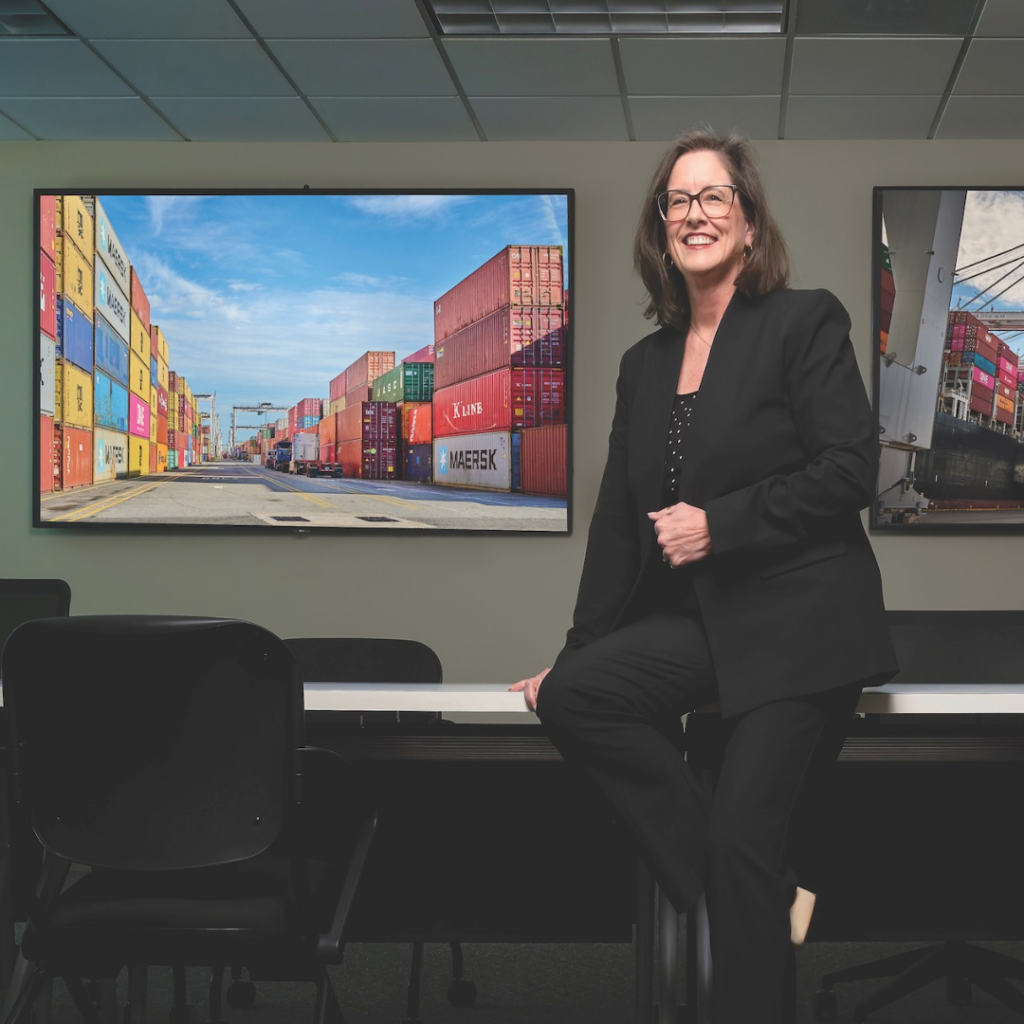
Shan Cooper doesn’t use the word “retired.” Instead, she calls it “a life of maximum flexibility,” allowing her to remain actively involved with her granddaughters, serve on corporate and nonprofit boards, act as a senior advisor and continue consulting work. Between serving on major corporate boards, advising McKinsey & Company, mentoring the next generation of leaders and helping nonprofits, Cooper continues to shape Georgia’s civic and business landscape.

Photo credit: Daemon Baizan
“I want to stay relevant and keep learning,” she says, explaining her approach to this busy chapter of her career. “And I want to make sure I’m giving back.”
This mindset has defined Cooper’s journey from aerospace executive to one of Georgia’s most respected civic leaders. After a successful career at Lockheed Martin, where she rose through the ranks to vice president and general manager of the company’s Marietta operations, Cooper went on to serve as chief transformation officer at WestRock and executive director for the Atlanta Committee for Progress before launching her own consulting firm, Journey Forward Strategies. She brings this leadership lens everywhere she spends her time, whether it’s a boardroom, classroom or nonprofit organization.
Cooper’s outlook on leadership was shaped early by her upbringing in Anniston, Alabama, as the daughter of a pastor. Her family was deeply involved in community service. She recalls being taught that “to whom much is given, much is required,” which comes from Luke 12:48 in the New Testament, and this has been a guiding principle of hers throughout the years.
That lesson still echoes in her work across Georgia, where she serves on the boards of Intercontinental Exchange, Southern Company and SouthState Corp., and chairs the Grady Health Foundation Board of Directors. She is a trustee at Emory University and leads the external advisory council for the Georgia Tech Research Institute. She says each of these roles is another chance to connect and combine leadership with purpose.
“If you take care of your people, they’ll take care of you.”
For Cooper, civic engagement is central to her identity. She is particularly passionate about education and history, serving on the board of the Georgia Historical Society, which helps develop curriculum and classroom resources for eighth-grade history teachers. “We’re just trying to make history exciting,” she says. “If students don’t know where we’ve come from, we can’t expect them to help shape where we’re going.”
She also works with nonprofits that address some of Georgia’s most pressing challenges, including food insecurity, homelessness and chronic absenteeism in schools. Her recent consulting work with the Truancy Intervention Project opened her eyes to how widespread those issues are and how much nonprofits need to innovate to survive in a changing funding landscape.
As a corporate veteran who is still very involved with major companies, albeit from the consulting side, Cooper believes business leaders today face new pressures and responsibilities. “Leaders are being asked to take positions on social issues and to care for their people in ways that weren’t expected before,” she says. “It’s not enough anymore to deliver a product or satisfy shareholders.”
Her advice to executives starts with something simple: self-care. “We’re not very good at that,” she says. “But you can’t take care of others, such as your employees or your teams, if you’re not taking care of yourself.”
Cooper emphasizes empathy and listening as critical leadership skills. “Leaders need to be approachable, compassionate and tuned in,” she says. “You have to really listen to your people and understand what’s happening in their lives, because they bring all of that to work.”
Cooper’s own leadership mantra – Mission first, people always – reflects that balance. “If you take care of your people, they’ll take care of you,” she says.
Cooper emphasizes collaboration as a key to how cities like Atlanta address challenges. “Corporate, city, local and state partnerships are so important,” she says. “The mayor [Andre Dickens] talks about Atlanta being a group project and team sport. When the business community, nonprofits and civic leaders come together, that’s when real change happens.” Whether tackling issues like food insecurity, broadband access or Westside revitalization, Cooper has seen firsthand how coalitions across sectors can effectuate change.
That spirit of teamwork was especially evident during the pandemic, when restaurant owners, civic organizations and volunteers worked together to feed families in need. “Nobody cared who got the credit,” she says. “It was just, ‘These are our neighbors. Let’s help them.’”
Despite her extensive résumé, Cooper insists she’s still learning about leadership, people and all of Georgia. “Every new role teaches me something,” she says. “And I’m surrounded by the next generation of leaders who will take all this further.” 
Dan Amos
Doing Right – By The Numbers
Young Dan Amos could read the lay of the land when he first signed on with Aflac in 1973. That’s why as son and nephew of the upstart insurance business’s founders, the fresh University of Georgia graduate chose a career path that started in sales.

Photo credit: Nathan LeDuc
“I was no fool,” Amos recalls. “I knew I was getting a break because of my family, and so I had to prove myself. In sales, the numbers speak for themselves. And if I didn’t do well, they weren’t going to keep me.”
For a decade, Amos beat the bushes selling policies. In the process he absorbed lessons that would shape the insurance juggernaut Aflac has since become.
“In sales, you learn that there are all types of people out there. You come to understand diversity and the role it plays in the world – and specifically, how it plays in business,” he says.
Rising through Aflac’s ranks, Amos was named CEO in 1990 and chairman of the board in 2001. His lengthy stewardship has coincided with astonishing revenue growth and international brand recognition for the company still formally known as American Family Life Assurance Company of Columbus. He is, among other things, “the man behind the duck,” the improbable marketing ploy that made “Aflac!” a household name.
At 74, Amos is genial, fit and energetic. He talks a lot about having fun, especially in his job.
“I like what we do as a company,” he says. “I feel like we make a difference. So, it’s still fun to me. I’m still having a good time with it.”
Those who know Amos best concur that this powerhouse CEO – and devoted Dawg fan – is one to keep it real. Around the building, he’s known as Dan. And the old-timers still call him Danny.
“For someone who has accomplished everything that he has,” says Dr. Douglas Graham, chief of the Aflac Cancer and Blood Disorders Center of Children’s Healthcare of Atlanta, “he is the most approachable and sincere person that you’d ever want to meet.”
Being approachable never hurts. But the Amos who figured his family might fire him if he failed to deliver remains a man of numbers. They’re right there on his desk. From the start of his tenure – and he has this down to the month – Aflac’s return to shareholders has outpaced both the Dow and S&P by more than 400%.
“In sales, you learn that there are all types of people out there. You come to understand diversity and the role it plays in the world – and specifically, how it plays in business.”
Amos gives full credit to the duck, introduced in TV ads in 2000, after which Aflac’s sales and brand recognition soared. Schooled as he was in risk, Amos remembers it as his biggest roll of the dice.
“When I tried to explain to people that we were going to have this duck, and he’s going to quack ‘Aflac!,’” he says, “I would get the most blank-faced looks. And I realized I was betting my career on a damned duck! What it says about Aflac, though, is we’re risk takers. And the insurance industry is all about managing risk.”
In Amos’s book, the fact that key Aflac managers and more than half of his board of directors are women and/or people of color is fundamentally good business.
“I’m selling to a multicultural group of people. When I walk into my staff meeting, why would I want a bunch of 60-year-old white men?”
Several years ago, Amos acknowledged that Aflac “is more than just about insurance.” Sure, he said to an interviewer, “we’re about branding and insurance and profits. If you don’t do that, you don’t get to keep your job. But next is, how can you give back to the community and make it a better place?”
To that end, the Aflac Cancer and Blood Disorders Center at Children’s Healthcare of Atlanta might one day stand as Amos’s greatest legacy. Since 1995, Aflac’s financial support for the center – which stands apart from the thousands of hours of service rendered by Aflac volunteers – totals nearly $200 million. Amos and his wife Kathelen are deeply invested.
“Not only do they visit with patients,” says the center’s Graham, “they are incredibly engaged in trying to figure out how we have the latest in care, how are we recruiting the best physicians and how we are going to have the latest in technology that we can offer our patients.”
Deep into a conversation that meanders past his jobs in sales and executive management, all the folks he’s promoted, the claims he’s paid, the Aflac Center, his love for the state of Georgia, his yearning for the outdoors, the revival of Columbus with its rafting, restaurants and museums and his taste for the chili at Dinglewood, the delightfully retro pharmacy across the street, Amos pauses.
“You know,” he offers, “trying to take care of people in need. That’s really my big thing.” Amid all the tasks that demand his attention, he never forgets what matters most.